Mention ‘B of the Bang‘ to Mancunians, and you’ll probably wish you hadn’t.
Even to this day, the infamous 00s East Manchester sculpture – designed to look like an exploding firework – still manages to have people rolling their eyes, generate heated discussions, prompt a wide range of responses, and remain as polarising as ever before, despite eight years having passed since it was finally dismantled for good.
Alongside the constant critique and ongoing debate surrounding its place and purpose in the city over the five years it was erected for, B of the Bang was given a slew of nicknames by residents and was branded by many as an eyesore.
It also seemed to enjoy much of its life as the butt of many a local gag.
But what was B of the Bang really about?
ADVERTISEMENT
What was it for? What inspired its creation? Why did it call Manchester home? Why was it so controversial and problematic? Why did people seem to have so much to say about it? And what actually happened to it in the end?
Well, it all started with a simple quote.
ADVERTISEMENT
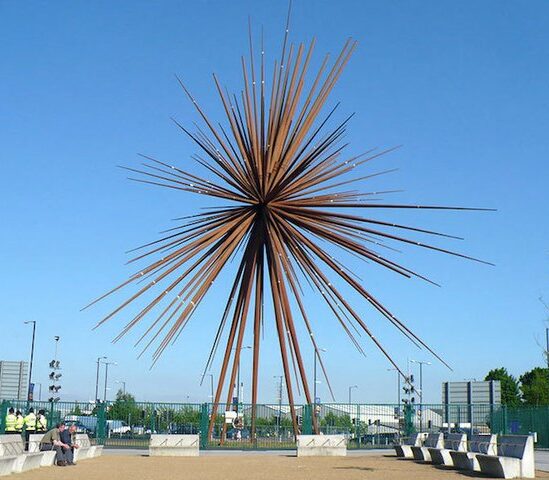
Taking its name from a quotation by British sprinter Linford Christie, in which he said that he started his races not merely at the “bang” of the starting pistol, but at “the B of the Bang”, B of the Bang B was a sculpture created by Thomas Heatherwick – often deemed one of Britain’s most significant designers – that was commissioned to commemorate the 2002 Commonwealth Games held in the city, and was installed at Sportcity next to the City of Manchester Stadium (Etihad Stadium) in the East Manchester area of Beswick, at the corner of Alan Turing Way and Ashton New Road.
The sculpture was first commissioned by New East Manchester Limited in 2003, but construction overran – largely due to a rather optimistic estimated completion date – and the official unveiling was delayed until 12th January 2005.
Being taller and leaning at a greater angle than the Leaning Tower of Pisa, B of the Bang B was one of the tallest structures in Manchester, and was even confirmed to be the tallest sculpture in the UK right up until the completion of Aspire in Nottingham in 2008.
ADVERTISEMENT
Credit: Sportcity
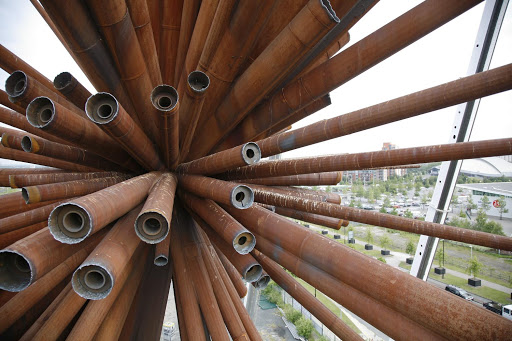
B of the Bang originally stood 56 metres (184 ft) tall, with 180 hollow tapered steel columns – or spikes – radiating from a central core. It was angled at 30 degrees and supported by five 25 m (82 ft) long, tapered steel legs, which connected to the spikes 22 m (72 ft) above the ground.
The sculpture weighed 165 tonnes, with the concrete in the foundations weighing over 1,000 tonnes, including a 400 m2 (4,300 sq ft) reinforced concrete slab.
In contradiction to its eventual fate, the sculpture was built to last, having been made from the same weathering steal as the iconic Angel of the North sculpture, which gradually develops a tightly-adhering oxide layer as it’s exposed to the elements, and this layer inhibits further corrosion by reducing its permeability to water.
As part of the design, the spikes even swayed slightly in the wind in order to withstand gusts in excess of 100 mph (160 km/h).
As well as being constructed to tackle the inevitable Manchester elements, it seems that B of the Bang was also built with a legacy in mind, as at the time of its construction, a time capsule was even placed inside one of the spikes of the sculpture – containing children’s poems and paintings – which was due to be opened circa 2300, but after being dismantled, the location of this time capsule is currently unknown.
ADVERTISEMENT
The sculpture cost £1.42 million in total to design and construct.
This actually ended up being twice the original estimate, as the initial costing plan had neglected to include installation costs.
Funding for the sculpture was sourced from a European Regional Development Fund contribution of £700,000, the North West Development Agency contributing £500,000, and Manchester City Council providing the final £120,000 towards its completion.
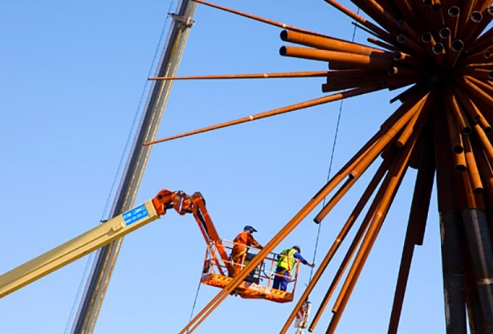
Credit: Connell Brothers / Sportcity
Its hefty price tag was only the tip of the controversy it generated over the years though.
Only six days before the sculpture’s official unveiling, the tip of one of the 2.1 m (6.9 ft) spikes detached and fell, but after close inspection, the launch event went ahead as planned.
ADVERTISEMENT
Four months later, in May 2005, a second spike had to be cut off by firefighters after it was discovered hanging loose, and at that time, the sculpture was closed off to the public, and the junction and pathway near the sculpture were temporarily closed.
As a result, some of the joints were re-welded, with equipment put in place to prevent excessive movement.
Despite these modifications though, B of the Bang remained fenced off.
After ongoing and worsening concerns, in May 2006, a total of nine spikes were removed from the sculpture and taken away for metallurgical analysis to discover the stresses being placed on the steel, but all of that meant nothing after it was announced in October 2007 that Manchester City Council were taking legal action against the makers of the sculpture, with the aim of completing the necessary repairs to the sculpture.
This resulted in an out-of-court settlement totalling £1.7 million in damages for breach of contract and negligence.
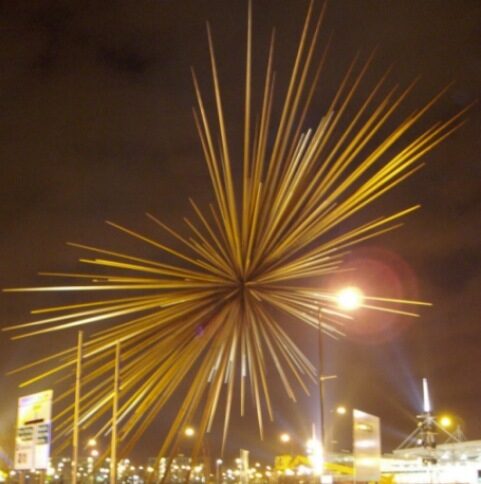
ADVERTISEMENT
Credit: Geograph (Peter Teal)
Following the publishing of an investigative report into the sculpture in 2009, Manchester City Council recommended that B of the Bang should be dismantled and placed in storage until funds could be raised for its safe reinstatement.
Several possibilities for the future of the sculpture were posed, but the report underlined the necessity for extensive testing to ensure these were safe first.
Despite a number of pleas to keep the sculpture erected – including from revered artist Anthony Gormley, who spoke out in its support, stating that: “It is a great tribute to Manchester that this groundbreaking work was commissioned [and] to allow it to disappear would be a loss not just of an inspirational artwork but also of the council’s nerve – removal of B of the Bang began in April 2009.
Although the council had originally promised to store the complex central core and legs, these too were cut apart during removal, which casted further doubt on future prospects for the landmark sculpture’s return at the time, and in early July 2012, the core was finally sold as scrap for £17,000.
But even though B of the Bang eventually fizzled out before its time, it’s hard to deny it made its mark on the city of Manchester.
ADVERTISEMENT
Just perhaps not in the way it was originally intended.
Featured Image – Wikimedia Commons
Trending
Massive rock, paper, scissors tournament with BIG pizza prizes takes over Trafford Centre this week
Emily Sergeant
A thousand free pizzas will be up for grabs to celebrate one of Greater Manchester’s newest restaurant openings this week.
That’s right – award-winning Neapolitan pizzeria Forbici is officially opening at the Trafford Centre.
From 11am until 12:30pm this Wednesday (5 August), Forbici will be giving away up to 1,000 full-sized pizzas, so visitors to the shopping centre will have the chance to taste what has recently been declared one of the best pizzas in the world without needing to spend a penny.
Following the opening of its first site on Cross Street in the city centre last year, before expanding over to Sheffield, this new 7,000-capacity Trafford Centre space at The Orient will be Forbici’s third restaurant in the UK and the second in Greater Manchester.
Crafted with signature three-generation ‘biga dough’, slow fermented to create a light, airy crust, alongside carefully sourced Italian ingredients, it’s no secret that Forbici offers some of the finest pizza in town.
Forbici is opening at the Trafford Centre this week / Credit: The Manc Group
And staying true to its name, every pizza is cut with scissors before being served.
The celebrations will then continue on Friday (August) as Forbici’s newest restaurant transforms into the home of Europe’s biggest Rock, Paper, Scissors tournament hosted by Manchester’s viral foodie content creator, Zack Hipps.
Across four sessions, you’ll have the chance to test your luck, speed, and strategy in a bid to be crowned champion – with tournaments taking place every hour from 11:30am.
Inspired by the pizzeria’s name, Forbici – which is, of course, the Italian word for ‘scissors’ – competitors will go head-to-head in fast paced knockout battles throughout the afternoon, with prizes up for grabs at every session and the winner of each game getting to take home a year’s supply of Forbici pizza.
There’ll also be a couple of exclusive local-themed pizza specials to celebrate the new opening too, including Forbici’s indulgent Manchester Tart pizza, and the Lancashire Hotpot pizza, which combines Fior di Latte, slow-cooked Lamb Ragù, and cracked black pepper on Forbici’s signature Biga base.
The Manchester special pizzas are also available at Forbici’s city centre restaurant as well, so you can feast wherever you find yourself.
Toni Dennan at Forbici said: “We’re incredibly excited to bring our innovative pizza craft to the Trafford Centre. To celebrate, we’re giving away 1,000 pizzas, inviting guests to experience Forbici on us.”
“Forbici is all about pushing pizza craft to new heights,” commented Forbici’s Toni Dennan. “Opening at Trafford Centre gives us the opportunity to share our passion for proper pizza with even more people.”
Simon Layton, who is the Centre Director at Trafford Centre, added: “We’re delighted to welcome Forbici to Trafford Centre, offering an innovative pizza concept to shoppers and leisure seekers alike. With a huge giveaway and exciting Rock, Paper Scissors tournament, Forbici’s opening week is not one to be missed and we look forward to welcoming customers down to the centre to celebrate its arrival.”
Forbici Trafford Centre is opening this Wednesday 5 August, and bookings are now live online here.
Featured Image – The Manc Group
Trending
Why so many are excited by the Irish teenager being monitored by Man City, United and more
Danny Jones
The next generation of Irish football is looking brighter, and there’s one particular young striker currently playing in the Republic of Ireland’s Premier Men’s Division that’s reportedly attracting interest from the likes of Manchester City, Man United, Chelsea and more.
Still just a teenager and having barely just broken into senior football, Michael Noonan is the youth player presently starring for Shamrock Rovers FC at just 18 years old.
Anyone who followed their recent run in the UEFA Conference League last year will know the kind of box office moments he’s already supplied fans of the South Dublin side, but he’s still a relatively new and somewhat unknown quantity to most, and one that’s already on the radar of some big clubs.
But just to put things into perspective, Irish football journalist Darryl Geraghty has gone so far as to dub him as “probably the hottest prospect in Irish football right now.” Here are just some of the reasons why…
Speaking to Betway (who have ironically just been announced as United’s new principal partner and official sponsor for their training gear), the sports writer said the increasing number of suitors floating in and around the youngster at such a crucial stage in his career comes as no surprise.
Turning 18 last month, the former St Patrick’s Athletic academy graduate is now free to entertain deals from other suitors, with the likes of Arsenal, Everton, Nottingham Forest, Ajax and ‘several’ others claimed to be circling his signature; Noonan is already said to have visited the Dutch giants for talks.
“A who’s who of European football are vying for his signature and it’s easy to see why”, says Geraghty. “Natural goalscorers are incredibly difficult to find, and Michael has that instinctive ability that elite clubs are always searching for.
“He doesn’t need five chances to score one goal. He has that natural striker’s knack of arriving in the right place at the right time, while his movement and pace off the shoulder constantly ask questions of defenders.”
“What’s impressed me most is how much his all-round game has developed. He’s become more involved in build-up play and is learning how to affect games even when he’s not scoring, which is essential for modern forwards.”
He also reiterated to Betway that “perhaps the most impressive thing is how unfazed he seems by the attention and expectation around him”, adding that “talent gets you noticed, but mentality is what convinces clubs to invest in a young player.”
Having helped ‘The Hoops’ to lift another title and a domestic cup, as well as growing an even wider experience base by representing his country in the national team’s youth ranks – most recently at the highly competitive under-21s level – this year could be a big turning point in his career.
Naturally, comparisons to the likes of Robbie Keane have already been drummed up, especially given how much talent he’s already shown at such an early age.
It’s “not because they’re identical players”, clarifies, “but because of the intelligence of his movement, his instinct for goals and his ability to fit into almost any attacking system.”
You only have to see some of his highlights for the resurgent Rovers to see his neat footwork in tight spaces and ability to drive into the right areas with conviction.
According to Geraghty, it’s merely “a matter of when rather than if“, and whoever snaps him up (more likely in the January window, it has been suggested) will be signing “one of the most exciting young strikers Ireland has produced in years.”
You can see his thrilling European debut performances against Norwegian side Molde FK down below.
At only 16, he became the youngest scorer in the competition’s history.