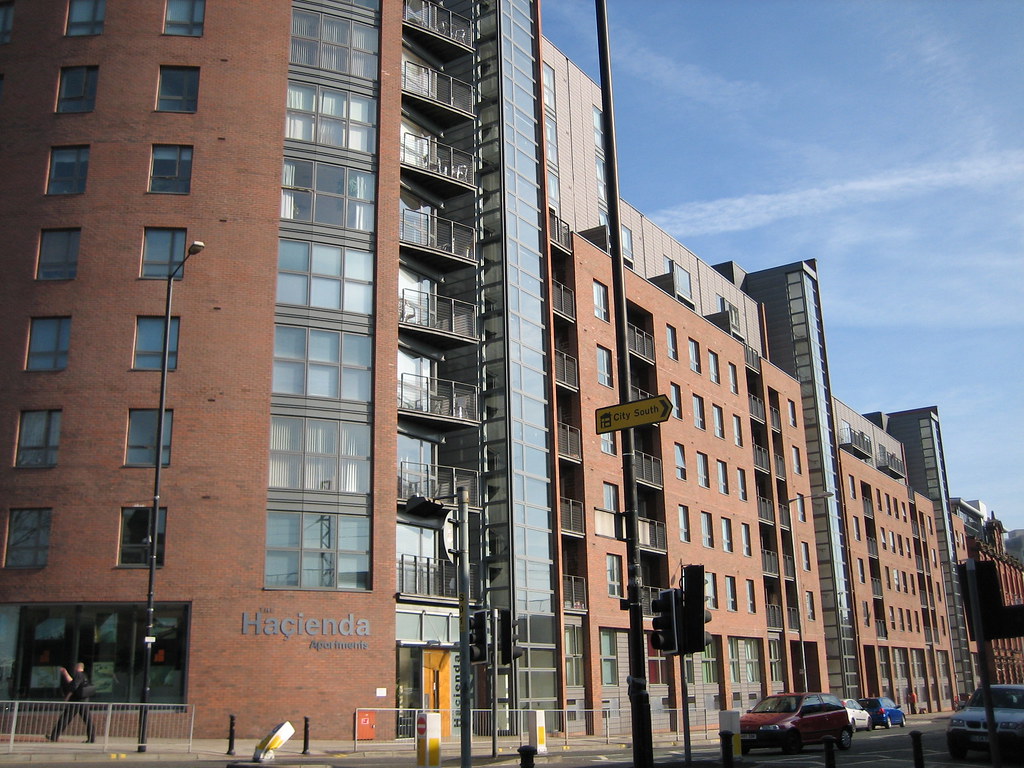
Legendary Manchester club The Hacienda is turning 40 this month, and to celebrate there will be a huge party in the car park beneath the apartments where the original club once stood.
Whitworth Street West might now be home to a series of neat magnolia two beds, but – if its walls could talk – they would still speak of hazy all-nighters, sweatbox dancefloors, and the thumping basslines of the early acid house scene where it all began.
Planned to mark 40 years to the day the club first opened its doors, the 40th anniversary party is set to take place on 21 May.
The Hacienda, once a ship building warehouse, then a nightclub, is now flats for Manchester’s city dwellers. / Image: Flickr
The event sees a host of the Hacienda’s finest residents return to the building with Graeme Park, DJ Paulette, Jon Dasilva, Tom Wainwright, Hewan Clarke, Aaron Mellor. K Klass live and surprise guests all coming along for the anniversary party.
The entire eight hour event is to be broadcast live by StreamGM and supports The Christie charity and Legacy Of War Foundation – Ukraine, Factory Founder Alan Erasmus’s appointed charity for his recent humanitarian mission to Ukraine.
ADVERTISEMENT
All proceeds from the event will be donated to charity, as was the case when a similar event was held at the same location in 2012 to mark the 30th anniversary.
According to reports in the Manchester Evening News, letters signed by organisers including Peter Hook and James Masters have already been sent out to residents of the Hacienda apartments to let them know of the 40th-anniversary plans – and invite them to join in.
ADVERTISEMENT
The letter reads: “The Hacienda is revered as part of both Manchester’s and the UK’s musical history, returning to the original site of the club for the 40th anniversary will be very special for everyone, undoubtedly enhancing the reputation of the building.
“As you might be aware, FAC251 The Hacienda celebrates the 40th anniversary in May 2022, having opened its doors in May 1982 to create the legacy which has given the apartments their unique heritage and history.
“Some might remember or may even have attended the event which we did for the 30th anniversary in 2012 which was much praised and this event will be generally similar to our previous event in the car park. All proceeds from the event are to be donated directly to charities.”
ADVERTISEMENT
The letter continues to say they hope residents will be “enthusiastic about the event” and apply for tickets to attend, adding: “It will generate worldwide attention and media on the building and be a great event for all concerned.”
Tickets go on pre-sale Thursday 12 May 10am with a general sale Friday 13 May 10am, both at at www.fac51-thehacienda.com.
Victim named and murder investigation launched after young woman is killed in Newton Heath stabbing
Emily Sergeant
The victim of a street stabbing in Newton Heath this week has been named for the first time as a murder investigation continues.
It comes after officers from Greater Manchester Police (GMP) responded to reports of a disturbance at around 2am yesterday (Thursday 15 October) on Dorking Avenue, in the Newton Heath area of Manchester, and when they arrived on the scene, they found a woman in her 20s with serious injuries that were ‘consistent with a stabbing’.
Despite best efforts of all emergency services involved, the young woman was sadly pronounced dead at the scene.
As the murder investigation progresses, the woman has now been publicly named and a photo of her has been released for the first time.
She has been named as 26-year-old Alisha Samuels.
At this time, one man, aged 25, has been arrested on suspicion of murder, and a man and woman, aged 61 and 38, have been arrested on suspicion of assisting an offender, and they all remain in custody – with officers continuing their enquiries to establish the full circumstances of this incident.
Alisha’s family have asked for privacy whilst they deal with the devastating loss of their loved one, GMP has stated.
“We are continuing to urge people who may have information in relation to this incident to please come forward to support our investigation and bring justice for Alisha,” the police force said in a public appeal.
Anyone who may have witnessed the incident, or has mobile phone, CCTV, or doorbell footage, is urged to call GMP on 0161 856 5464, or contact them via the Major Incident Public Portal here.
Alternatively, you can contact Crimestoppers on 0800 555 111
Featured Image – GMP (Family Handout)
News
Former supply teacher jailed for multiple upskirting and AI sex offences across Greater Manchester
Emily Sergeant
A former supply teacher has been jailed for multiple upskirting and AI sex offences in schools across Greater Manchester.
Abusali Rahman – a British national of Bangladeshi ethnicity from Salford – appeared in Bolton Crown Court this week for his sentencing after first being charged with, and then pleading guilty to, several offences.
The offences are including, but not limited to, 12 counts of taking an indecent photograph/pseudo-photograph of a child (images obtained by upskirting), three counts of making indecent photograph / pseudo-photograph of a child (making AI-generated images), and one count of attempting to meet girl under 16 following sexual grooming.
The offences are alleged to have taken place between December 2023 and June 2025, according to Greater Manchester Police (GMP).
Twelve girls have been identified in relation to the upskirting offences – aged between 13 and 16 at the time of the alleged offending – at seven high schools in three Greater Manchester boroughs (Bury, Bolton, and Salford).
GMP says it has remained in close contact with the schools, local authorities, and other partners throughout the investigation to ensure all appropriate support is in place for those who need it.
Additionally, the court also heard how Rahman amassed a collection of images of young girls, using AI and other methods to sexualise them.
The images numbered more than 300 in total, ranging from Category A to Category C classifications, and Rahman would post these on social media, often alongside humiliating and disgusting captions.
Rahman was sentenced to six years in prison, and will also be subject to a 20-year Sexual Harm Protection Order.
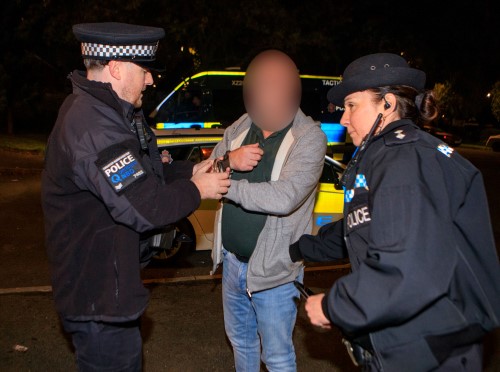
A former supply teacher has been jailed for child sex offences in schools across Greater Manchester / Credit: GMP
Detective Constable Lisa McGaffin, from GMP’s Bolton Child Protection Team, described Rahman’s crimes as ‘absolutely abhorrent’.
“My thoughts throughout this process have always been with the young girls who have been subject to such indignity,” DC McGaffin said following the sentencing this week. “Their welfare and support will always be a priority for us.
“While working as a teacher – someone who young children should trust and be safe with – Rahman repeatedly took secret photos for his own sick gratification, before posting images online which showed his total disregard for the girls’ respect and dignity.

 Georgina Pellant -
6th May 2022
Georgina Pellant -
6th May 2022