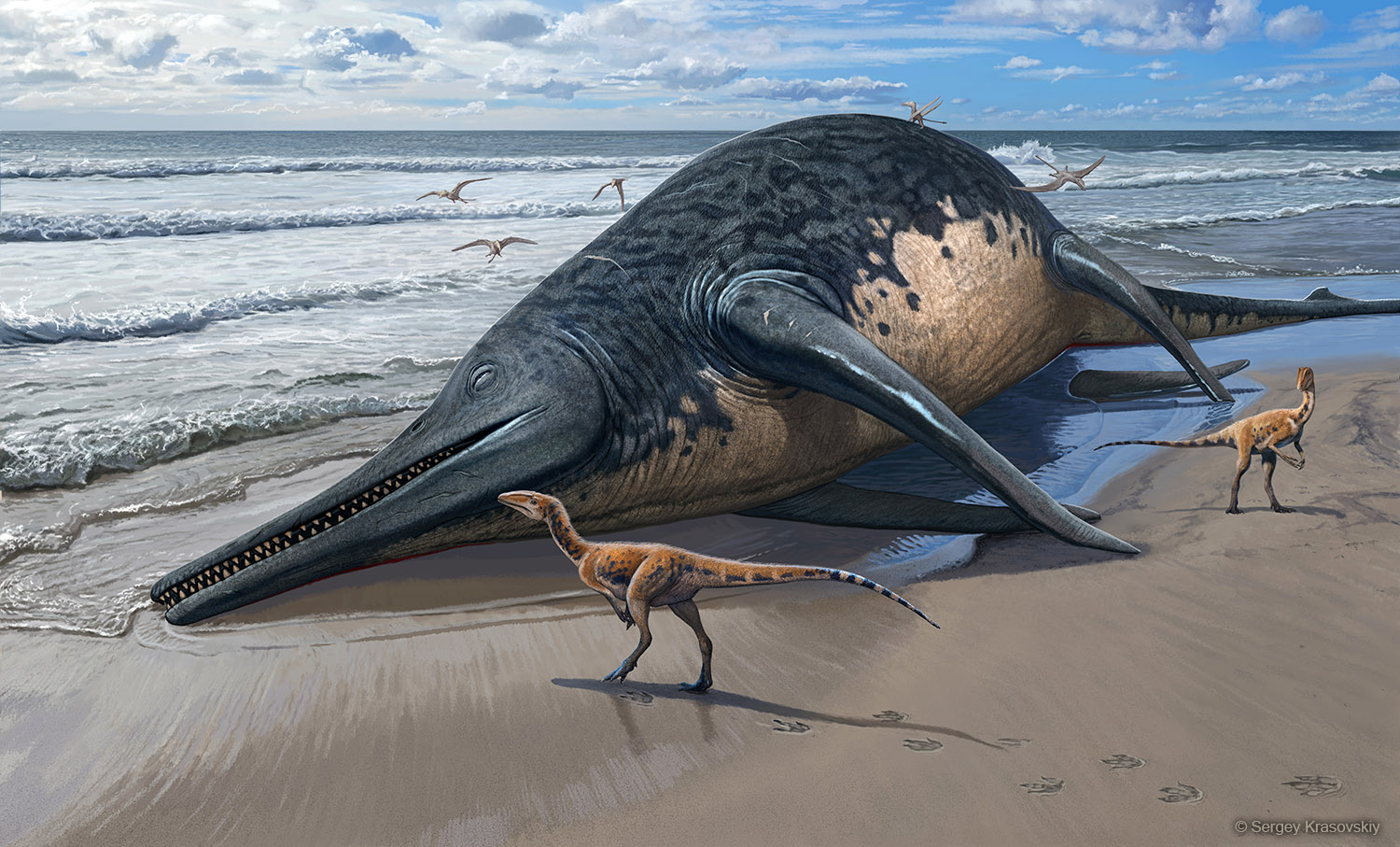
A Manchester-based palaeontologist has unearthed the bones of what may be the largest known marine reptile.
This new identification is a crucial part of a fascinating eight-year long discovery journey.
It all started when a seasoned fossil collector named Paul de la Salle found a giant jawbone on Lilstock Beach, near Bridgewater in Somerset, back in May 2016, and then father and daughter, Justin and Ruby Reynolds from Devon, found the first pieces of a second jawbone and another giant bone while searching for fossils on the beach at Blue Anchor, also in Somerset, in May 2020.
And now, a palaeontologist at the University of Manchester (UoM) Dr Dean Lomax, has identified the fossilised remains of the second gigantic jawbone that measures more than two metres long.
Experts have identified these bones as belonging to the jaws of a new species of enormous ichthyosaur – which is a type of prehistoric marine reptile – and astonishing estimations suggest the oceanic titan would have been more than 25-metres long.
ADVERTISEMENT
Dr Lomax has been working together with Justin and Ruby Reynolds, along with Paul de la Salle and several family members, since the father-daughter duo first contacted them about their groundbreaking discovery in 2020.
A Manchester palaeontologist has unearthed bones of what may be the largest known marine reptile / Credit: UoM
“I was amazed by Justin and Ruby’s find,” Dr Lomax commented.
ADVERTISEMENT
“In 2018, my team and Paul de la Salle studied and described Paul’s giant jawbone, and we had hoped that one day another would come to light.”
He explained that Justin and Ruby’s new specimen was “more complete and better preserved” than the first find, and that he “became very excited” at the chance to learn more following their discovery.
As mentioned, the Manchester-based research team, led by Dr Lomax, revealed that the jaw bones belong to a new species of giant ichthyosaur that would’ve been about the size of a blue whale, and they have called the new genus and species Ichthyotitan severnensis – which means ‘giant fish lizard of the Severn’.
ADVERTISEMENT
The bones – which represent the very last of their kind – are around 202 million years old, and date back to the end of the Triassic Period in a time known as the Rhaetian.
During this time, the gigantic ichthyosaurs swam the seas while the dinosaurs walked on land.
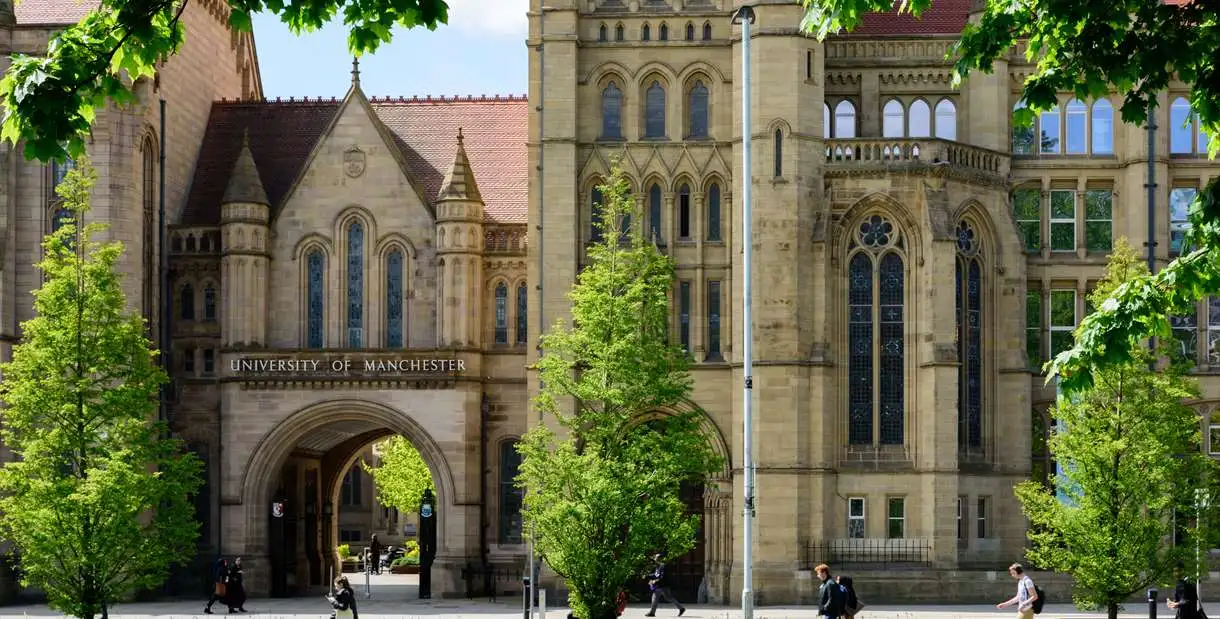
The University of Manchester, where Dr Dean Lomax works as a palaeontologist / Credit: UoM
Ichthyotitan is not the world’s first giant ichthyosaur, but the discoveries by Paul, and Justin and Ruby, are said to be “unique among those known to science”, as they appear roughly 13 million years after their latest geologic relatives – including Shonisaurus sikanniensis from British Columbia in Canada, and Himalayasaurus tibetensis from Tibet in China.
Speaking on the confirmation of the bones’ identification this week, Dr Lomax said: “This research has been ongoing for almost eight years.
“It is quite remarkable to think that gigantic, blue whale-sized ichthyosaurs were swimming in the oceans around what was the UK during the Triassic Period.
“These jawbones provide tantalising evidence that perhaps one day a complete skull or skeleton of one of these giants might be found.”
Featured Image – UoM
News
Victim named and murder investigation launched after young woman is killed in Newton Heath stabbing
Emily Sergeant
The victim of a street stabbing in Newton Heath this week has been named for the first time as a murder investigation continues.
It comes after officers from Greater Manchester Police (GMP) responded to reports of a disturbance at around 2am yesterday (Thursday 15 October) on Dorking Avenue, in the Newton Heath area of Manchester, and when they arrived on the scene, they found a woman in her 20s with serious injuries that were ‘consistent with a stabbing’.
Despite best efforts of all emergency services involved, the young woman was sadly pronounced dead at the scene.
As the murder investigation progresses, the woman has now been publicly named and a photo of her has been released for the first time.
She has been named as 26-year-old Alisha Samuels.
At this time, one man, aged 25, has been arrested on suspicion of murder, and a man and woman, aged 61 and 38, have been arrested on suspicion of assisting an offender, and they all remain in custody – with officers continuing their enquiries to establish the full circumstances of this incident.
Alisha’s family have asked for privacy whilst they deal with the devastating loss of their loved one, GMP has stated.
“We are continuing to urge people who may have information in relation to this incident to please come forward to support our investigation and bring justice for Alisha,” the police force said in a public appeal.
Anyone who may have witnessed the incident, or has mobile phone, CCTV, or doorbell footage, is urged to call GMP on 0161 856 5464, or contact them via the Major Incident Public Portal here.
Alternatively, you can contact Crimestoppers on 0800 555 111
Featured Image – GMP (Family Handout)
News
Former supply teacher jailed for multiple upskirting and AI sex offences across Greater Manchester
Emily Sergeant
A former supply teacher has been jailed for multiple upskirting and AI sex offences in schools across Greater Manchester.
Abusali Rahman – a British national of Bangladeshi ethnicity from Salford – appeared in Bolton Crown Court this week for his sentencing after first being charged with, and then pleading guilty to, several offences.
The offences are including, but not limited to, 12 counts of taking an indecent photograph/pseudo-photograph of a child (images obtained by upskirting), three counts of making indecent photograph / pseudo-photograph of a child (making AI-generated images), and one count of attempting to meet girl under 16 following sexual grooming.
The offences are alleged to have taken place between December 2023 and June 2025, according to Greater Manchester Police (GMP).
Twelve girls have been identified in relation to the upskirting offences – aged between 13 and 16 at the time of the alleged offending – at seven high schools in three Greater Manchester boroughs (Bury, Bolton, and Salford).
GMP says it has remained in close contact with the schools, local authorities, and other partners throughout the investigation to ensure all appropriate support is in place for those who need it.
Additionally, the court also heard how Rahman amassed a collection of images of young girls, using AI and other methods to sexualise them.
The images numbered more than 300 in total, ranging from Category A to Category C classifications, and Rahman would post these on social media, often alongside humiliating and disgusting captions.
Rahman was sentenced to six years in prison, and will also be subject to a 20-year Sexual Harm Protection Order.
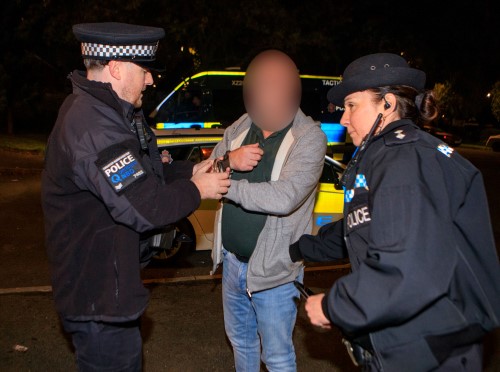
A former supply teacher has been jailed for child sex offences in schools across Greater Manchester / Credit: GMP
Detective Constable Lisa McGaffin, from GMP’s Bolton Child Protection Team, described Rahman’s crimes as ‘absolutely abhorrent’.
“My thoughts throughout this process have always been with the young girls who have been subject to such indignity,” DC McGaffin said following the sentencing this week. “Their welfare and support will always be a priority for us.
“While working as a teacher – someone who young children should trust and be safe with – Rahman repeatedly took secret photos for his own sick gratification, before posting images online which showed his total disregard for the girls’ respect and dignity.

 Emily Sergeant -
18th April 2024
Emily Sergeant -
18th April 2024