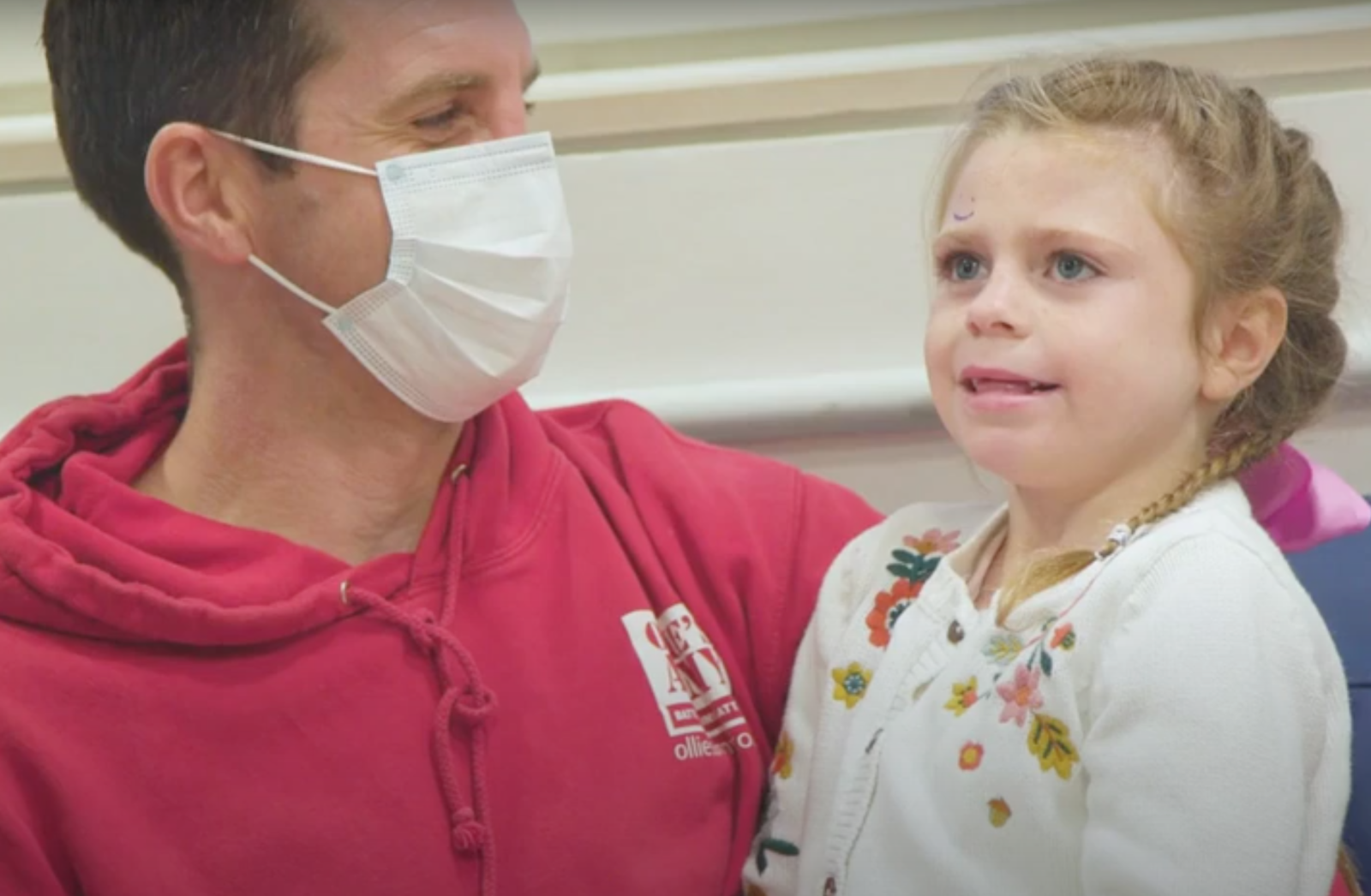
An eight-year-old Cheshire girl with a rare degenerative disease has become one of the first to receive a pioneering new treatment that will attempt to save her eyesight.
Amelia Carroll, from Poynton near Stockport, was diagnosed with CLN2 Batten disease – an incurable and fatal condition that affects roughly around 30-50 children in the UK – when she was just two.
The disease is caused by a change in a gene that is responsible for making a specific enzyme in the nervous system, and it results in seizures, a gradual decline in a child’s ability to walk, speak and see, as well as progressive dementia.
Amelia’s 11-year-old brother Ollie also has the same condition, yet has sadly already lost his eyesight.
“We have watched our son Ollie go blind, and now the same is starting to happen to Amelia,” mother Lucy Carroll explained, which is why her and her husband Mike decided to contribute to a fundraising campaign together with families of other children affected by the disease alongside the Battens Disease Family Association (BDFA) to help fund a world-first trail of a groundbreaking new treatment at Great Ormond Street Hospital (GOSH).
ADVERTISEMENT
Over £200,000 was raised through the campaign, and clinicians and researchers at GOSH and ICH say the treatment programme has the potential to transform the quality of life for children living with CLN2 Batten disease.
Amelia became one of the first children in the world to receive the treatment, and is said to already be responding to it “perfectly”, CheshireLive reports.
For the past two years, enzyme replacement therapy has been used to help prevent neurological deterioration in children with CLN2 disease. The drug, called Brineura, was first approved for use on the NHS in 2019 and is administered directly into the brain by a regular infusion.
It has shown to restore enzyme activity and slow the onset of disability.
However, this infusion into the brain does not prevent children going blind, as the enzyme cannot cross the blood-retina barrier, and this means that the nerves in the eye cannot function and vision is lost, which is why clinicians and researchers at GOSH and ICH are trying a the treatment to prevent the onset of blindness instead.
ADVERTISEMENT
To do this, GOSH said they are using the tiny amount of the drug leftover from the brain infusion and injecting it directly into the back of the eye.
The 18-month treatment trail – which is said to be being given on a compassionate use basis – hopes to prevent eyesight deterioration in children by providing the enzyme that the nerves in the back of the eye need to function.
Ms Carroll said “to save a child’s sight would be incredible”, and if it does indeed work, it would “make such a big difference to Amelia’s quality of life”.
“We just pray it works,” she added.
Speaking on the groundbreaking treatment trail, Professor Paul Gissen, from GOSH and the UCL GOS Institute of Child Health, said: “If successful, we hope our work can pave the way to saving the sight of more children with this disease to preserve their quality of life for as long as possible.”
ADVERTISEMENT
Amelia’s father, Mike Carroll, said the “amazing” nurses and doctors treating his daughter were “incredible”.
New proposals to transform one of Manchester’s busiest roads revealed
Emily Sergeant
New proposals which could transform one of Manchester’s busiest roads have been unveiled.
Oldham Road is one the key routes into the city centre, and sees upwards of 26,000 journeys a day via a combination of car, bike, and public transport, according to Transport for Greater Manchester (TfGM), but these new plans are set to improve journey times, safer crossings, protected cycleways, better connections, and boost sustainability.
“We know that things can be better,” TfGM said in a statement unveiling the proposals this week, adding that change is needed.
In the last five years alone, there have been 36 collisions on Oldham Road between Great Ancoats Street and Queens Road, with seven serious injuries caused as a result, which is why Council believes, with a number of targeted improvements, the road can be made better for everyone.
New proposals to transform one of Manchester’s busiest roads have been revealed / Credit: TfGM
When asked during the last consultation, hundreds of locals said what they wanted buses to come more often and be more reliable, safer places to cross the road, wider pavements for walking, and better-protected cycle lanes.
As part of the unveiled plans – which are currently out for consultation too – TfGM and the Council is proposing adding more bus lanes so buses don’t get stuck in traffic, as well making bus stops nicer with better places to wait, and building more cycle lanes that are separate from cars.
Proposals also include changing traffic lights to help people cross the road, and fixing busy junctions so they’re easier and safer to cross.
Proposals are aiming to make the road safer, better-connected, and more sustainable / Credit: TfGM
“Improving everyday journeys is a priority, and the proposals for Oldham Road are central to this,” commented Alison Chew, who is TfGM’s Interim Director of Bus.
“Through the Bee Network, we’re creating a joined-up, safer and more affordable transport system for Greater Manchester, reducing congestion for everyone and connecting people with places and opportunities.
“These plans aim to make bus stops safer and easier to use, improve the speed and reliability of bus services, and provide better walking and cycling routes with upgraded crossings and footpaths.
“As Manchester city centre continues to grow, improving the way people can move easily around the city is a major driver for change. We know that things can be better.”
You can have your say on the proposals on the Council website here.
Featured Image – TfGM
News
Subjects for first vocational equivalent to A-Levels revealed ahead of introduction next year
Emily Sergeant
The subjects for the first vocational equivalent to A-Levels have been revealed ahead of their introduction into the curriculum next year.
Claiming that too many have been ‘held back’ by a system that didn’t ‘value every route to success’, the Government has now announced that young people will be able to take the very first V-Levels in subjects like education, finance, and digital in 2027, as part of landmark reforms to close the skills gap and help them secure well-paid jobs.
V-Levels are described as being ‘transformational’ new qualifications where learning is designed around real jobs and the skills that employers actually need.
They combine study and real‑world work experience to achieve the final outcome.
As mentioned, the new qualifications will be introduced next year for 16‑year‑olds, providing a year of study before progressing to V-Levels, T-Levels or A-Levels – with the initial subjects being Education and Early Years, and Digital.
The first subjects for the vocational equivalent to A-Levels have been revealed / Credit: EasyPeasyAI | JESHOOTS (via Unsplash)
A separate two‑year, employment‑focused route will also be available for those aiming to move straight into work or an apprenticeship after education.
Students who want to specialise in technical, sector-focused studies will also have more options, as T-Levels will soon be expanded to include subjects such as Sports, Fitness and Exercise Science, and Care Services.
These further changes to T-Levels will refine content and assessment, and allow providers more scope to tailor industry placements, to ensure that more young people can access them.
“Our bold reforms will end the snobbery in post-16 education, supporting young people with real choice and real opportunity to build secure, future‑proof careers,” commented Education Secretary, Bridget Phillipson, as the V-Level subjects were announced.
“Not only that, but it will give parents much-needed confidence in a system that values every route to success, as we continuing driving forward our mission to ensure two‑thirds of young people are in education, training, or apprenticeships by 25.”
Bill Watkin, Chief Executive of the Sixth Form Colleges Association, added: “We are pleased that a third qualification pathway will sit alongside A levels and T levels in the future.
“The changes announced to T levels today are also very welcome and should make it easier for more young people to study a T level and for schools and colleges to offer them.”