A brand new ’21st-century library’, learning centre, café and events space is coming to Stockport town centre later this year and we thought we’d take a quick look at the exciting project.Let’s start with what and where it is exactly, shall we?
Being sold to the public as not just a new modern library but a learning hub and ‘discovery’ centre, StockRoom is the upcoming government-backed community development inspired by similar multi-use spaces like the Storyroom over in Chester.
Set to open up along the busy strip of Merseyway Shopping Centre right in central Stockport and spanning across a 47,000 sq ft space with several floors just next to the H. Samuel jewellers and other vacant units where the likes of Next used to be.
The concept is to deliver an “innovative space for creativity, discovery and inspiration” but boiled down to the basics, it will serve as a new home and sister site for many of the activities and resources currently housed within the Central Library, as well as a place for people to meet, study, hone skills, relax etc.
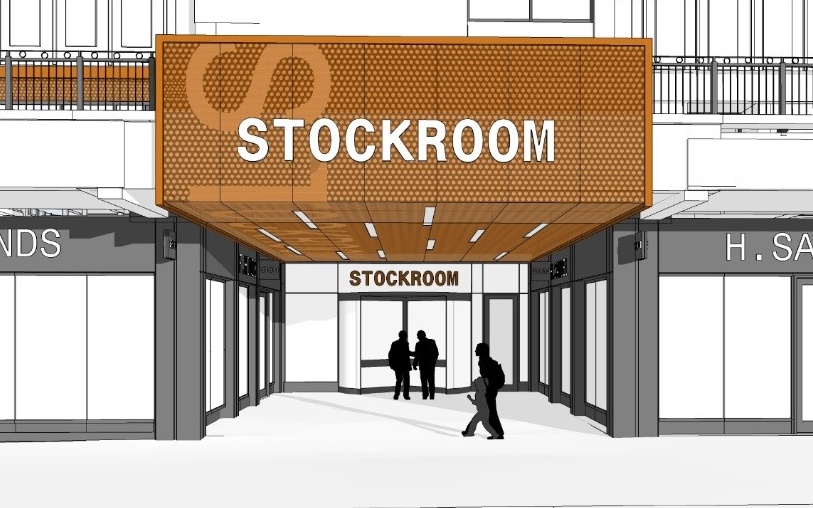
How this little stretch of the high street looks now.How it’s set to look in the coming months.A surface look at Stockport’s new library, learning centre and free public space. (Credit: Stockport Council/AEW Architects)
How much is costing?
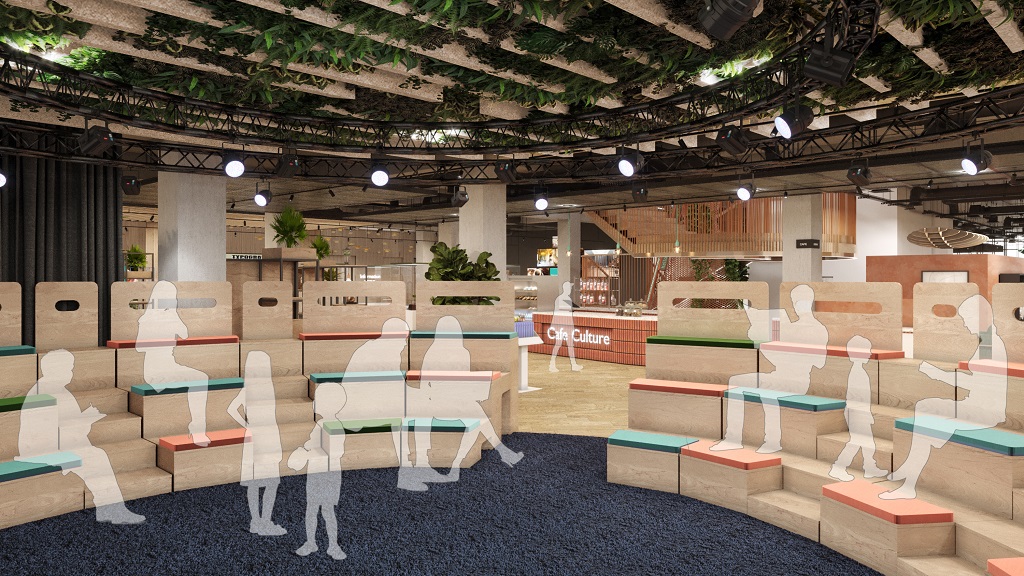
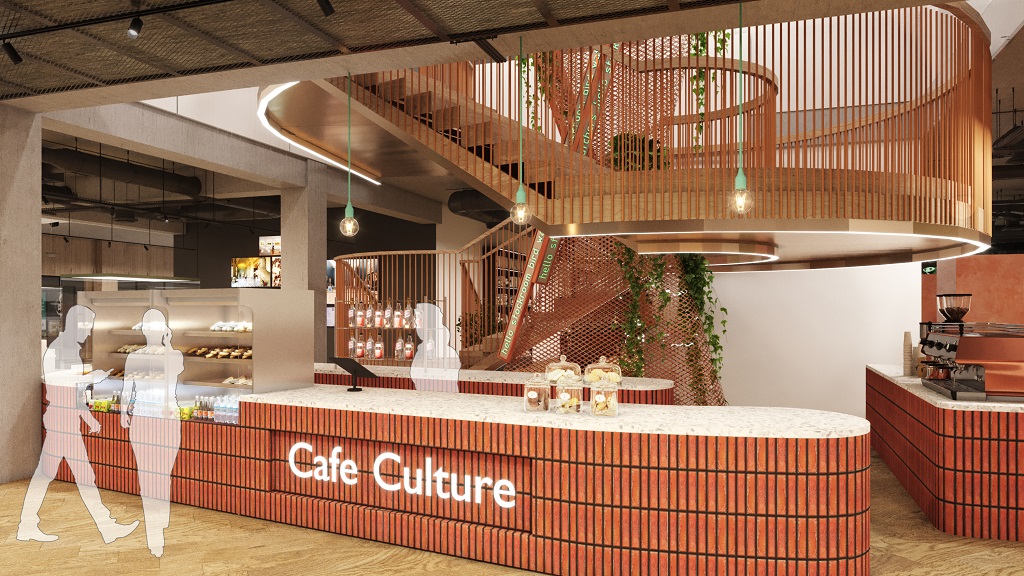
With kid’s play areas and a dedicated children’s library, a “high-quality” bistro offering and IT facilities; a multi-faith prayer room, arts and crafts zones as well as spaces for live music, entertainment and special events, this place isn’t coming cheap.
ADVERTISEMENT
Using funding predominantly for the UK’s nationwide Future High Streets Fund, which totals over £1 billion, the StockRoom was initially priced up at approximately £14.5 million when it first signed off back in December 2021, but has since seen costs shoot up as a result of inflation.
While projections rose to nearly £22m last year, after negotiations with contractors and an injection of some more funding from Stockport Council, the figure is now thought to be closer to £16.5m. Still a big and pricey project, nonetheless.
ADVERTISEMENT
The build is being designed by Manc architecture firm AEW. The new Stockport library will also offer food and drink.Credit: Stockport Council/AEW Architects
When is it opening?
Now, although there is no firm opening date for StockRoom yet, it has now been slated for an autumn opening date, with adjacent units like the old Next and the former 64,000 sq ft M&S site across the road set to be redeveloped by Greater Manchester property firm, Glenbrook, later this year too.
There are suggestions that the Council could permanently move the town’s main library to the new learning-based location if it proves popular with SK locals when it launches and were residents willing to back such a proposal.
With the vacant BHS department store also set to be redeveloped in the near future, the face of Merseyway is set to look very different very soon.
ADVERTISEMENT
The current Merseyway tunnel area will become the entrance.The latest CGIs of how the main space could look.Credit: Stockport Council
With Stockport being named Greater Manchester’s Town of Culture in 2023 and having once again been named one of the best places to live in the North West this year, the regeneration of the old Cheshire town and now thriving business, foodie and creative hub is making an exciting time to be in SK.
If you take into account all of the other new developments from apartments and hospitality venues to public spaces like StockRoom, the town is already looking very different than it did a few short years ago.
On the sporting side of things, the latest plans to upgrade and expand Stockport County‘s home ground will no doubt prove massive for the local community and surrounding Edgeley area, in particular.
Victim named and murder investigation launched after young woman is killed in Newton Heath stabbing
Emily Sergeant
The victim of a street stabbing in Newton Heath this week has been named for the first time as a murder investigation continues.
It comes after officers from Greater Manchester Police (GMP) responded to reports of a disturbance at around 2am yesterday (Thursday 15 October) on Dorking Avenue, in the Newton Heath area of Manchester, and when they arrived on the scene, they found a woman in her 20s with serious injuries that were ‘consistent with a stabbing’.
Despite best efforts of all emergency services involved, the young woman was sadly pronounced dead at the scene.
As the murder investigation progresses, the woman has now been publicly named and a photo of her has been released for the first time.
She has been named as 26-year-old Alisha Samuels.
At this time, one man, aged 25, has been arrested on suspicion of murder, and a man and woman, aged 61 and 38, have been arrested on suspicion of assisting an offender, and they all remain in custody – with officers continuing their enquiries to establish the full circumstances of this incident.
Alisha’s family have asked for privacy whilst they deal with the devastating loss of their loved one, GMP has stated.
“We are continuing to urge people who may have information in relation to this incident to please come forward to support our investigation and bring justice for Alisha,” the police force said in a public appeal.
Anyone who may have witnessed the incident, or has mobile phone, CCTV, or doorbell footage, is urged to call GMP on 0161 856 5464, or contact them via the Major Incident Public Portal here.
Alternatively, you can contact Crimestoppers on 0800 555 111
Featured Image – GMP (Family Handout)
News
Former supply teacher jailed for multiple upskirting and AI sex offences across Greater Manchester
Emily Sergeant
A former supply teacher has been jailed for multiple upskirting and AI sex offences in schools across Greater Manchester.
Abusali Rahman – a British national of Bangladeshi ethnicity from Salford – appeared in Bolton Crown Court this week for his sentencing after first being charged with, and then pleading guilty to, several offences.
The offences are including, but not limited to, 12 counts of taking an indecent photograph/pseudo-photograph of a child (images obtained by upskirting), three counts of making indecent photograph / pseudo-photograph of a child (making AI-generated images), and one count of attempting to meet girl under 16 following sexual grooming.
The offences are alleged to have taken place between December 2023 and June 2025, according to Greater Manchester Police (GMP).
Twelve girls have been identified in relation to the upskirting offences – aged between 13 and 16 at the time of the alleged offending – at seven high schools in three Greater Manchester boroughs (Bury, Bolton, and Salford).
GMP says it has remained in close contact with the schools, local authorities, and other partners throughout the investigation to ensure all appropriate support is in place for those who need it.
Additionally, the court also heard how Rahman amassed a collection of images of young girls, using AI and other methods to sexualise them.
The images numbered more than 300 in total, ranging from Category A to Category C classifications, and Rahman would post these on social media, often alongside humiliating and disgusting captions.
Rahman was sentenced to six years in prison, and will also be subject to a 20-year Sexual Harm Protection Order.
A former supply teacher has been jailed for child sex offences in schools across Greater Manchester / Credit: GMP
Detective Constable Lisa McGaffin, from GMP’s Bolton Child Protection Team, described Rahman’s crimes as ‘absolutely abhorrent’.
“My thoughts throughout this process have always been with the young girls who have been subject to such indignity,” DC McGaffin said following the sentencing this week. “Their welfare and support will always be a priority for us.
“While working as a teacher – someone who young children should trust and be safe with – Rahman repeatedly took secret photos for his own sick gratification, before posting images online which showed his total disregard for the girls’ respect and dignity.

 Danny Jones -
14th March 2024
Danny Jones -
14th March 2024