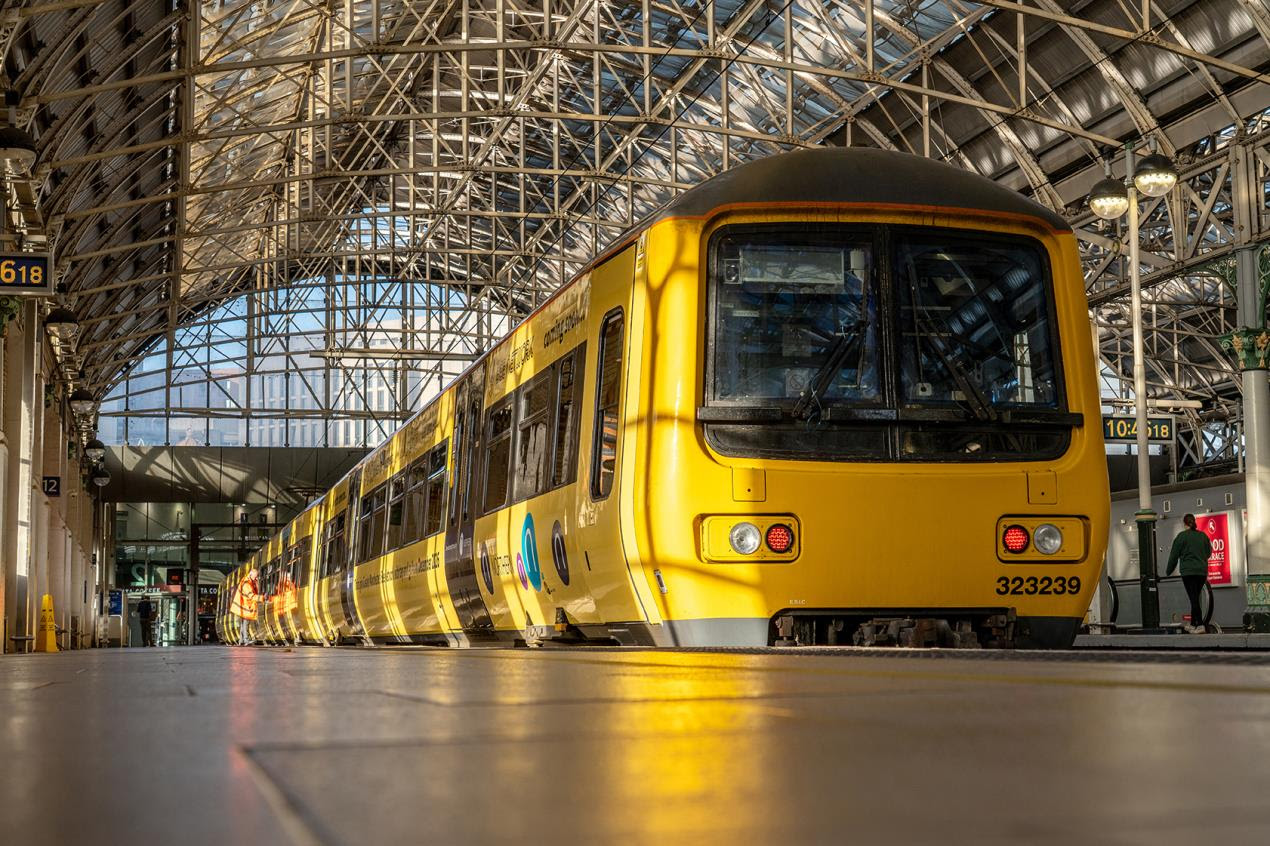
The first Bee Network train has been unveiled, as Greater Manchester prepares to integrate all public transport options in 2026.
Greater Manchester Mayor Andy Burnham has this week revealed a step-by-step plan for bringing the region’s rail lines into the Bee Network to create the first truly integrated public transport system outside London.
With just one year to go until the first rail services start joining the Bee Network, industry leaders unveiled a new yellow Bee Network promotional train and set out how passengers will benefit from new services, improved stations, and simpler fares and ticketing in the months ahead.
The first two lines – which will connect Manchester to Glossop and Stalybridge – are set to join the Bee Network from 13 December 2026.
Contactless ‘tap in, tap out’ ticketing will also rolled out across 17 stations on this date.
ADVERTISEMENT
Greater Manchester is on track to bring rail into the #BeeNetwork from December 2026. 🚆🐝
From new trains to station upgrades, contactless ticketing and step-free access – this is the start of a fully integrated transport system connecting trains, trams, buses and active… pic.twitter.com/FysCgzY72w
Transport for Greater Manchester (TfGM) says these initial two rail lines are ‘just the beginning’, with more lines set to follow in 2027 and 2028, and the further roll out of contactless and capped fares will work to join buses, trams, and trains together as Greater Manchester continues its journey to deliver an ‘affordable, accessible, and joined-up’ transport network.
By March 2026, the Bee Network app and TfGM website start to join together.
ADVERTISEMENT
They will feature comprehensive rail station information, from car park and cycling spaces through to step-free access – with real-time rail departure and disruption information added by the summer, and journey planning available by autumn.
Also, another huge step in the plan, is that from May 2026, TransPennine Express will run 25/7 night-time trains to Manchester Airport as a way of supporting the region’s ‘thriving’ night-time and visitor economy.
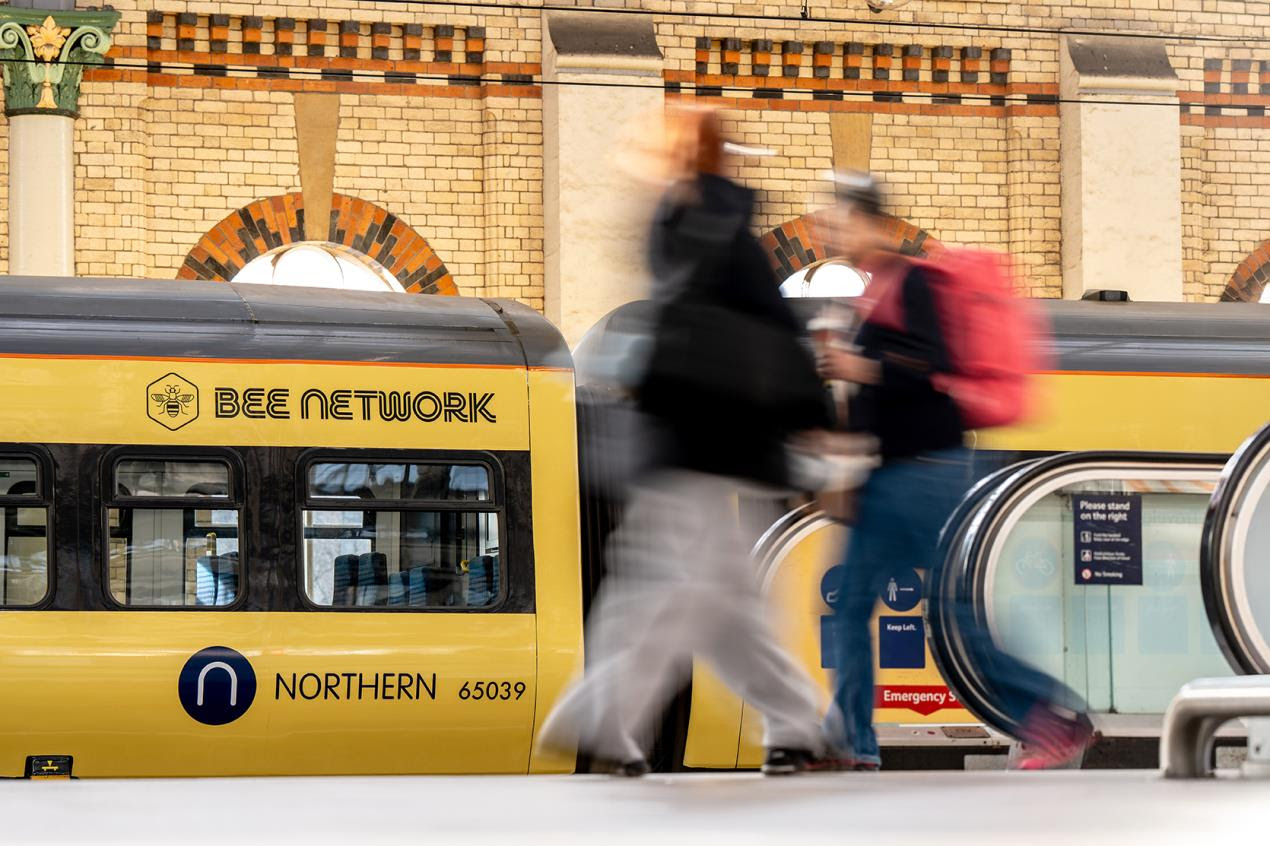
The first-ever Bee Network train has been unveiled ahead of its 2026 launch / Credit: TfGM (Supplied)
Looking forward the future, additional and later-running services on the Airport, Alderley Edge, and Rochdale-stopping lines will be piloted from 2027.
ADVERTISEMENT
And then, from January 2028, eight rail lines – with 64 stations included – will be fully integrated with Bee Network buses and trams, ‘tap and go’ payments, and daily and weekly fare caps, while the remaining 32 stations will join the system by 2030.
“With one year to go until rail joins the Bee Network, we are on the cusp of delivering a fully integrated, world-class transport system for our global city-region,” commented Mayor Andy Burnham, as the first Bee Network train was unveiled this week.
“These changes will make everyday journeys easier and open up new opportunities for people across Greater Manchester.
“I am excited for what the next twelve months will bring as we build a better, more connected future for us all.”
Featured Image – TfGM (Supplied)

News
Hundreds of staff to strike at four Greater Manchester hospitals next week
Emily Sergeant
Hundreds of staff at four of Greater Manchester’s hospitals are set to strike next week.
More than 350 Northern Care Alliance Foundation Trust (NCA) employees – including nurses, clinical support workers and housekeepers – are walking out for three days next week after union UNISON says an offer to ‘resolve’ a dispute was withdrawn before discussions could take place.
According to the union, the dispute centres on the NCA’s use of an outside agency called NHS Professionals (NHSP) to manage overtime.
When covering staff shortages, workers are entitled to time-and-a-half pay – however in some cases, staff earn less than they would on a normal shift, and some have even been missing out on more than £80 per shift, the union added.
Operating theatre staff were previously on picket lines in June, and although an option to resolve the row was initially tabled by NCA bosses, this has now fallen through.
Hundreds of staff at four of Greater Manchester’s hospitals are set to strike next week / Credit: Stephen Andrews (via Unsplash)
This means that staff at Salford Royal Hospital, Royal Oldham Hospital, Rochdale Infirmary, and Fairfield Hospital in Bury are walking out next week on Monday 24, Wednesday 26, and Friday 28 August.
In particular, staff from all four sites will also gather in Salford on Wednesday (26 August) for a ‘unified’ day of protest.
Understandably, some disruption is expected at each of the hospitals on strike days.
“Those at the top of NCA have shown a lack of leadership and made their disregard for their staff clear,” explained UNISON North West regional organiser, Kevin Dolan.
“A deal was put on the table but taken away before we had chance to talk it over. We are ready to continue negotiations, but it’s obvious NCA has no intention of resolving this.
“This isn’t complicated. Staff are simply asking for what their contract says they’re entitled to. Nothing more.”
Featured Image – Pxhere
News
Wetherspoons introduces new phone rule at all UK pubs after customers are ‘driven nuts’
Emily Sergeant
JD Wetherspoon has announced a major new phone rule in all its sites across the UK after customers complain of being ‘driven nuts’.
The pub chain – which has nearly 800 branches across the UK – announced earlier this week that it has made the decision to ban people from playing music or videos out of their phones, and from taking calls on loudspeaker.
The ban, which has been introduced effective immediately, follows a rising number of complaints from customers about the noise – with owners saying sounds from smartphones and tablet computers had become an ‘increasing problem’ in recent years.
Wetherspoon founder and chairman, Tim Martin, says he wants Wetherspoon pubs to be ‘an oasis of tranquillity and contemplation’.
Wetherspoons has introduced a new phone rule at all its UK pubs after customers are ‘driven nuts’ / Credit: Allan Rohmer (via Unsplash)
A formal statement from the company announcing the ban reads: “Following complaints from customers, who are being driven nuts by other people’s videos and amplified phone conversations, Wetherspoon has asked customers to switch their phones to silent or to use earphones.”
Tim Martin added: “In order to avoid customers being driven chicken jalfrezi by a cacophony of sound, we are kindly asking phone users to pipe down.”
Wetherspoon’s ban follows a YouGov poll conducted last year questioning public opinion on a proposition made by the Liberal Democrats of introducing fines of up to £1,000 for ‘headphone dodgers’ who play music out loud on buses and trains.
62% of people, on average, said they would back this move if it was introduced.
The poll, which surveyed 6,815 British adults, found that almost three-quarters of those over 65 would support the fines, while those aged between 18 and 24 were split 47% to 43% in favour of it.
Early public reactions to Wetherspoon’s ban appears to be overwhelmingly positive.