Manchester Airport Group (MAG) and Ryanair are taking legal action against the government over its traffic light travel system.
MAG – which owns and operates Manchester, London Stansted and East Midlands airports – is teaming up with Michael O’Leary’s airline to tackle the government on international travel rules, reports the BBC.
The legal challenge – which arrives just days after confirmation the end of lockdown will be delayed – apparently has the backing of other big travel companies.
Travel groups are arguing that the government needs to produce more data to support its decision-making on restrictions to certain countries.
MAG and Ryanair have launched legal action over travel list restrictions / Image: Wikimedia Commons
Currently, the government is operating a traffic light system for travel – which categorises countries as ‘green’, ‘amber’ or ‘red’ depending on their risk level.
ADVERTISEMENT
Arrivals from green list countries do not need to quarantine upon their return to the UK, whereas those coming back from Amber nations must self-isolate for 10 days. Anyone returning from red list countries must quarantine in a hotel.
All passengers – regardless of destination – are asked to take COVID tests.
ADVERTISEMENT
Countries can be moved between lists at any time.
But Ryanair CEO O’Leary has called the system a “shambles”.
Earlier this week he stated: “UK tourism and aviation needs a pragmatic travel policy, which permits vaccinated UK and EU citizens to travel between the UK and the EU without the need for quarantine or negative PCR tests.
ADVERTISEMENT
“This will at least allow the UK tourism industry to plan for what is left of the summer season and get hundreds of thousands of people back to work.”
Ryanair’s boss has called the / Image: Photo by Fotis Christopoulos via Unsplash
Charlie Cornish, MAG CEO, released a statement earlier this month claiming it was “clear the government doesn’t trust its own system” – which he called “not fit for purpose.”
He wrote: “The lack of transparency is shocking and totally unacceptable. If the Government has information that supports its decisions, then it needs to publish it. We have repeatedly asked for this data, but we are being left in the dark about how it is making these choices, with no opportunity for scrutiny or challenge.
“That is not the way to go about limiting people’s freedoms and crippling the country’s travel and tourism sectors. With so much at stake, we need immediate transparency and urgent action to make this system of travel restrictions fit for purpose.”
A government spokesperson said it could not comment on specific legal proceedings, but confirmed: “We recognise this is a challenging period for the sector, as we seek to balance the timely reopening of international travel while safeguarding public health and protecting the vaccine roll-out.”
ADVERTISEMENT
“We have provided £7bn to help support for the industry during the pandemic.”
Featured image: Flickr
News
Manchester Town Hall is FINALLY taking wedding and events bookings for the first time since 2018
Emily Sergeant
A new era is on the horizon, as Manchester Town Hall has announced that it’ll be finally taking bookings for weddings and events once again.
That’s right… for the first time since it closed its doors to the public for what is the UK’s biggest restoration project to date back in 2018, one of Manchester’s most iconic landmarks is soon set to welcome its first weddings and events in a decade – with bookings for the city’s most romantic address now open once again.
Manchester Town Hall has stood at the centre of civic life in the city since 1877, and for generations, couples have exchanged their vows within its walls.
Now, as it enters the home stretch of its restoration, the Grade I-listed building is gearing up to kickstart weddings and corporate events from January 2028.
Set reopen to the public next year, first up will be a series of celebratory reopening events – which are yet to be announced – before a phased approach will then allow the building and teams to be fully prepared to host commercial events again from 2028.
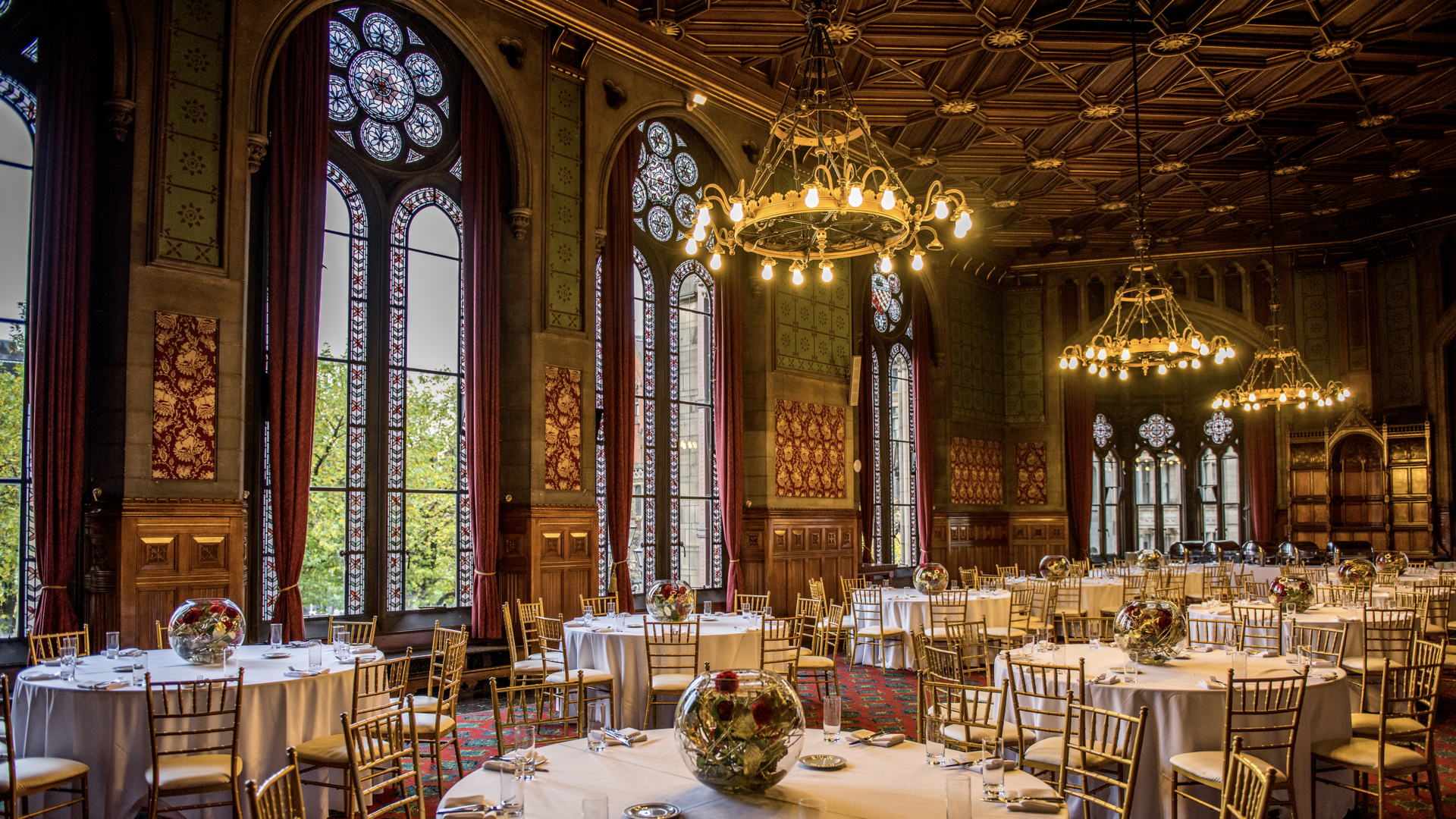
Manchester Town Hall has announced that it’s finally taking wedding and events bookings for the first time since 2018 / Credit: Supplied
From its grand architecture and soaring stained glass windows, to sweeping staircases that offer the perfect ‘just married’ photo opportunities, this one-of-a-kind venue gives couples the opportunity to combine the romance and grandeur of a historic setting with the energy of a city centre celebration.
Inside the restored building, you’ll find The Great Hall, which is a magnificent setting with striking architectural character, as well as The Conference Hall, The Banqueting Hall, and The Reception Room, all of which offer equally characterful spaces that are perfect for private dinners, ceremonies, or corporate events.
The Lord Mayor’s Parlour is one of many settings overlooking the newly reopened Albert Square, while various elegant reception areas provide the perfect location for drinks and arrival moments.
“Our Town Hall is a real Victorian masterpiece and we’re looking forward to sharing it with the public once again,” explained Cllr Garry Bridges, who is Leader of Manchester City Council, as bookings finally open up this week.
“It’s a special building which belongs to the people and it’s great that they will be able to celebrate important landmarks in their lives, such as marriage, in its spectacular setting.
“The Town Hall is full of history. Here’s to many more stories being written within its walls.”
Want to be one of the first people who gets married or hosts an event at Manchester Town Hall once it reopens in 2028? You can enquire about booking here.
Featured Image – Supplied
News
Bolton personal trainer charged with sexual offences relating to multiple women
Emily Sergeant
A personal trainer from Bolton has been charged with sexual offences relating to multiple women.
Following an extensive investigation into alleged crimes in the Bolton area, Greater Manchester Police (GMP) has confirmed that Payam Postchi, of Greenway Close in Bury, has been charged with one count of sexual assault by penetration, and two counts of sexual assault by touching.
The charges relate to three women, according to GMP.
Detective Chief Inspector Mike Sharples, from GMP’s Bolton district, explained: “Following an initial investigation by officers, we have secured three charges in relation to alleged sex offences committed at a business in the Bolton area.
“We understand that the nature of this kind of investigation may cause anxiety, but I want to stress that all appropriate work is being completed, with the women involved being supported throughout the process.”
Postchi, who is a British national of Iranian origin, appeared at Manchester and Salford Magistrates court yesterday (30 September 2026).
Detectives are now urging the public to ‘avoid speculation’ during active criminal proceedings, but are still appealing for any relevant information.
DCI Sharples concluded: “If anyone thinks they have any information or otherwise has concerns in relation to the case, I would urge them to come forward.
“Additionally, I would remind people that criminal proceedings are now active and to avoid speculation which could impact the ongoing work.”

 The Manc -
17th June 2021
The Manc -
17th June 2021