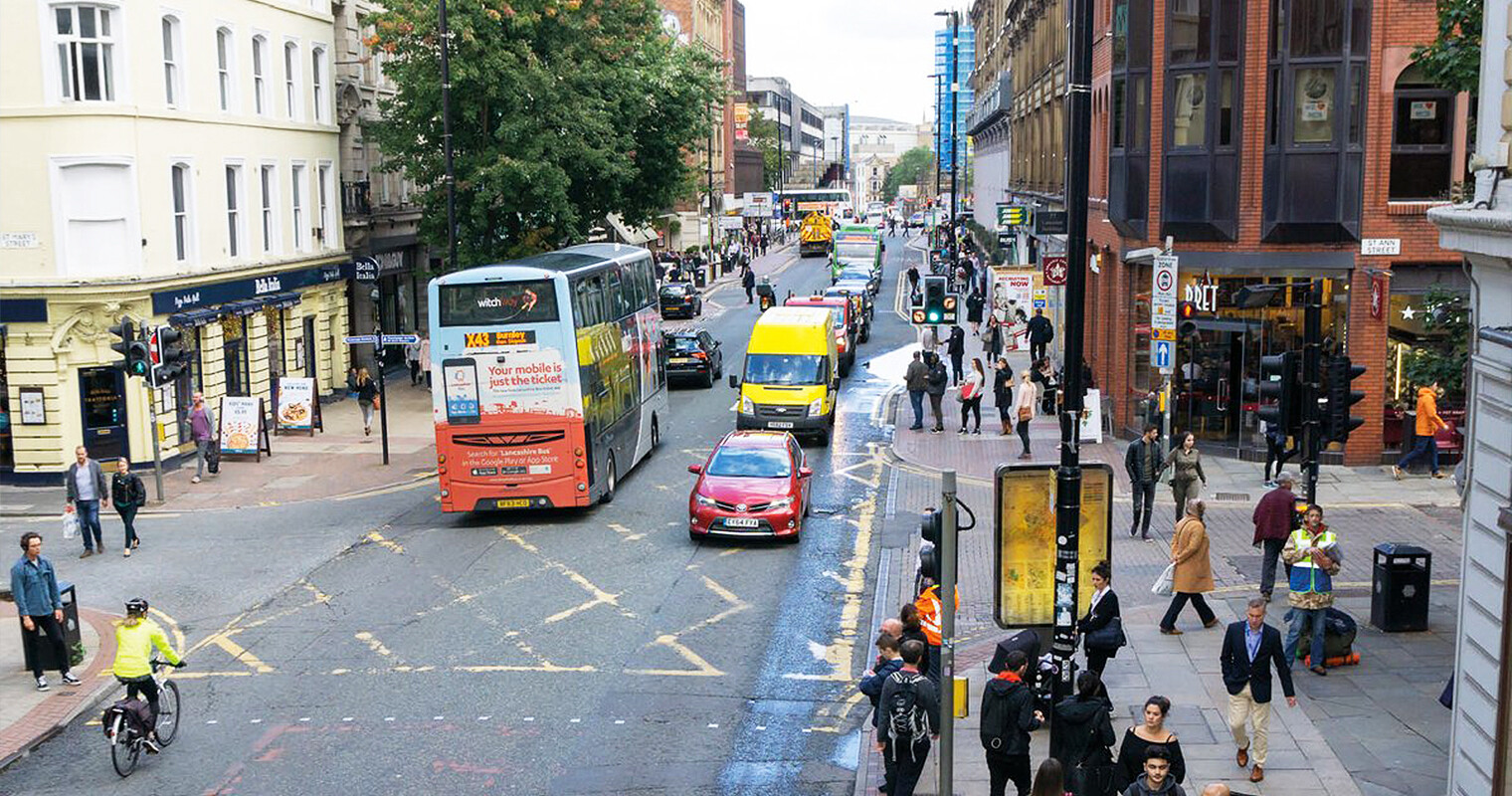
Manchester residents are being encouraged to provide feedback on new plans for Deansgate - which include pedestrianisation and introducing a one-way system.
Manchester residents are being encouraged to provide feedback on new plans for Deansgate – which include pedestrianising parts of the road and the introduction of a one-way system.
A section of the city centre street was closed to vehicles back in May to help with social distancing and support the economic recovery of the city after lockdown.
However, Diamond bus company objected to the plans – forcing Manchester City Council to create a makeshift route for buses to travel through.
But now the asking the public for feedback on a new experimental traffic order – which will make the space between King Street West and Blackfriars Street open exclusively to pedestrians and bikes.
Under the new proposals, King Street to Quay Street will also become one-way only in a southbound direction (with the northbound carriageway closed).
ADVERTISEMENT
The consultation about the permanent closure of part of Deansgate is now open until 15 January, and we want to hear your thoughts on this important project.
According to the council, the proposals will improve air quality in the area and support Greater Manchester’s commitment to become zero carbon by 2038.
The council has also argued it will make Deansgate ‘more pleasant and easier for pedestrians to get around.’
ADVERTISEMENT
A new bus gate will be built on Bridge Street at the junction of Gartside Street, meaning only buses would be able to drive out of the city centre across the River Irwell into Salford via this route.
The council stated: “This bus-only corridor door is designed to complement the other measures in the experimental order and to support public transport.”
Impact will be monitored for at least 12 months before a decision is made whether the changes should become permanent.

ADVERTISEMENT
Wikimedia Commons
Councillor Angeliki Stogia, Executive Member for the Environment, Planning and Transport, said: “We believe there are significant environmental and safety benefits to the closure of this section of Deansgate, which should be a safe and welcoming space for people of all ages at the heart of the city.
“We’re making these proposals in support of our vision for a greener and healthier city centre, with cleaner air, more space to walk and cycle and more reliable bus journeys in and out of the city. However, before decisions are made, it’s crucial that we get the views of the people and businesses that any closure would affect.
“If you have views on these proposals for Deansgate, I’d encourage you to share them as part of this consultation, so we can take them into account when deciding the next steps.”
Councillor Roger Jones, Executive Support Member for Transport at Salford City Council added: “When we went into lockdown in March, people commented on the cleaner air and quieter streets and many have taken to walking and cycling for both commuting and leisure.
“We believe that these measures will encourage more people to continue walking, cycling or using public transport and reaping the benefits of that. I hope that as many people as possible will have their say and comment on the future of Deansgate in this consultation.”
To have your say on the proposals, head over to the Manchester City Council website.
The consultation is open until Friday 15 January 2021.
News
The simple hack that can save healthcare workers and teachers money on their holidays
Danny Jones
With cost-of-living pressure ever-present in the background of most everyday lives, finding some spare pennies for a getaway feels more difficult than ever, and if there’s anyone who deserves discounts on a holiday, it’s healthcare workers.
That’s why, when we became aware of the simple hack that can save those working in healthcare services money on holidays, we thought we’d help spread the word.
We’re sure lots of you working within the sector already know plenty about this booking strategy, but for anyone who doesn’t, how do you fancy saving up to half a grand on your next jolly?
In fact, even those working in education can cut their costs, too.
With searches for ‘holiday voucher code’ up by 73% on Google, and even the likes of TikTok seeing ‘money saving tips’ up by 45%, travel agency TUI have decided to team up with the Health Service Discounts platform for 2026.
Providing those who work for the NHS with a ‘Holidays for Heroes’ (HfH) access code on various popular peak-season trips, this exclusive discount can be added on top of all other seasonal TUI deals, including the company’s ‘First Choice’ package holidays.
With the HfH code alone guaranteeing workers an extra £100 off their bookings, play your cards right, and you could get up to £500 in total discounts overall.
How to access the healthcare ‘Holidays for Heroes’ deal
Separate from standard Blue Light card savings, here’s how it works, and don’t worry, it’s all very simple:
As mentioned, education workers can also benefit from similar money off, with an extra £50 per person through the TUI x Discounts for Teachers partnership, as well.
Ella Foden-Lynch, Partnerships Manager for TUI, said in a statement: “Getting away is absolutely vital for wellbeing, especially for those working in high-stress healthcare and education roles.
“With the cost-of-living crisis still putting a strain on household budgets, we know how hard it is to stretch your pay to cover a much-needed family break. By unlocking these exclusive TUI deals, we hope to give our key workers the realistic recovery time they deserve without the financial worry.”
So, for those of you healthcare heroes and teachers looking for a well-deserved break, we urge you to find an affordable holiday that suits you very soon. With cheaper airport pints also inbound later this year, here’s hoping you save even more spends for when you’re away.
New ‘cutting-edge’ cancer treatment to be rolled out on NHS from next week
Emily Sergeant
A new ‘cutting-edge’ cancer treatment is set to be rolled out on the NHS from next week.
Thousands of men with prostate cancer are to be offered high-powered ‘precision’ radiotherapy on the NHS to target the disease more effectively – helping reduce side-effects and spare them 15 courses of treatment.
The highly targeted SABR (stereotactic ablative radiotherapy) delivers radiotherapy to the tumour from many different directions to help reduce the risk of cancer spreading or returning.
SABR has been proven to be effective at far fewer doses than conventional radiotherapy.
Standard radiotherapy can often be a major burden for patients and loved ones, due to the substantial treatment and travel time involved, but SABR is typically delivered in just five doses within a fortnight, compared to at least 20 doses with external beam radiotherapy.
Thousands of men with prostate cancer are to be offered high-powered ‘precision’ radiotherapy on the NHS to target the disease more effectively, helping reduce side-effects and spare them 15 courses of treatment.
Around 17,500 men are diagnosed with low or intermediate risk prostate cancer in England each year and could be offered the option of SABR radiotherapy.
It is expected that the cutting-edge technique for localised prostate cancer will be offered at all 48 radiotherapy providers across England in the coming days – with the first centres making it available on the NHS from next week.
The roll-out could free up around 50,000 appointments for prostate cancer treatment each year, helping the NHS continue to bring down waiting times for patients.
NHS chief executive, Sir Jim Mackey, said the news will ‘transform’ treatment for thousands of men with localised prostate cancer.
“This cutting-edge approach will transform treatment for thousands of men with prostate cancer, helping the NHS provide far more powerful and convenient care to stop their cancer spreading,” Sir Mackey commented.
“Having been proven effective in keeping cancer under control, this technology will not only help reduce the risk of certain side effects but also the major ‘to-and-fro’ burden of hospital treatment, which can be really draining for so many patients and their families.”