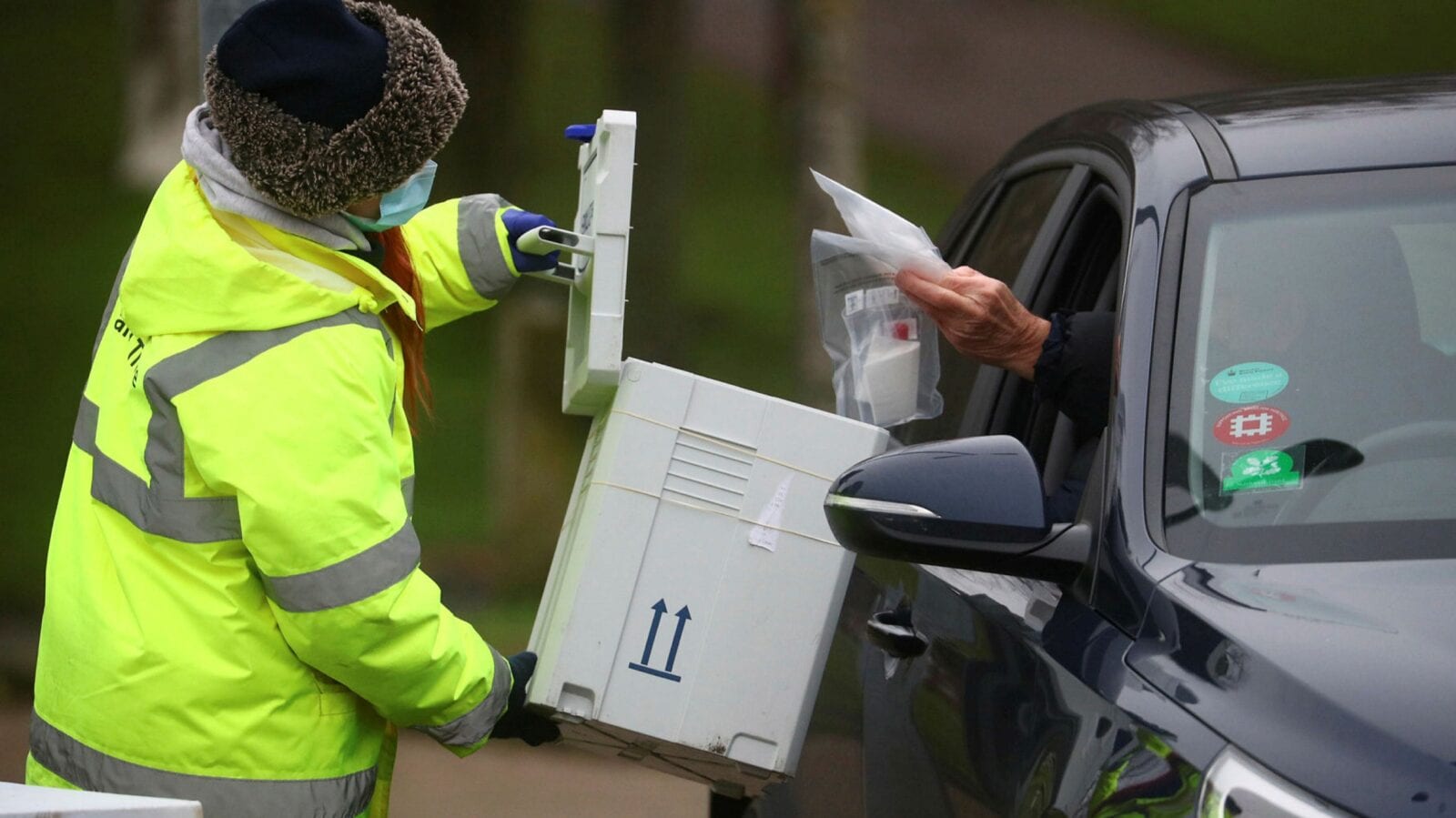
Surge testing is to start in Manchester where a new Covid-19 variant has been found.
According to BBC North West, the testing will focus mainly in South Manchester where four cases of the Kent variant have found in two unconnected households.
The surge testing will begin tomorrow (Tues 9 Feb) in specific postcode areas (M14 4, M14 7, M15 5, M15 6, M16 7 and M16 8) with more than 10,000 tests set to be supplied to the community.
Additional testing sites will be set up in the area to enable everyone over the age of 16 who live, works, or studies in in the designated area to get a test as quickly as possible.
Surge testing is to start in Manchester where a new Covid-19 variant has been found. It focuses mainly in South Manchester in these postcode areas M14 4, M14 7, M15 5, M15 6, M16 7 and M16 8. pic.twitter.com/oKrRFDg6rc
In the coming days, volunteers will also begin knocking on people’s doors to offer alternative testing for anyone who can’t get out to a testing site, and testing will also be made available for people who work but don’t necessarily live in the area.
ADVERTISEMENT
David Regan, Director of Public Health, Manchester City Council, said: “We all know that the virus will change over time and it’s important that we investigate new strains to understand how they might spread. This is exactly what we’re doing with the intensive testing in parts of Manchester with local testing units and people going door-to-door to offer people tests.
“There is no evidence that this variant will be resistant to the vaccines or causes a more severe illness, and it is not yet known if the strain can be passed more easily between people. But it is really important that everyone who lives in the boundary area and is over the age of 16 plays their part and gets a test.
ADVERTISEMENT
“The best thing we can all do it to keep following the rules – Hands, Face, Space – get a test if you have symptoms, and keep your vaccination appointment when you are called.”
Cllr Bev Craig, Manchester City Council’s executive member for adult health and well-being, said: “It’s understandable that some residents in the area may be concerned by all this, but we need to remember that it’s very normal for viruses to mutate. The important thing is that this mutation has been identified and that we’re taking action to stop its spread.
“We are following the public health approach to react to the new variant and we will be working with community groups, local champions, MPs and councillors to ensure as many people as possible know how to get a test so we can understand more about this version of the virus.
ADVERTISEMENT
“There are no changes to the restrictions in Manchester and if you do have to go out for one of the permitted reasons, please make sure you carry on following the rules on social distancing, and wearing a face covering, as well as washing your hands regularly.”
If you live in any of the aforementioned post code areas, please check the Council’s website.
News
NHS to begin offering new one-minute jab to women with ‘aggressive’ form of cancer
Emily Sergeant
The NHS is set to begin offering new immunotherapy for hundreds of women with aggressive cervical cancer across the country.
Pembrolizumab – which experts have described as being able to ‘take the handbrake off’ the body’s immune system to target cancer – will now be presented as a new treatment option for women in England with locally-advanced cervical cancer, which means the cancer has grown beyond the cervix to regions such as the pelvic wall, but not yet spread further around the body.
Trials found that adding pembrolizumab to standard chemoradiotherapy helped keep cancer ‘at bay’ for longer, and improved survival rates overall.
Two years after starting the treatment, nearly seven in 10 patients (68%) were still living without their cancer progressing, compared with 57% for those receiving chemoradiotherapy alone, according to NHS figures.
The trial also found that 82.6% of patients were still alive three years after treatment with pembrolizumab and chemoradiotherapy, compared with 74.8% with chemoradiotherapy alone.
Hundreds of women with aggressive cervical cancer are to be offered a new immunotherapy treatment.
It marks one of the biggest improvements in treatment for the disease in years, and could help more women survive and stay cancer-free in the long term.
The drug is either given every three or siz weeks via an infusion, or as a ‘one-minute’ injection, alongside chemoradiotherapy.
The NHS estimates around 550 patients in England will be eligible for the treatment – which has been approved this week by the National Institute for Health and Care Excellence (NICE) – over the next two years.
Patients will now receive fast-tracked access, funded by NHS England’s Cancer Drugs Fund.
“This is great news for women facing a diagnosis of aggressive cervical cancer, and represents one of the biggest improvements in treatment for this disease in recent years,” commented Professor Peter Johnson, who is the NHS National Clinical Director for Cancer.
“Combining this immunotherapy with existing treatment has had very positive effect for patients in trials, helping the body’s immune system to target cancer more effectively.
“We’re delighted it will be available for patients on the NHS as it could help hundreds more women survive and stay cancer-free in the long-term.”
Featured Image – NappyStudio (via Unsplash)
News
Andy Burnham wants to bring the ‘Greater Manchester way’ to Westminster
Emily Sergeant
Andy Burnham has set out his vision for the country if he is to become Prime Minister.
In case you need brining up to speed first, after it was announced earlier this month that Andy Burnham had clinched the victory in the crucial Makerfield by-election, winning 24,927 votes (54.8% vote share) and a majority of 9,231, he then went onto announce his intention to run for Labour Party leader, and therefore Prime Minister, after Keir Starmer confirmed he would be stepping down.
And this week, Mr Burnham has now delivered his first speech as part of his ongoing campaign, addressing how he plans to give the country a ‘new direction’.
Burnham says that he wants to bring the ‘Greater Manchester way’ to Westminster.
A lot has been discussed and reported on when it comes to Burnham’s intentions to create a so-called Number 10 North here in Manchester, but what exactly does it mean to take the ‘Greater Manchester way’ to the capital?
“The Greater Manchester way is based on strong partnership between all sectors: public, private, community, voluntary, academic, faith, and our trade unions,” Burnham said in his speech.
He continued: “When I started as Mayor in 2017, we set about building a new approach, a new politics based on the exact opposite of the Westminster approach.
“Place-first, not party-first. Problem-solving, not point-scoring. Long-term, not short-term.
“A decade on, it’s incredible how much we’ve been able to achieve by working together instead of fighting against one another.”
Burnham said he feels the truth is that the country spends ‘too much time arguing and not enough time doing’ and that for Britain to get back where it ‘should be’, his Government would ask everyone to ‘face the same way’ and then ‘pull in that same direction together’.
He declared that No 10 North will be the ‘nerve centre’ for a rewired Britain.
“It will be the conduit through which we redistribute power and resources across the UK,” he concluded. “It will coordinate all parts of Government, at national and local level, to agree a long-term economic strategy and help all places set new growth ambitions.”