Travel warnings have been issued as millions of people prepare to journey across the UK this bank holiday weekend.
With the three-day weekend upon us, and people nationwide preparing to make the journey to visit family or friends on their extra day off work or school, the RAC has now issued one of its annual travel warnings – anticipating that 18 million people could be hitting the roads from this Friday evening onwards.
It’s all according to a new study of drivers’ late May bank holiday getaway plans carried out by the RAC and traffic analytics specialists INRIX.
There’s warnings of a potential ‘double dose of delays’ on Friday 23 and Saturday 24 May when the highest number of leisure trips are projected to be made by car – a total of 3.4 million on both days, respectively.
That figure drops slightly to 2.7 million on Sunday 25, before 3 million hit the roads on bank holiday Monday (26 May) for the start of half term.
ADVERTISEMENT
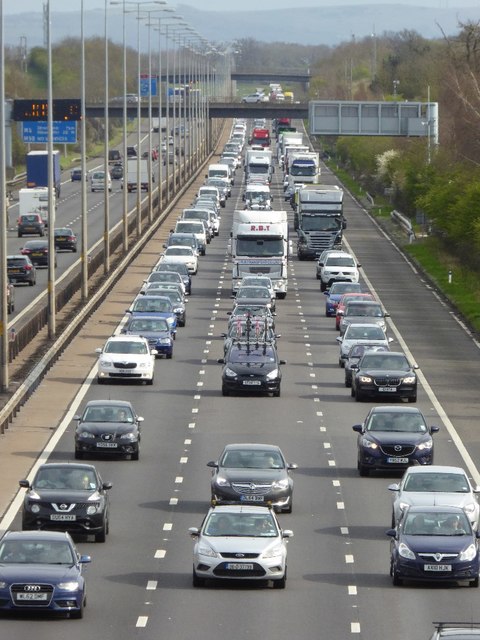
18 million people are expected to hit the roads over the bank holiday weekend / Credit: Geograph | Pxfuel
To make matters even worse, an additional 5.4 million getaway journeys may take place at some point throughout the bank holiday weekend too, but at this point, drivers planning these trips are still unsure exactly when they’ll travel.
With most getaway trips due to begin before lunchtime, the research suggests the best times to hit the road will either be very early in the morning or later into the evening – with the majority (68%) of drivers saying they’ll be heading off at some point between 5am and 12pm, 14% planning to leave between 5am and 8am, nearly a third (30%) intending to travel mid-morning between 8am and 10am, and a further quarter (24%) setting off later between 10am and 12pm.
ADVERTISEMENT
Traffic is expected to ease off rather significantly later in the day though, so if you are in a position to leave your journeys until the evening, then the RAC is advising that you take that option, as apparently on 3% of motorists say they are planning to do that so far.
“Our research shows it really is best to leave as early or late as possible this bank holiday weekend, as the majority of motorists are planning to set off in the morning,” commented RAC Mobile Mechanic, Aaron Bryan, ahead of the bank holiday weekend.
Shaun Jones, AA Patrol of the Year, also added on a similar note: “With the upcoming bank holiday, we anticipate a significant increase in traffic.
ADVERTISEMENT
“We advise all drivers to plan their journeys in advance and stay updated with congestion and roadworks.”
Featured Image – Geograph
News
New measures announced to tackle ‘rogue’ landlords across Greater Manchester
Emily Sergeant
A cohort of trained enforcement officers are set to hit the streets in all 10 boroughs to help improve the lives of the region’s renters.
Forming part of Greater Manchester‘s commitment to the highest-quality housing standards alongside the Good Landlord Charter, the newly trained enforcement officers will be tasked with protecting tenants, joining Council teams in checking rental properties, bringing enforcement action against bad landlords, and cracking down on illegal practices.
The introduction of the new enforcement officers comes after what has been ‘years of sustained pressure’ on local budgets.
Greater Manchester Combined Authority (GMCA) says it is working with the 10 councils across the region to strengthen local teams, rebuild in-house skills and expertise, and ensure that powers can be applied with consistency in all boroughs.
As mentioned, this all forms part of the Good Landlord Charter – which is GMCA’s ‘bold approach’ to drive up standards for renters across the region.
Landlords of more than half of rented properties in Greater Manchester have now signed up as supporters of the Charter, and as supporters, they have committed to going above and beyond legal minimums to improve the renting experience for hundreds of thousands of people.
“A safe place to call home is the cornerstone of a happy, healthy life,” explained Mayor Bev Craig. “But for years, people have felt trapped in poor-quality housing, and cash-strapped councils were unable to step in to help. I’m putting an end to that.
“We know there are plenty of good landlords in Greater Manchester, and many of them have already signed up to our Good Landlord Charter, but too many are just not good enough.
“That’s why we’re deploying a new generation of expert housing officers onto the streets of our towns and cities.”
Mayor Bev Craig declared that she ‘won’t stand by and let rogue landlords take advantage of people’.
She continued: “By empowering renters, working with responsible landlords, and using our powers to crack down on the bad ones, I will make sure everyone in Greater Manchester has the foundation for a good life.”
Featured Image – Benjamin Elliott (via Unsplash)
News
One million UK adults who have never smoked before are now vaping, new stats reveal
Emily Sergeant
More than a million UK adults who claim to have never smoked cigarettes are now vaping.
According to alarming new data from the Office for National Statistics (ONS), relating to people aged 16 and over, around 2.8 million men (11.3%) and 2.1 million women (8.2%) are thought to be smokers in the UK… but more than a million people, who have never smoked before, have now made the decision to start vaping instead.
People in the 25 to 34 age group were found to be the most likely to vape, according to the data, overtaking those aged 16 to 24, as it was the only age group to see a rise in e-cigarette usage.
Daily or occasional vaping is still higher than the proportion of people smoking cigarettes too, the ONS revealed, at 5.4 million, or 9.9%, versus 4.8 million (8.7%).
One million UK adults who have never smoked are now vaping / Credit: Lil Artsy (via Pexels) | Pxhere
“Fewer than one in 10 adults now smoke,” commented David Mais, from the ONS.
“This is the lowest proportion on record and continues the long-term decline in smoking. [But] at the same time, e-cigarette use remains more common than smoking and has followed an overall upward trend since 2020.
“E-cigarette users are also getting older, with those aged 25 to 34 now overtaking 16 to 24-year-olds as the age group most likely to use them.

 Emily Sergeant -
22nd May 2025
Emily Sergeant -
22nd May 2025