Every city has something to be proud of, and Manchester has a lot.
It might be a city with “so much to answer for”, as the famous quote goes, but with a history that’s as rich, vibrant, and culturally diverse as Manchester’s, we’re happy to answer for it.
From iconic music and sporting achievements, to groundbreaking inventions, political movements, world firsts, and so much more, there’s no end to list of things that Manchester has gifted the world over the years, and we should have no shame in shouting about them from the rooftops with pride.
But are we forgetting something here? Is there something missing from that list?
Oh yeah, there’s also Vimto.
ADVERTISEMENT
Vimto is a much-loved Manchester-born soft drink that contains the juice of grapes, raspberries and blackcurrants – each in a 3% concentration – which is then flavoured with a selection of delicately-balanced herbs and spices.
It was created in 1908 at 19 Granby Row in Manchester city centre – now part of The University of Manchester’s grounds – by John Noel Nichols, who was a wholesaler of herbs, spices and medicines that saw the market opening for soft drinks, due to the temperance movement and the passage of the 1908 Licensing Act.
ADVERTISEMENT
It was originally sold under the name Vim Tonic, which Nichols shortened to Vimto in 1912.
It’s hard to believe it now, but Vimto was originally registered as a health tonic or medicine when it was first created, but was then re-registered as a cordial in 1913.
Credit: Wikimedia Commons
It enjoyed so much success during the initial years following its creation that in 1910, because the Granby Row premises had become too small, Vimto production moved to a warehouse at Chapel Street, Salford, then to Old Trafford (1927), and finally to a state-of-the-art plant in Wythenshawe in 1970.
ADVERTISEMENT
As well as its continued popularity throughout the 20th and 21st centrury, Vimto has even taken on a life of its own as a flavour too in more recent years, meaning that as well as being able to pop to your local shop or supermarket to buy some Vimto cordial, a bottle of still Vimto, a can of the fizzy kind from the chippy on a Friday, or even a Vimto slushie, you can now also buy some Vimto bon bons, Vimto ice lollies, candy sprays, chewy bars, and a cheeky Vimto cocktail to go along with it – although the latter doesn’t actually contain Vimto, it has to be said.
There’s even a Vimto Remix range too, boasting some other unique flavour combinations like Mango, Strawberry & Pineapple, and Raspberry, Orange & Passion Fruit, so it’s really come a long way from its origins.
And yes, we know it’s not for everyone.
Someone once pointed out that its name is an acronym for vomit, which you can make of that what you will, and it’s also certainly got its fair share of competitors on the market too, but there’s no denying it’s a drink that’s loved round these parts.
To cut a long story short, Manchester is pretty proud of Vimto.
ADVERTISEMENT
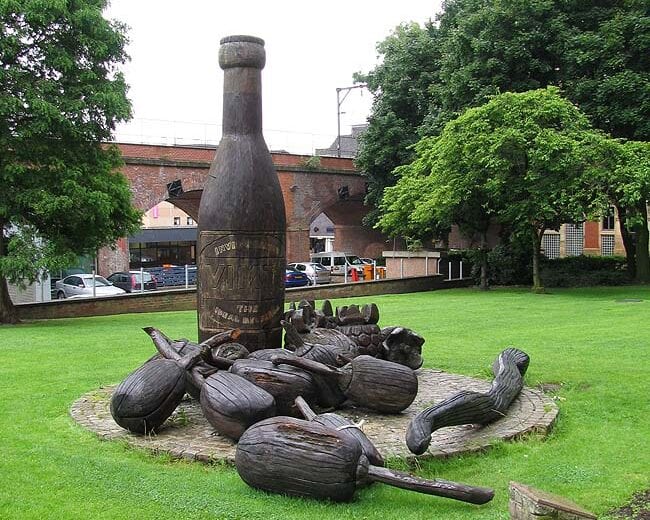
So proud in fact, that we decided to dedicate a monument especially to it, and stick it pride of place in the heart of the city centre, on the very spot that it was created.
Credit: Manchester History
The sculpture is aptly entitled A Monument to Vimto.
The giant wooden bottle and berries was first commissioned by J.N. Nichols plc, and carved by environmental artist Kerry Morrison out of an oak tree from a sustainable forest, before being successfully installed in Granby Row in 1992.
And we’re not kidding either, the monument now stands proudly at the site of the original factory where the first batch of Vimto was ever made.
After 19 years of the typical Manchester weather taking its toll, and plenty of attention from city revellers, the monument was ready for a refresh, and was thus “brought back to its former glory” in 2011 with a much-needed makeover.
ADVERTISEMENT
The grapes and raspberries were restored – with the grapes changing from red to green to reflect the ingredients of Vimto – the blackcurrants were replaced entirely, a new wooden barrel was constructed to replace the bottom of the Vimto bottle, and new labels were carved and painted.
As bizarre as it may be, and despite the many heads it’s turned over the years, Manchester is as proud of the Vimto monument as we are the drink itself.
And we would’t have it any other way.
Featured Image – Flickr
Trending
Two North West cities named among the ‘noisiest’ in the UK – including Manchester
Emily Sergeant
A new analysis has revealed a list of the noisiest cities in the UK, and two Greater Manchester locations are in the top five.
From blaring sirens and car horns, to house parties, barking dogs, and loud neighbours, escaping the noise of a city can feel almost impossible – even in your own home.
No matter whether you live in the hustle and bustle, or you’re out in the sleepier suburbs, noise can keep you up at night, disturb your peace, and lead to frustration. But just how loud are Greater Manchester’s cities compared to the rest of the UK? In a bid to get to the bottom of it, Alpine Hearing Protection has done some research to compile a top 10 list.
And both Salford and Manchester have found themselves not just within the top 10, but within the top five… and to make matters worse, Salford has actually claimed the number one spot.
The reason Salford has found itself at the top of the list, according to the research, is because it sits at the intersection of several major transport and urban hubs, with major motorways running through or around the city including the M60, M61, and M62.
Major rail routes also run through the city – including via Salford Crescent – which sees 16 million passengers every year, and also leads to Manchester Airport.
Top 10 noisiest cities in the UK
Salford
Portsmouth
Manchester
Southampton
London
Leeds
Stoke-on-Trent
Wakefield
Newcastle upon Tyne
Bradford
Parts of Salford are also very built-up, making pockets of the city noisy – especially in the concentrated centre where traffic, construction, nightlife and commercial activity get loud.
And of course, like any growing city, construction noises have been noted as ‘particularly bothersome’ for residents where major developments are springing up.
Manchester is third on the list of noisiest cities, due to many of the same reasons as Salford.
But the difference being that Mancunians are noted as one of the many reasons why the city is so loud – with residents making 5,301 noise complaints across Manchester between January 2024 and January 2025, and Hulme identified the loudest area with 304 complaints.
As well all know, Manchester is also home to many universities, which brings an active nightlife scene to the region, especially in the city centre, and in recent FOI data, it was revealed that the University of Manchester saw 2,049 noise complaints in the last five years.
Motorists warned of common winter driving habit that could land them with annoying fines
Emily Sergeant
With the temperatures drastically dropping now as we head into winter, motorists are being warned against a common driving habit.
On a wintry morning when the windscreens are frozen and your hands are equally as frozen too, it’s pretty common for drivers to start the engine, turn the heater right up, and remain stationary for several minutes to warm the car up before setting off on their journey… but did you know that doing this could see you, inadvertently, fall foul of the law?
That’s right – as ridiculous as it sounds, leaving your car engine running ‘unnecessarily’ while parked on a public road is illegal.
And to make matters worse, the rules on ‘engine idling’, as it’s known, apply regardless of whether the driver is using the heating, waiting for someone, or simply sitting in the vehicle.
Known as a stationary idling offence, Rule 123 of the Highway Code states that drivers must not leave a vehicle’s engine running unnecessarily while it is stationary on a public road, and according to the rule, a fixed penalty of up to £80 can be issued, right there and then.
Motorists are being warned of a common winter driving habit that could land them with annoying fines / Credit: PickPik | Wikimedia Commons
Fines will only be handed out if a motorist is stopped by a police officer who asks them to switch the engine off, and they fail to comply.
“However tempting it might be to sit in a vehicle with the engine running and the heater on to warm up, we strongly advice against it,” commented RAC senior policy officer Rod Dennis.
“As well as polluting the air and wasting fuel, drivers who leave their engines idling unnecessarily on a public road also risk an on-the-spot fine of £80. On cold mornings, the best approach is to clear any ice or snow properly and ensure windows are fully de-misted before setting off, then get on your way and let the car warm you up.”
There are some exceptions to the rule, however, as keeping the engine running is permitted in certain circumstances.
This includes when a vehicle is stationary because of traffic conditions, when the engine needs to run so a mechanical fault can be investigated, or if certain work is being carried out on the side of the road.

 Emily Sergeant -
4th November 2021