The incredible history of Manchester Pride (and how far it’s come)
From police raiding the village bars for 'licentious dancing' in the 80s to the famous footloose policewoman filmed on the parade in 2015, Manchester Pride has come a long way indeed.
Manchester Pride is today one of the biggest LGBTQ+ events in the country, bringing thousands into the city every year to celebrate love in all its forms.
Over decades, the festival has grown into one of the longest-running Pride celebrations in the country – expanding massively over the years, whilst doing its bit to raise awareness, acceptance, and huge sums of money for important charitable causes.
But it wasn’t always like this. Rather, when it began life in 1985 as the Gay Pub and Club Olympics, organisers had to deal with a lot of hostility from both the police and the public simply to put on some fun events like .boat racing down the canal, tugs of war, and egg and spoon races judged by local drag queens.
At that time, there was still a lot of institutionalised homophobia in Greater Manchester. Back then, the village was a secretive area that people visited covertly and most of the bars had blacked out windows so you couldn’t see in.
The community struggled with a lot of prejudice, as well as police raids to stop what was at that time termed as ‘licentious dancing.’
ADVERTISEMENT
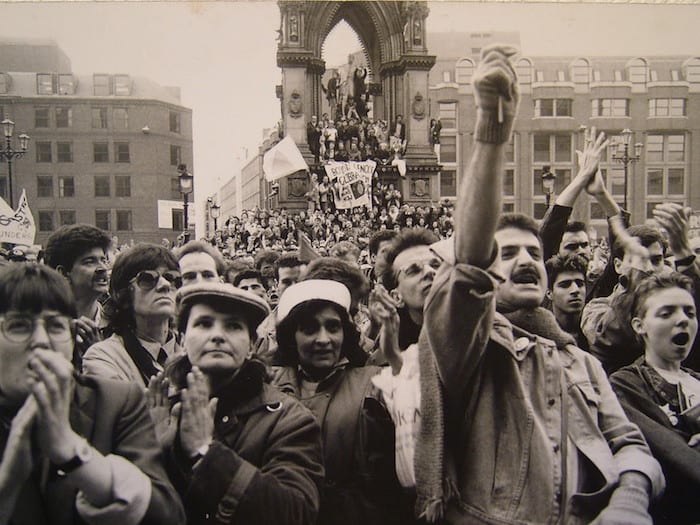
Albert Memorial rally, 1988. 20,000 people were in attendance / Image: Manchester City Council / Manchester Libraries
An except from Mancunian Gay magazine in 1984 titled ‘Not tonight, Anderton’ tells the story of how one night 20 plain clothes officers stormed into Napoleons and forced everyone in attendance to provide their personal information before being allowed to leave – an incident that was later branded as “an obvious case of police victimisation” in a press release issued by the Gay Centre.
In spite of this, the first Gay Pub and Club Olympics event still went ahead on the August Bank Holiday weekend of 1985. Notably, the event had the support of a new generation of Labour councillors elected in 1984 – who gave the gay community their support and appointed a Lesbian and Gay officer in a move reportedly inspired by Ken Livingstone.
ADVERTISEMENT
Inspired by Livingstone’s ‘s early days on the Greater London Council, in 1984 those new Labour councillors created an Equal Opportunities Committee and appointed Lesbian and Gay officers Maggie Turner and Paul Fairweather in what would prove to be a landmark move for gay rights in the north of England
1986 saw things gradually improve for the community, as councillors ‘put their arms around’ the gay community and gave it their support, welcoming a Northern Pride event in 1986 and contributing public funds towards the previous year’s celebrations.
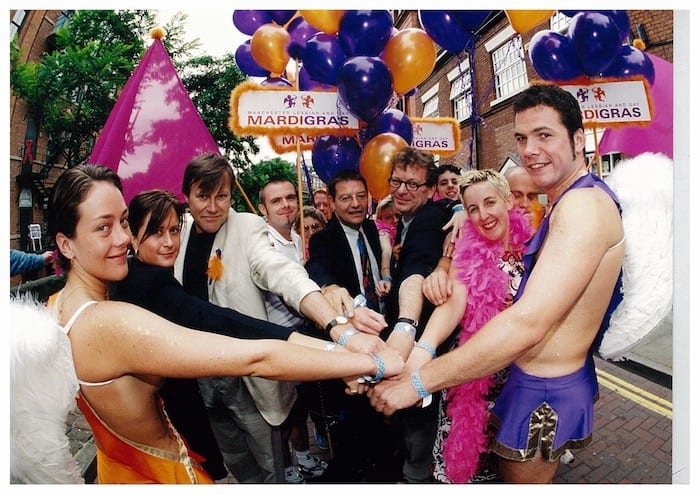
The late Tony Wilson is pictured here alongside Coronation Street’s David Neilson (Roy Cropper) and Councillor Pat Karney. / Image: Manchester City Council / Manchester Libraries
Paul Fairweather, Manchester’s first Gay officer, covered the 1985 event for Manchester magazine Mancunian Gay: That year, the council had donated £1,700 towards the event which was focused around fundraising for AIDS.
ADVERTISEMENT
“Some of the bars got together to raise money for AIDS organisations in the city. There was a lot of support from the gay community and a lot more hostility from people in the city.
“At the time it was a very small event but people really, really put their heart into it. I think underlying it was beginning of the AIDS epidemic – people were concerned about the future.”
As the ’80s continued, Manchester’s fight for gay rights continued with the Section 28 march in 1988 acting as a huge turning point as the Thatcher government’s draconian legislation brought people out onto the streets to protest in their droves.
At the time, Manchester was almost alone in voicing its opposition and those involved came under huge pressure both politically and through the media. However, the marches were huge in that for one of the very first times locals who weren’t part of the gay community joined in solidarity and allyship.
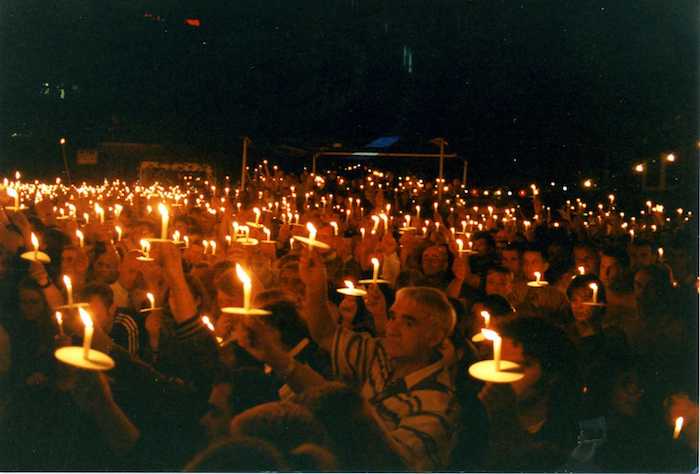
Although the exact date of this image is unknown, it depicts a familiar scene that takes place very year at Sackville Gardens and is one of the most poignant moments of the festival / Image: Manchester Council / Manchester Libraries
Ultimately, though, that protest put paid to the restrictive legislation, which had been introduced to explicitly discriminate against gay people and prevent them from discussing their sexuality with, say, teachers or social workers at the time.
ADVERTISEMENT
The march also did its bit to bring together different elements of the disparate tribes within the LGBT community, and the next year was followed by another event called Love Rights ’89 – which was billed as a “celebration of Lesbian and Gay Sexuality”.
Still, it wasn’t until the early nineties that the Gay Village welcomed its first openly-gay bar and even then police raids in the area continued right up to 1994.
The battles against institutional homophobia were still being fought, clearly, and some continued to call the Canal Street area ‘Satan’s Square Mile’ – but the opening of new nightclubs like Nightclub Cruz 101 and seminal events Electric Chair and Poptastic saw the community pushing back.
In 1991, the Village Charity was formed and the Manchester Mardi Gras, ‘The Festival of Fun’ was created – raising £15,000 that year alone.
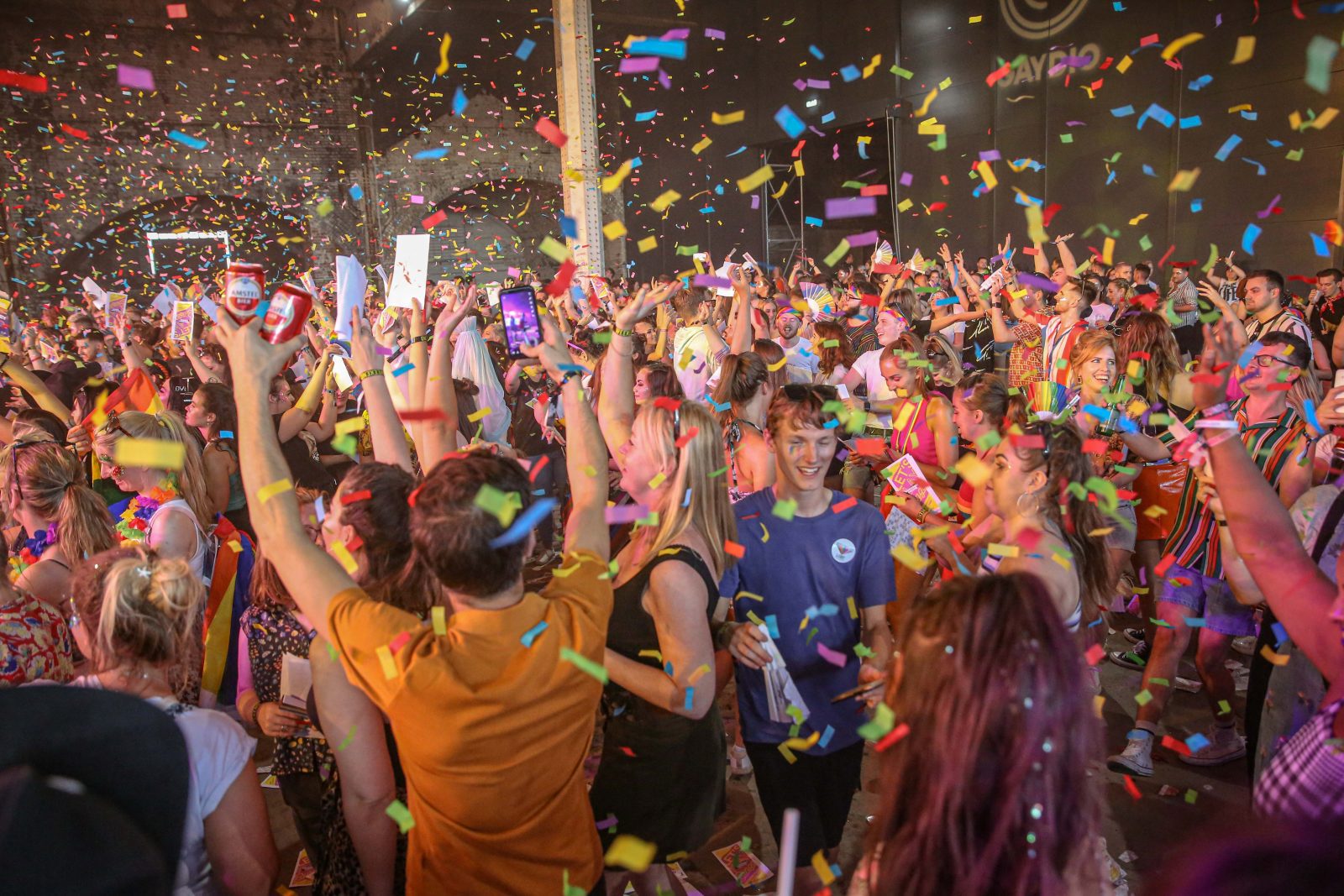
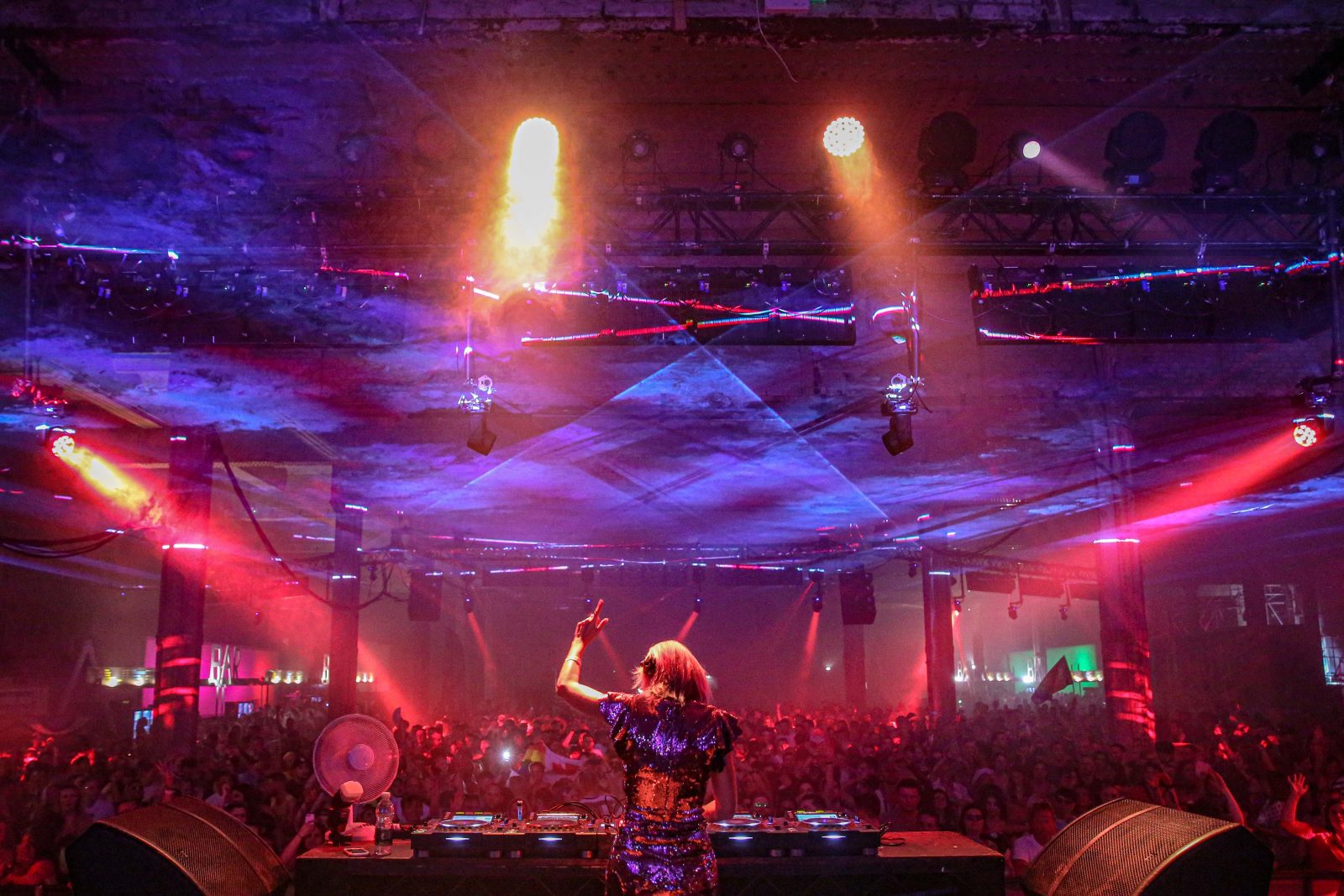
A more recent image from one of the legendary parties held inside a car park in the village / Image: Gpphotography / Manchester Pride Festival / Down At The Social PR
That year, there was a ‘street market’ in Sackville park (instead of on the road outside the Rembrandt Hotel) soundtracked by DJ Mike Coppoc, and a ‘It’s a knockout’ competition that was characterised by the wearing of some very tight cycling shorts – by all accounts ‘the thing’ to wear at the time.
ADVERTISEMENT
A heartfelt speech by Paul Orton of The Village Charity closed that year’s event on the Monday night, followed by a fireworks display which ended with “Manchester Cares” spelt out in the night sky.
In the years that followed, the free-to-attend event grew and grew, with stages erected in the public park and on the car parks every year. Then, in 1999, for the first time ever the Gay Village area was fenced off and what was then known as a “pledgeband” was introduced, with a commitment that 50% of proceeds raised would go to charity.
The decision to cordon off the village and charge an entry fee was contentious at the time, and is still considered to be so by some today – with some campaigners arguing that the wristband system prevents some members of the community from taking part by imposing financial restrictions.
In part because of this, some bars and clubs in the village still don’t require a wristband to gain entry to this day and the campaign group Facts About Manchester Pride have done quite a lot of work to suggest that there isn’t a basis in law to charge people access to the village over the Bank Holiday weekend.
Image: Gpphotography / / Manchester Pride Festival / Down At The Social PR
Despite the contention, though, for many the party was only becoming more popular. By the early 00’s the event was attracting more than 100,000 people a year.
ADVERTISEMENT
Renamed from Mardi Gras to Gayfest in 2001, the celebrations still didn’t officially become Manchester Pride until 2003, when the event was renamed once more – this time by Marketing Manchester.
In the years that followed, millions of pounds have been raised through the festival – which now has numerous different parts to it such as the Superbia Weekend, the Gay Village Party, Manchester Pride Parade (which is not taking place this year), Youth Pride MCR and the Candlelit Vigil.
It’s also continued to push the boundaries and campaign for equality, too. Manchester’s parade was the first in the UK to include services like the police, NHS and army amongst its floats – showing just how far things have come within the space of 20 years.
Remember the dancing footloose policewoman filmed on the parade in 2015? We can’t imagine that having happened without the progress of the past 20 odd years.
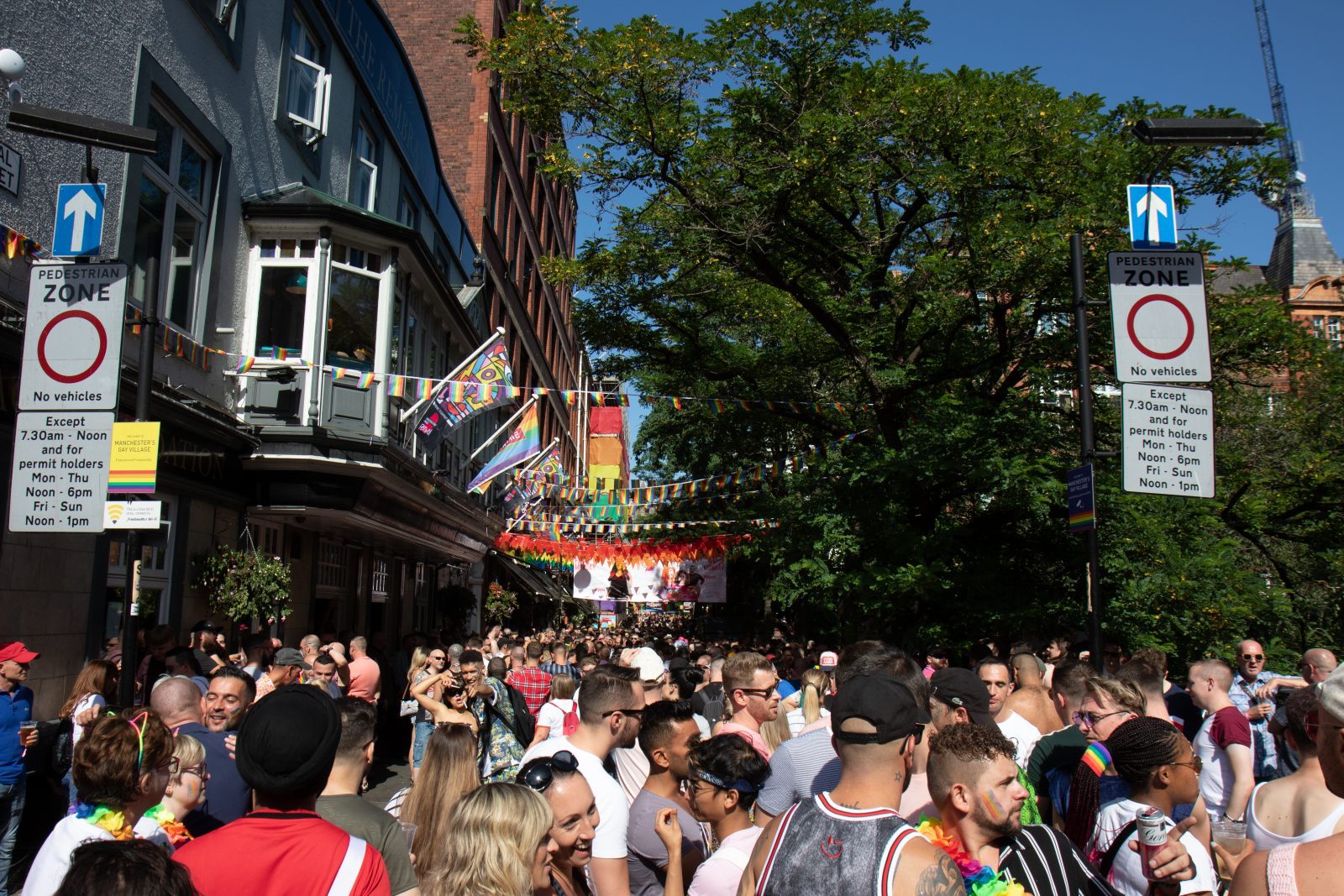
A familiar sight, this is how Canal Street looks today when the village party takes over for the four-day knees-up / Image: Manchester Pride Festival / Down At The Social PR
From what was essentially a jumble sale in the 80s to a world-recognised event, no matter what criticisms you may have of Manchester Pride it’s still fair to say that it has done a lot for promoting equality within the wider community. It’s also one of our favourite times of year.
ADVERTISEMENT
Of course, the work’s not done – in 2019, the festival’s Chief Executive went on record to say that “the fight has only just begun.”
“Every year I am asked do we still need a Pride celebration and every year I say yes we do.,” said Mark Fletcher.
“We must support every single member of every single LGBTQ+ community and fight until they feel equal and free to be themselves.”
These comments feel even more pertinent in 2023 after ‘anti-woke’ GMP Chief Constable Stephen Watson told officers they cannot decorate their uniforms with rainbow badges and patches this year – leading some to wonder if we’re going backwards, not forwards.
Manchester Pride Festival 2024 will take place between 23 and 26 August – you can find out more here.
Feature image – Manchester City Council / Manchester Libraries.
Feature
Meet Larishka – the DJ making her mark on Manchester’s Garage scene
Emily Johnson
It’s time to meet Larishka – Audio North’s Artist of the Month for October.
For Larishka, music has always been around her in some form. Growing up surrounded by classical and rock music, she never expected her route into electronic music to begin with a Parklife set from Carl Cox, before eventually becoming a DJ, promoter, and co-owner of Manchester’s Ghosts of Garage.
Today, she runs events, DJs across House, Garage and Bass, and is helping build a community around one of Manchester’s most exciting electronic music brands.
From promoter to DJ
Larishka actually started out as a promoter while doing an apprenticeship at a music booking agency. She always knew she wanted to work on the events side rather than bookings, but felt like she wasn’t going to make many connections within the industry while living in Oldham.
Her plan was to go to university to study music, with the hope of learning to produce while also moving into Manchester and making connections within the city’s music scene.
Quite quickly into her studies, she joined Ghosts of Garage. After about a year, she had something of a lightbulb moment.
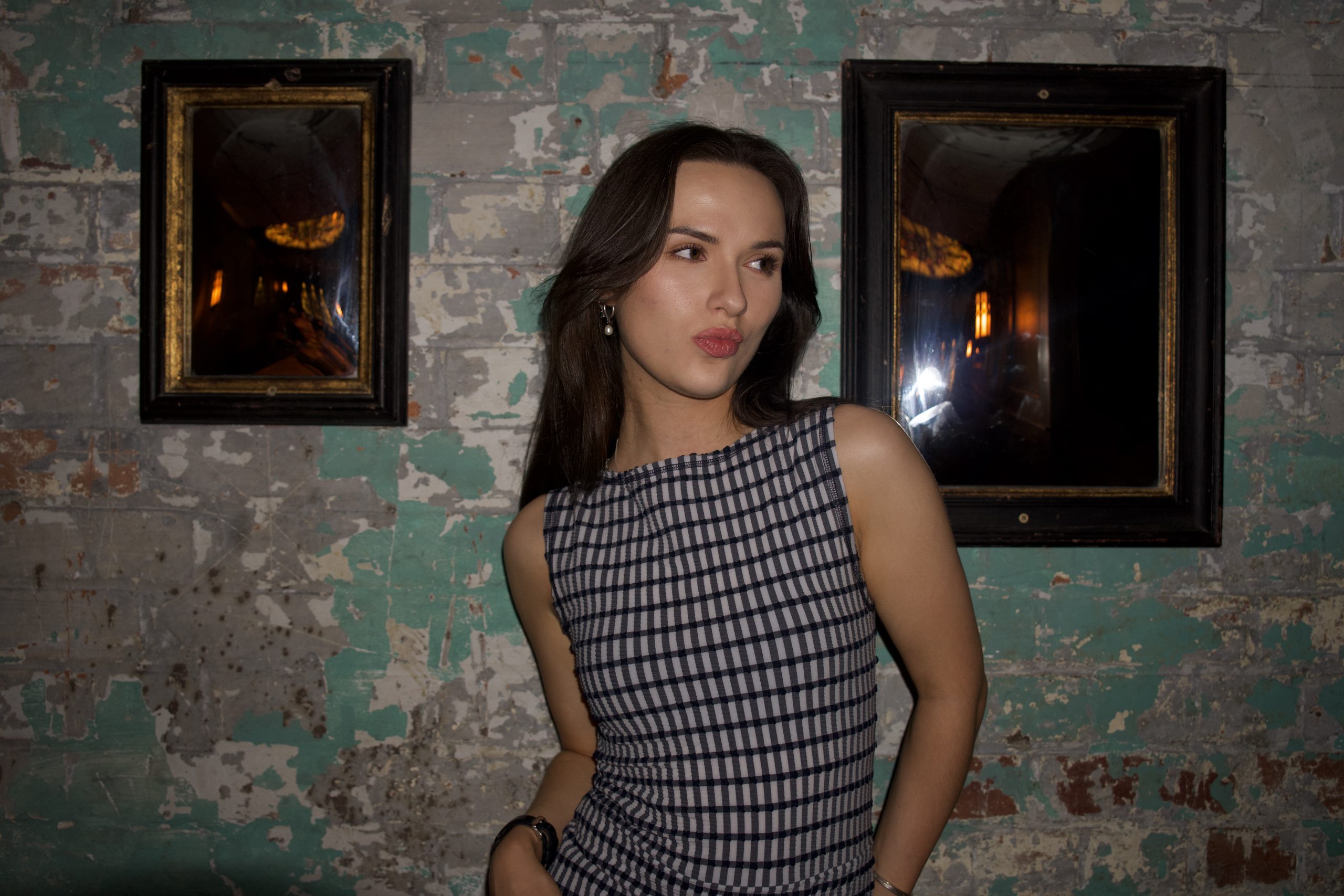
Meet Larishka, the DJ making her mark on Manchester’s Garage scene / Credit: Supplied
“I was studying music, I run my own nights, and I was always on the aux at house parties, so why have I not learned to DJ yet?” she explained.
That realisation came while she was sitting on MATTIK’s living room sofa, where she asked if he would teach her. Before long, she was calling him every day asking if they could go to the studio and practise mixing.
“I owe it to him really, he was a brilliant teacher.”
“I get it” – the Parklife moment that changed everything
Larishka’s introduction to electronic music wasn’t exactly the traditional one.
“I grew up on classical and rock music – my dad was a sound engineer in the 70s so that was his thing really, and my mum played the piano every single day so that’s what I was constantly around.”
She first heard house music when she was around 15 or 16, after a friend sent her a track they had found on SoundCloud.
“I listened to it out of my phone and didn’t really get it, it was too repetitive.”
A few years later, everything changed. After hearing Parklife from her window every year growing up, Larishka eventually went to the festival for the first time and watched Carl Cox close The Valley. He played ‘Finder’ by Ninetoes, and it was the first time she had experienced electronic music on a huge sound system.
“I remember being in absolute awe and turning to my friend and saying ‘I get it’ and from then, I was just absolutely hooked.”
It became a genuine turning point.
“I had my A Level exams that following week and when I was revising all I was listening to was house music and I remember my Dad coming in and saying ‘Is this you forever now?’ and I said ‘Yeah I think it is'”.
Larishka is Audio North’s Artist of the Month for October / Credit: Supplied
Why Manchester means so much
“I mean it’s home, and always has been.”
Having become part of the city’s music scene, she says she feels incredibly lucky to have found a community around her.
“There’s a certain camaraderie that exists here that I don’t know that you’d find anywhere else.”
For her, that sense of community is what makes Manchester’s music scene so special.
“Seeing people you know everywhere you go, you kinda feel like you’re never alone and that you’re actually part of something.”
That spirit extends beyond electronic music, too.
“And it’s not just in electronic music either, that spirit exists across all genres – Manchester music history is so rooted across such a broad spectrum of genres, and to see that still prevailing today is something we should all be proud of.”
Building Ghosts of Garage
It’s impossible to talk about Larishka’s journey without talking about Ghosts of Garage.
She’s a co-owner of the brand, having joined in 2021, and works across its marketing, bookings and creative direction alongside Rich Reason. For her, one of the biggest things that makes a Ghosts of Garage night stand out is its commitment to the music.
“The music and lineups truly never miss, which is a credit to Rich. The guy knows how to program a lineup.”
The team makes a conscious effort to champion new talent, often including at least one Manchester or UK debut on a lineup.
“A big part of each event is making them unique while keeping the brand consistent – each event has to have its own USP or else the nights get boring and people think they can just skip this one and go to the next and it’ll be the same.”
For Larishka, music has always been around her in some form / Credit: Supplied
Community is a huge part of the brand.
“We’re also big advocates of community and want to create the gap between audience and DJ as little as possible, so try to get the crowd involved as much as possible through things like our WhatsApp community.”
The aim is to make people feel like buying a ticket means becoming part of something bigger.
“We want people to feel like if you buy a ticket for our event, then you’ve unlocked a key to be part of something.”
Larishka’s advice for getting into Manchester’s music scene
For anyone hoping to break into Manchester’s music scene, Larishka’s advice is simple – go out.
“I’m way more likely to book you if we’ve met and we’ve had a good chat because it means I can put a face to a name and I know what you’re like.”
ADVERTISEMENT
For her, being part of the community is about more than simply sending messages and asking for opportunities.
“Being an active member of the community means you’re already part of the night, so booking you to DJ just makes you even more part of it than you already are, rather than someone I’ve never met before who’s in my DMs.”
Ultimately, it comes back to the same thing that has shaped so much of Larishka’s own journey – showing up, meeting people, and becoming part of something.
Featured Image – Supplied
Feature
Manchester’s first banana pudding bar has opened in the city centre
Clementine Hall
Make sure to save room for pudding…because one of the city’s most-talked about dessert brands has found a new home.
Buttercup launched last summer, creating little pots of the hit US dessert made famous by the iconic Magnolia Bakery.
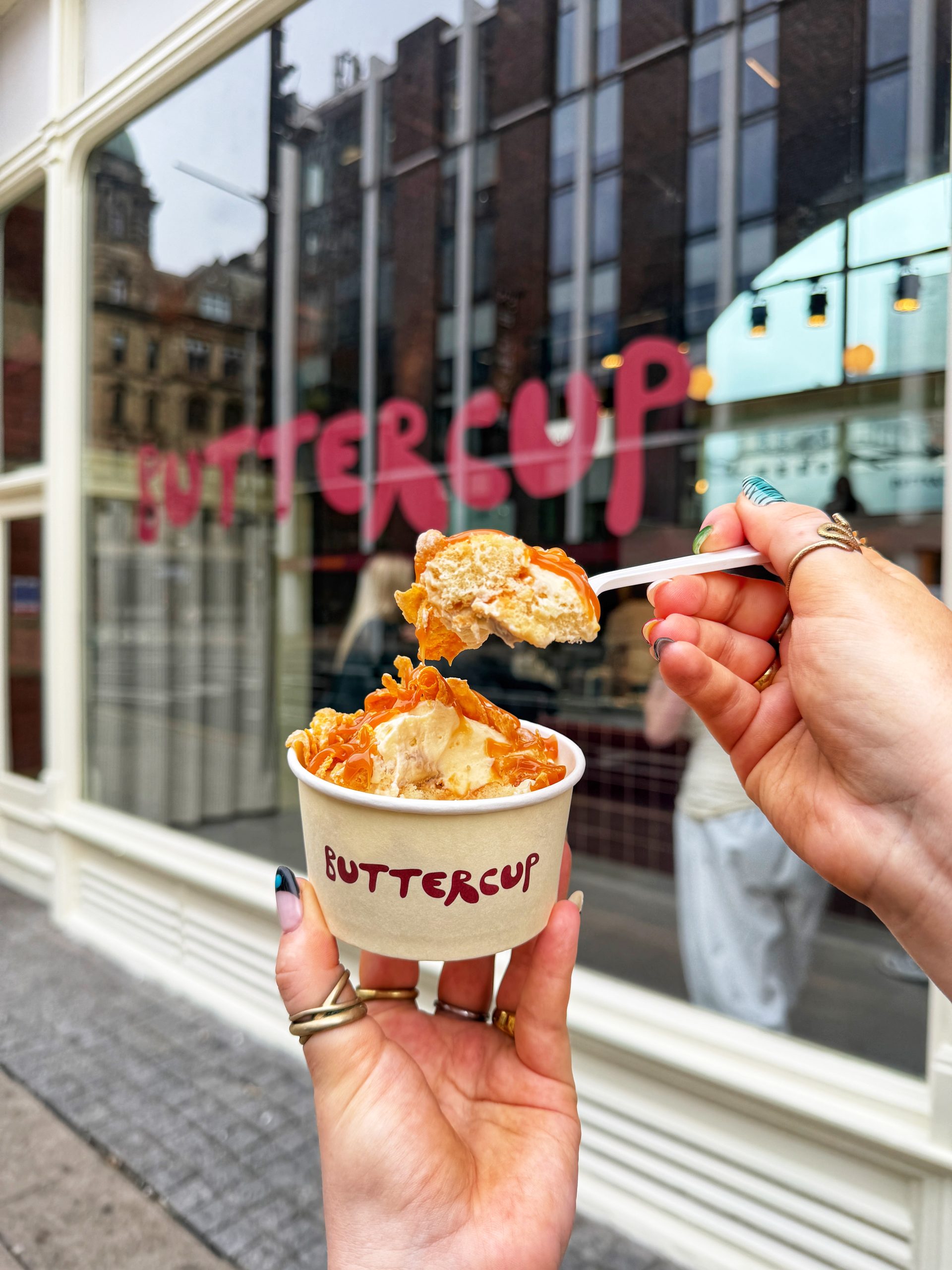
Each dessert features vanilla custard whipped with cream, soft sponge, and fresh banana, which you can then customise with rotating flavours and toppings.
And after a brief disappearance from the Manchester foodie scene, Buttercup is back with a bang with their beautiful new home on Deansgate.
Images: The Manc Group
And when we say beautiful, we really mean it.
Glossy burgundy tiles, butter yellow walls and sleek chrome furniture make up the space beneath the huge arched window, and there’s even a few seats for you to enjoy your pud and watch the world go by.
Open daily from 10am til 10pm, the menu includes three puddings on rotation ready to scoop.
Images: The Manc Group
Choose from the classic banana, indulgent tiramisu and an ever-changing seasonal special, alongside a wall of toppings for you to customise your own pud.
Each recipe has been perfected in-house and the proof really is in the banana pudding…because it tastes just as good as it looks.
Since launching, Buttercup has served around 50,000 puddings, hosted sell-out pop-ups across the city, collaborated with some huge brands, and built a loyal following around its signature build-your-own pudding bar.
Image: The Manc Group
With this new standalone space, you’ll of course be able to indulge in its signature banana pudding, as well as breakfast yoghurt bowls, coffee and matcha.
Officially opening tomorrow Saturday 26 September, the first 50 customers will get a free topping and sauce with the purchase of any pudding, plus a free lip gloss from Manchester-born beauty brand REFY.

 Georgina Pellant -
24th August 2023
Georgina Pellant -
24th August 2023