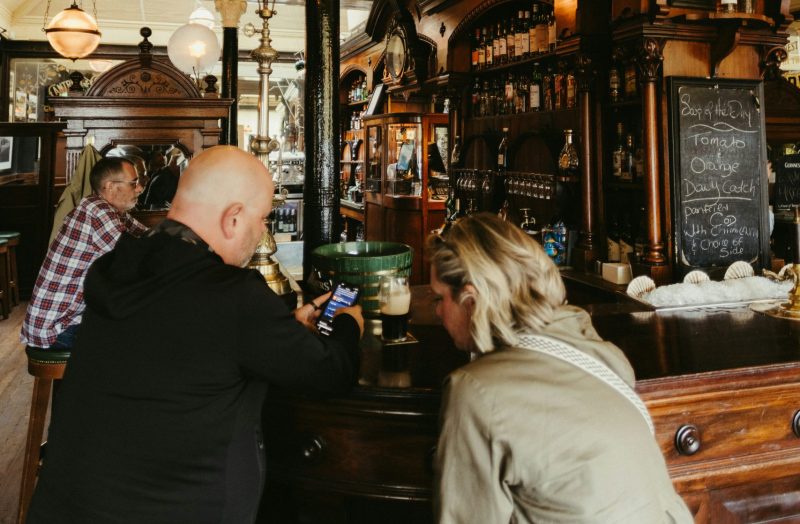
The tech company keeping Manchester in Sync for nearly 30 years
Over three decades, Sync has played a crucial role in nourishing a restlessly creative city - helping to cement Manchester’s reputation as an artistic hub.
‘Silver linings’ has become a popular topic since the pandemic swept Britain.
It’s human nature to find positives even in the most disastrous of situations. The ability to look on the bright side keeps people going even when times are tough… and few of us have experienced anything as tricky as the past 10 months.
The biggest silver lining for many during this period has been tech.
If a government-imposed stay at home order had to happen, at least it was in 2020 – an age where tech is so powerful and accessible, we’ve been able to stay in touch with loved ones, earn a wage from home, and fill any furlough time by streaming box sets.
Even 10 years ago, things would have been very different.
ADVERTISEMENT
Tech has been deemed so valuable, in fact, that some shops have been classified as ‘essential’; meaning they’ve been permitted to remain open through lockdowns to keep the country running.
One of those is right here in Manchester: Sync.
ADVERTISEMENT
Based on Deansgate in the city centre, Sync was born of GBM Digital, who themselves were part of a design and print house set up in Ardwick all the way back in 1992.
Over the subsequent three decades, the company has played a crucial role in nourishing a restlessly creative city – helping to cement Manchester’s reputation as an artistic hub.
Sync has been so impactful over the years, in fact, that the company has acquired ‘partnership status’ with the quartet of software juggernauts: Apple, Google, Microsoft and Adobe.
ADVERTISEMENT
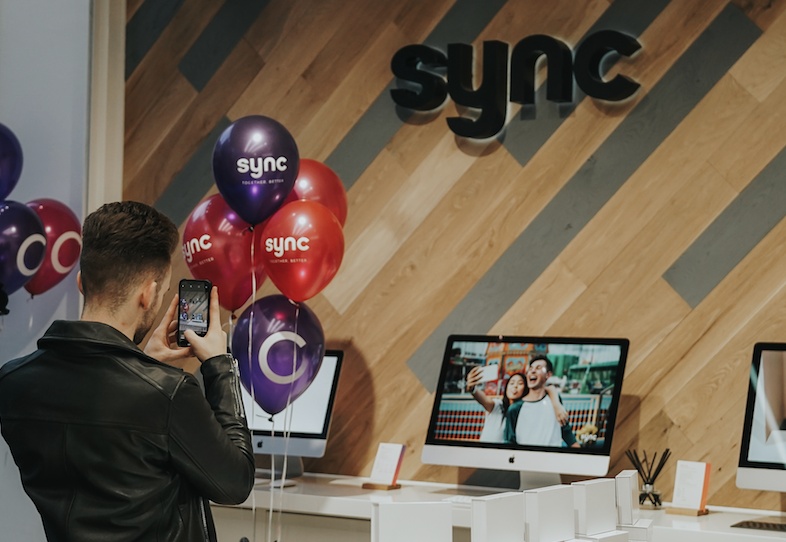
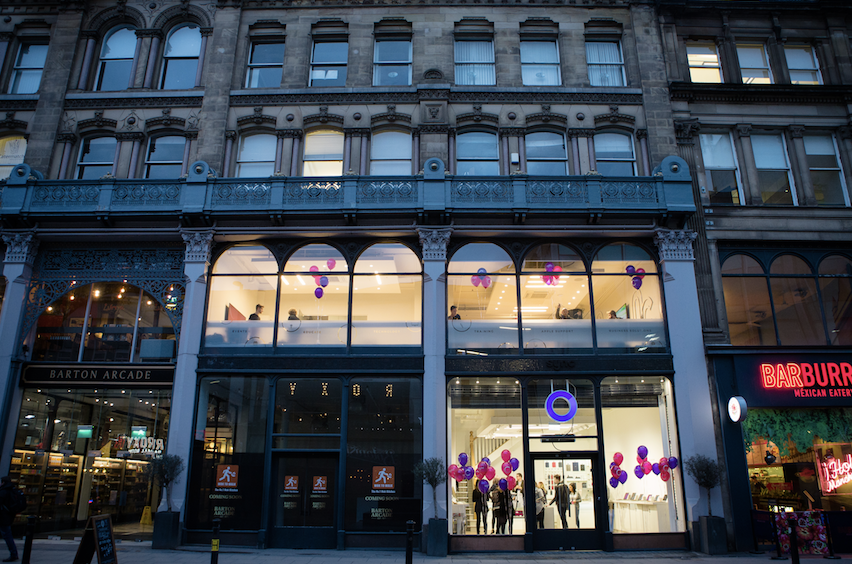
The business has teams across Britain, but the physical three-level Deansgate venue is considered something of a HQ – containing a tech shop, Apple service & repair centre, and a training and conference centre.
Throughout lockdown, Sync Deansgate remained a place where customers could get their Macs, iPads, iPhones, Watches and Beats under Apple warranty fixed – tracking the repairs every step of the way.
Booking slots are posted online – with customers sent specially-designed totes via a courier. People simply pop their device in the tote and the courier whisks it back – before delivering the fully-repaired product.
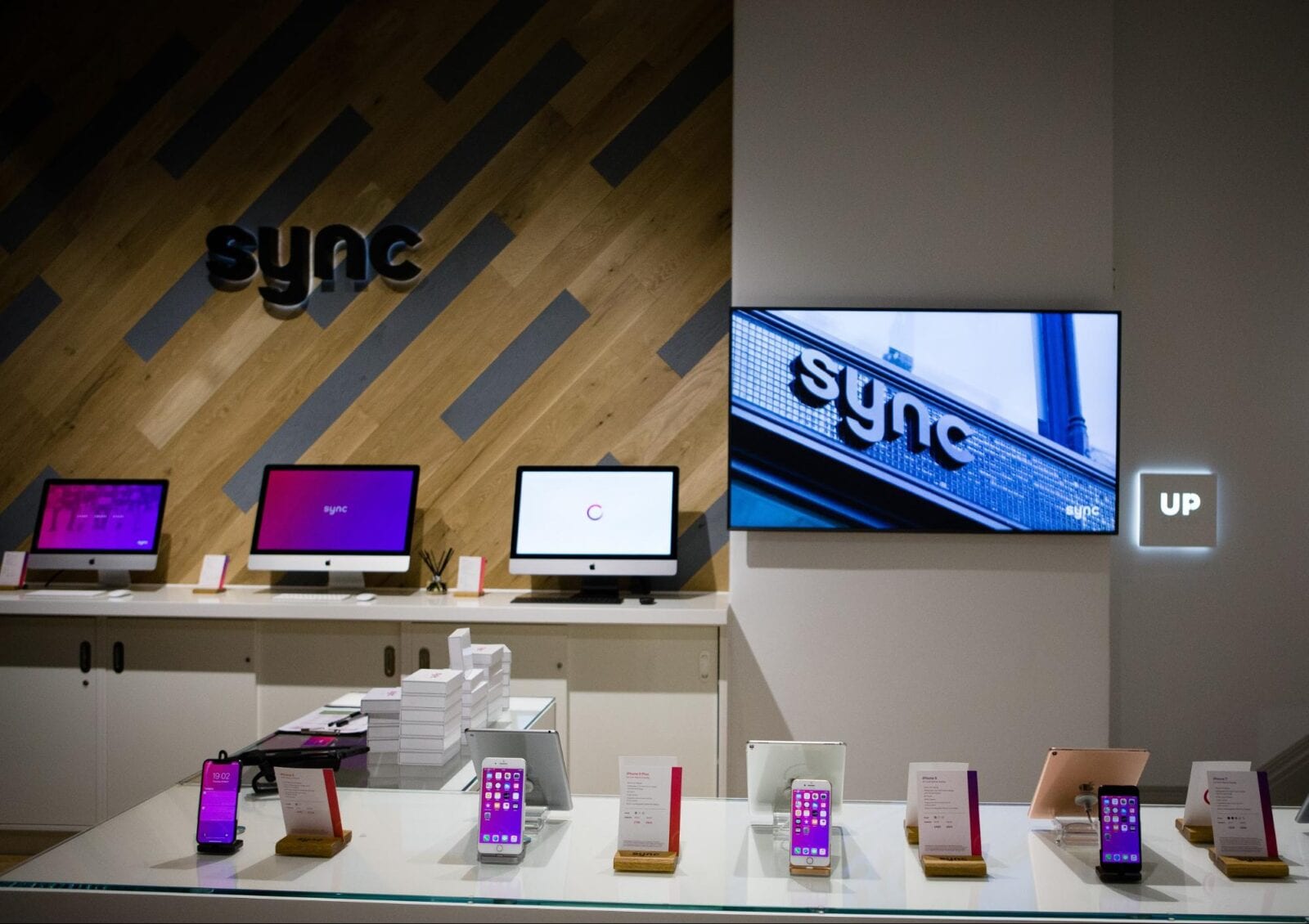
Sync has served as the city’s digital support network during this difficult period. But instead of simply providing emergency-style patch and fix work, the brand has also continued to raise the bar.
ADVERTISEMENT
For example, Klarna 0% finance has been made available for all Apple products from Sync (where baskets are under £1,000) – an offer unavailable anywhere else in the UK, let alone Manchester.
Sync is also the only company of its kind to provide full Mac configurators for schools and businesses – giving organisations the incredible power to build their own Mac for their own needs.
Staff are different, too – weighing with next-level aftercare for individuals and organisations.
Scott Bordoni, Head of Operations at Sync, described the company as a “tech business with heart”.
“Our goal is to inform and educate,” he explains.
ADVERTISEMENT
“Our teams practice a consultancy-first approach, utilising their technical expertise and industry knowledge to address key challenges for our customers.”
Adil Ladha, Digital Marketing Specialist, says it’s this very ideology that has set Sync apart from its competitors.
So often, a business-customer relationship barely stretches beyond the point of sale. But at Sync, they see the transaction as just the beginning.
“For us it’s about the development of long-term relationships,” Adil states.
“We put time, effort and energy into supporting our customers – giving them the opportunity to upgrade and futureproof quickly and easily whenever they desire.”
ADVERTISEMENT
Alongside repairs, one of the most valuable services Sync continued to provide during lockdown was training sessions – which were shifted online.
Scott says: “Prior to the pandemic, our teams were working at national scale, running and supporting over 280 days of face-to-face training and informational events per annum – all at zero-cost, in order to support businesses and schools.
“As key workers, our national teams remained in operation throughout the first lockdown, supporting businesses, public sector organisations (including the NHS), and schools – helping to ensure that other businesses, organisations and key workers were able to continue through the crisis.”
Sync delivered an astonishing 110 free skills-based training sessions to businesses and key workers during the first portion of the pandemic – all-the-while remaining on hand to keep IT systems fully functional.
Siding with the big boys has helped, of course.
ADVERTISEMENT
Sync’s direct line to Apple means that customers get the creme-de-la-creme of tech services, supported by the kind of insight and knowledge that you’d find at the Genius Bar.
Being closely allied with Apple on this many fronts looks impressive on paper. But it’s even more applause-worthy when you realise what’s required to get on the team.
Getting accredited by Apple doesn’t just involve firing off a charming email or launching a savvy piece of modern marketing that turns heads at Silicon Valley. Sync is tasked with repeatedly demonstrating the highest standards in knowledge and expertise – as well as frequently providing evidence of capability and performance.
It’s tough stuff, hitting such high standards day in, day out. But Sync staff appear to revel in the challenge.
ADVERTISEMENT
The brand boasts around 70 employees nationwide today – and some of them were at GBM when it launched 28 years ago.
The team have grown up together to build something quite special – and their reputation is spreading.
Scott adds: “Whilst the technology and deployment practices have updated through the years, our mission statement has continued to stay the same: Delivering customer-centric solutions via a consultancy-lead approach.”
The typically hectic stretch of tarmac on Deansgate has quietened down again in recent weeks due to Lockdown 2.0. But Sync is still operating.
The Barton Arcade site remains open for repairs by appointment only – with ‘collect and repair’ services available to anyone who can’t visit the store.
ADVERTISEMENT
Almost every single person in Manchester has relied on tech in some capacity to carry us through the toughest few months many of us can remember.
Teachers. Nurses. Office workers. Joe Public. We’ve managed to bear up and power through via laptop and phone screens.
Take tech out of the pandemic, and you’re left with a totally different picture – probably one with fewer businesses, isolated communities, and significantly lower morale.
Being in a digital era has at least offered something of a silver lining.
And it’s Sync that’s helped to keep that silver lining intact.
Business
The lost but still much-loved Greater Manchester food and drink spots that Mancs miss the most
Danny Jones
Unfortunately, these days, it feels as if we read about another place closing across the Manchester boroughs almost every week at this point – in fact, many of you might find out about those very closures right here on The Manc.
But, like anyone, we often just sit thinking back on some of our favourite bars, restaurants, takeaways and more that have sadly closed over the years.
10 of the most missed restaurants, bars, cafes and clubs in and around Manchester
1. Danish Food Centre
Starting off with the one we saw the most in the comments is the Danish Food Centre on the shopfront of the Royal Exchange on Cross Street, before sadly closing during the mid-1980s.
Exactly what it sounds like, this old Scandinavian spot first opened back in 1965 and was even known for a traditional sarnie known as ‘The Danwich’, as well as an interior lounge dubbed ‘Copenhagen Corner’.
That being said, many people used to nip here on their dinner break, to meet friends for lunch and a brew, or even to buy things to take home. It was eventually shut down by the Danish government, and we still envy those who got to experience it; still, without the original, we’d never have the likes of KRO Bar.
2. Horts/Ronnie’s Cafe Bar
Another one that popped up plenty in the long list of replies was Horts that used to sit on St. Ann’s Square and the attached Ronnie’s.
The former was more of a wine bar and the latter your standard cafe, but together, they were an ideal city centre favourite that served locals day and night.
By the late 80s, both had sadly disappeared, but people still reminisce about “the grand piano sat under a gorgeous glass dome” and how much they “loved the comfy leather Chesterfield sofas.”
Also up there in the trio of most-mentioned places below the post was the legendary Dutch Pancake House – no, not the one that rears its head at the Manchester Christmas, but at least you can still look forward to your annual fix.
The one we’re talking about was the busy corner of Elisabeth House (now 1 St Peter’s Square), which served a giant menu of sweet and savoury pancakes.
We lost it in the 2000s after developers bought the building, and lots of people are still angry about it.
Number four is Blinkers French and Bistro, which held that border between Salford and Manchester, and was owned by Cheshire-based millionaire, Selwyn Demmy.
The Wilmslow-born businessman may have been known for his famous ‘Hunter’s Moon’ in Wilmslow, but he was also the man behind the bar, restaurant and club which used to be on King Street West.
Before that, it was called the Le Phonographe, and it’s also not to be confused with the modern-day Blinker Bar now serving up top-notch cocktails over on Spring Gardens. By all accounts, it was a real ‘if you know, you know’ kind of gaff…
Next up is the old Grinch bar and grill, which used to be on Chapel Walks just off Cross St, and sadly closed back in 2016 after more than two decades.
More than a few Mancs said they “loved” either visiting and/or working here back in the day, and another cited that “their fried chicken was amazing”.
There’s plenty still open around there these days – including the likes of 10 Tib Lane, New Wave Ramen and the ever-reliable Town Hall Tavern – but evidently, there’s still plenty that really miss it. These days, it’s a pretty good Korean place called Annyeong.
6. Dry Bar/’Dry201′
This next one is a location that does still exist and is technically still a very busy bar most evenings, weekends and sunny afternoons if you can get a seat in the window.
However, many will argue that nothing quite compares to the old Dry Bar, a.k.a. Dry201/’FAC 201′, over in the Northern Quarter.
Nowadays, it’s home to the new and improved Freemount, which moved from its previous venue on Oldham Street; nevertheless, countless people still recall the watering hole in “the original format” as one of the best bars in town.
Their social presence still exists. (Credit: Dry Bar via Facebook)
7. UCP
One we’ve heard tales of now and again over the years, but still slightly wince whenever we hear the full name. In case you’re unaware, UCP is an abbreviation of United Cattle Products, which was the name of a company that had a big presence here in Greater Manchester.
To be fair, it was a pretty familiar brand across the region and the North as a whole, but their flagship four-storey shop over at Market Street/Pall Mall was the go-to place for lots of meat products.
We’ll say it, one of the main things people would go there to seek out was that word that still makes lots of people squirm: tripe – but remember, for generations this was a very common ingredient in various meals and for some, still is.
8. Croma
Ok, this one is more of a recent one that we’re sure lots of you still remember like it was yesterday, because in relative terms to most of this list, it kind of was.
Croma in Manchester city centre shut in 2022 after the pandemic, their Didsbury restaurant closed by March 2023, and the Chorlton site followed suit just last year.
However, we still maintain we’ve had some of our best pizza nights in these places.
For our/your penultimate pick, a fair few people noted Henry’s, which also lay claim to being Manchester’s ‘first’ cafe bar back in the day – that, of course, is still up for debate.
The group behind this brand opened up a venue in our city centre back in 1986, near Parsonage Gardens, but only made it to 2007 despite remaining fairly popular for a long time.
It went on to be replaced by another chain in Revolution; however, they are also closing locations all across the UK. Gutting.
It was arguably better known in London, such as in Mayfair. (Credit: Ewan Munro via Flickr)
10. Cornerhouse
Last but not least, the legacy of the Cornerhouse cinema needs no explanation, really, but there’s a lot to be said for the lasting love lots of people had for their memories made in there and the joint bar next door, quite literally spitting distance away.
Still sitting like a bittersweet reminder on the (you guessed it) corner leading up to Oxford Road Station and Whitworth Street, the theatre itself is home to little more than gig posters and an ever-changing rotation of murals these days.
However, you will be glad to know that the bar and visual arts centre across the road is still Manchester Metropolitan’s Arts, Culture and Media Hub, so it’s still alive in some fashion.
We (well, I*) couldn’t wrap up this round-up without paying tribute to one of the best places this city has ever seen, let alone just NQ.
It might not be right at the top of your dream revival list, but we’re sure plenty of you will agree that, for a period of time, CBR+B was the place to be.
Featured Images — The Manc Group/Dry Bar (via Facebook)
Business
The plans to build 107 new homes in Manchester city centre – including affordable housing
Daisy Jackson
A new community of homes – including affordable housing – is on the way to Manchester city centre.
Fresh new images have been unveiled of Ferrous, a brand-new 107-home rental scheme that will be built in Piccadilly East later this year.
The new development from Capital&Centric will include 15% affordable housing, as well as a new pocket park.
The new scheme is partly thanks to a £1.6m investment from the Greater Manchester Combined Authority, which will see a previously underused brownfield site regenerated.
The site near Manchester Piccadilly was previously owned by Transport for Greater Manchester.
Although the planning consent didn’t require an affordable housing, Capital&Centric has committed to delivering around 15% of the new homes as affordable.
Alongside the pocket park, there’ll be a small kiosk designed as a launchpad for an independent food or drink operator.
Piccadilly East was named by The Sunday Times as one of the UK’s most up-and-coming places to live, thanks to developments like Crusader Mill and Neptune Mill, plus the landmark ‘Jenga’ Leonardo Hotel.
Tom Wilmot, Joint Managing Director at Capital&Centric, said: “The GMCA funding is helping unlock new homes on a challenging city centre site while allowing us to deliver affordable homes as part of the scheme.
“We’ve also carved out space for greenery and an independent operator because small pockets of public space make a massive difference. In a post-industrial city you have to go big on planting. Kampus showed that and we want to create a mini version here.”
Construction on Ferrous is expected to start later this year with completion anticipated in 2028.