An amber health warning has been issued for the North West and other regions as temperatures continue to drop across the country.
Having already provided an update on the “possibility of snow” and the imminent cold snap earlier this week, the Met Office and UK Health Security Agency (UKHSA) have now added a heat-health warning to their forecast for the new few days as things get increasingly colder across Great Britain.
With temperatures expected to reach as low as -5C by Friday, 29 November, the Met Office and UKHSA pushed out an amber heat-health alert on Wednesday, with the elderly, clinically vulnerable and the health sector in general said to be those most at risk.
Although the freezing weather obviously has the potential to affect everyone — with the likes of the North East and Northern Ireland having already been given a yellow weather warning as well — amber heat-health warnings are deemed to require an ‘enhanced response‘ as they are likely to significantly impact “across the whole health service” and possibly other sectors too.
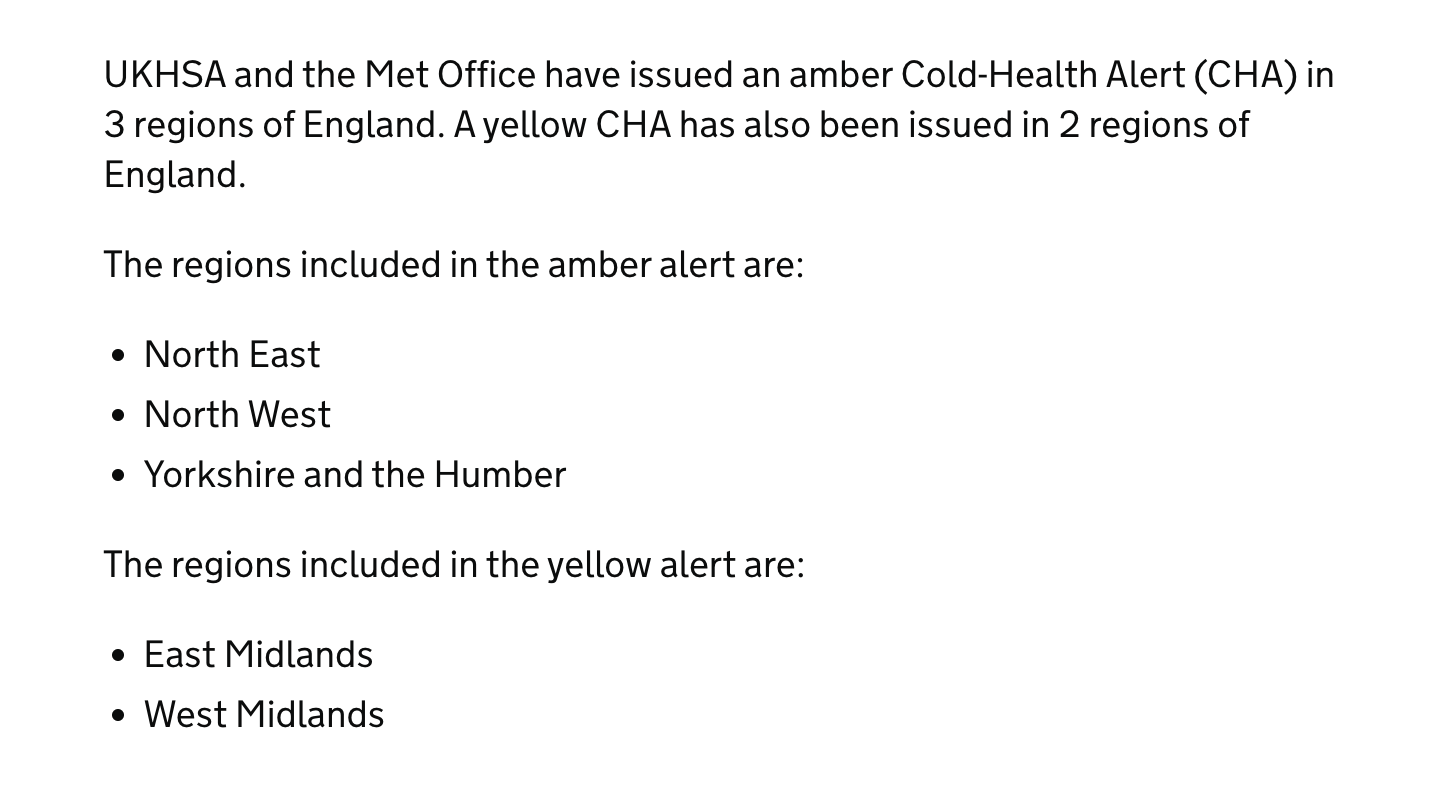
The current heat-health alerts that have been issued for the UK. (Credit: gov.uk)
Under the relatively new CHA (cold-health alert) system, anything beyond a yellow level alert means that it is expected that there will be increased use of healthcare services by vulnerable populations and an increase in risk to health to individuals over the age of 65, those with pre-existing health conditions, including respiratory and cardiovascular diseases and other vulnerable groups like rough sleepers.
ADVERTISEMENT
As well as the Met Office offering their verdict, the UKHSA’s Head of Extreme Events and Health Protection, Dr Agostinho Sousa, said: “With a risk of widespread overnight frosts and some snow across the country this week, it’s important to check in on the wellbeing of those most vulnerable to the cold.
“Cold weather can have a serious impact on health, particularly older people, and those with pre-existing health conditions, as it increases the risks of heart attacks, strokes and chest infections.
ADVERTISEMENT
“If you have a pre-existing medical condition or are over the age of 65, it is important to try and heat the rooms where you spend most of your time in[doors], such as your living room or bedroom.”
For those considered to be at risk during this cold snap and amber-heat health warning, the official government-sanctioned advice is that if you can’t heat all the rooms in your home, it is important to heat the rooms you spend the (i.e. living room in the day and bedroom before going to sleep) to at least 18 degrees if possible.
They also recommend wearing a few thin layers instead of one thick layer, as the former is better at trapping heat than just one big jumper etc.
ADVERTISEMENT
Other advice on how to stay safe during these colder periods includes stocking up on food and medicine, keeping windows closed and reducing draughts at home, as well as getting vaccinated against flu and COVID-19.
If you or someone you know is in need of help, you can get in touch with the NHS on 111 and if it is an emergency please call 999 immediately.
Elbow get behind campaign to save Jodrell Bank from closure
Danny Jones
Manc band Elbow are among the latest to get behind the campaign to save Jodrell Bank Observatory from closing permanently.
The Greater Manchester natives famously played a sold-out gig at the important scientific and cultural landmark for a very special live album recording well over a decade ago, and know all too well the site’s national and, indeed, global heritage.
Choosing the Observatory and the rare chance to perform a show in the shadow of the world-renowned James Lovell Telescope, it probably remains one of their most significant standalone UK date ever.
With that in mind, the local lads have been left just as worried by the news of its impending closure as everyone else, and have therefore issued a fresh appeal to help keep it open.
Posting a timely statement on social media, the group wrote: “Jodrell Bank has long been close to elbow’s heart. In 2012, the band played beneath the Lovell Telescope for one of the most memorable shows in our history.
“The recent news that funding for the e-MERLIN radio telescope network is set to end in 2028 puts the future of the scientific work at Jodrell Bank under serious threat. It is a remarkable place, with an extraordinary history, and one that continues to play an important role in science, culture and education.”
In addition to reliving clips and images from the historic live set all the years later, they also pointed people towards their ‘elbow – Live at Jodrell Bank‘ album documentary, which has now been made available online for the very first time as part of wider efforts to raise awareness around the cause.
Directing people to key online resources shared by the institution and astrophysics centre itself following their unfortunate update late last month, the push to not only find the funding but sustain support for the facility continues to ramp up throughout the world of science, arts and industry.
For anyone who somehow missed the news – 2028 being the current deadline handed down as per budget cuts across the sector – concerned parties here in the North West and all over the country have since started petitioning to save Jodrell Bank Observatory from shutting down for good.
In addition to being described as a “huge blow” to the field by the Royal Astronomical Society (RAS), some have even gone so far as to describe the decision as a form of “vandalism” when it comes to research and British culture as a whole.
Having also served as the host venue for the annual bluedot Festival since 2016, the multi-genre science and arts celebration could soon be forced to find a new home.
The battle is far from over yet, and the community has time to rescue Jodrell Bank Observatory from its fate, but it will take lots of money and more notable public figures to make it happen.
Once again, you can do your bit by signing the petition mentioned above right HERE.
Featured Images — Emma Farrer (via Wikimedia Commons)/The Manc Group
News
All Greater Manchester boroughs to have 24-7 night buses from next month as new services launch
Emily Sergeant
Extra night buses, new routes, and more frequent bus services are being rolled out across the Bee Network at the end of this month.
You may remember that back in March, it was announced that every borough of Greater Manchester was set to get a night bus service in what is hoped to be a ‘boost’ to the night-time economy, and now plans to introduce these from September onwards have been confirmed by Transport for Greater Manchester (TfGM), along with a series of other measures.
Oldham, Stockport, Tameside, and Trafford will all get a 24-hour bus service by next month, meaning every part of the region will have a night bus operating Thursday through to Sunday.
It’s expected that once the new services have launched, it will help around 625,400 people working in the night-time economy across Greater Manchester, as well as those out enjoying the region’s nightlife, TfGM has said.
Some of the other changes set to be introduced from next month include a selection of brand-new bus services, and more frequent buses during the day and at the weekends.
All Greater Manchester boroughs will have 24-7 night buses from next month / Credit: TfGM
There will also be better connections overall to key employment and leisure destinations like Manchester Airport, Trafford Centre, MediaCity, Middlebrook Retail Park in Bolton, Kingsway Business Park, and Logistics North.
“The Bee Network belongs to the people of Greater Manchester and it needs to work for every community,” explained Mayor Bev Craig.
“As we build it, we’re listening and responding to what residents want with the biggest set of improvements we’ve ever made in one go.
🚌 More improvements are on the way across the #BeeNetwork.
36 service changes will benefit around 740,000 people across Greater Manchester, helping more communities access reliable, convenient public transport.
“We’re bringing night buses to every borough, launching new routes and ensuring buses run more often in the mornings, evenings and weekends. In doing so, we’re making it easier than ever for people to get around the city region by bus, but we’re also supporting our businesses, whose staff and customers need a reliable and safe way to reach them.
“Almost three quarters of a million people live within walking distance of a bus route we’re improving over the next few months, and we’ll continue improving connections for even more communities based on the feedback we get.”