The Metrolink tram network is facing disruption tonight, with the Bury line – which happens to run past Parklife festival – completely suspended.
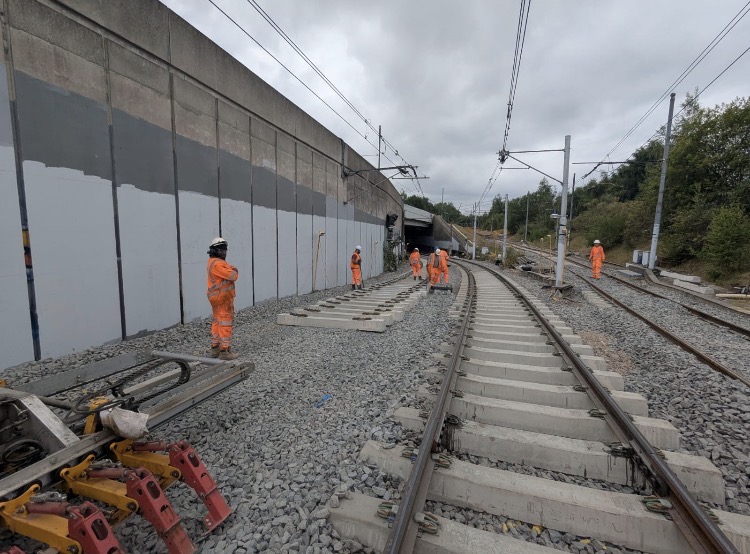
Transport for Greater Manchester announced that there had been severe damage to an overhead line at Victoria station.
It means that no tram services will be operating from Heaton Park or Bowker Vale, which service the massive Parklife festival.
Instead, gig-goers are being advised to use the dedicated shuttle buses – or to brave the walk back to the city centre.
And while tickets are being accepted on local bus services while the trams are down, it’s a Sunday service with only limited buses available.
ADVERTISEMENT
It’s expected that the Bury line will remain shut down until the end of service on Sunday 11 June and may still be down into tomorrow morning.
Repairs are being undertaken throughout tonight and into tomorrow morning.
ADVERTISEMENT
Other services are being impacted by the overhead line damage, including the Oldham and Rochdale line which is part-suspended, and other services which are delayed and being re-routed.
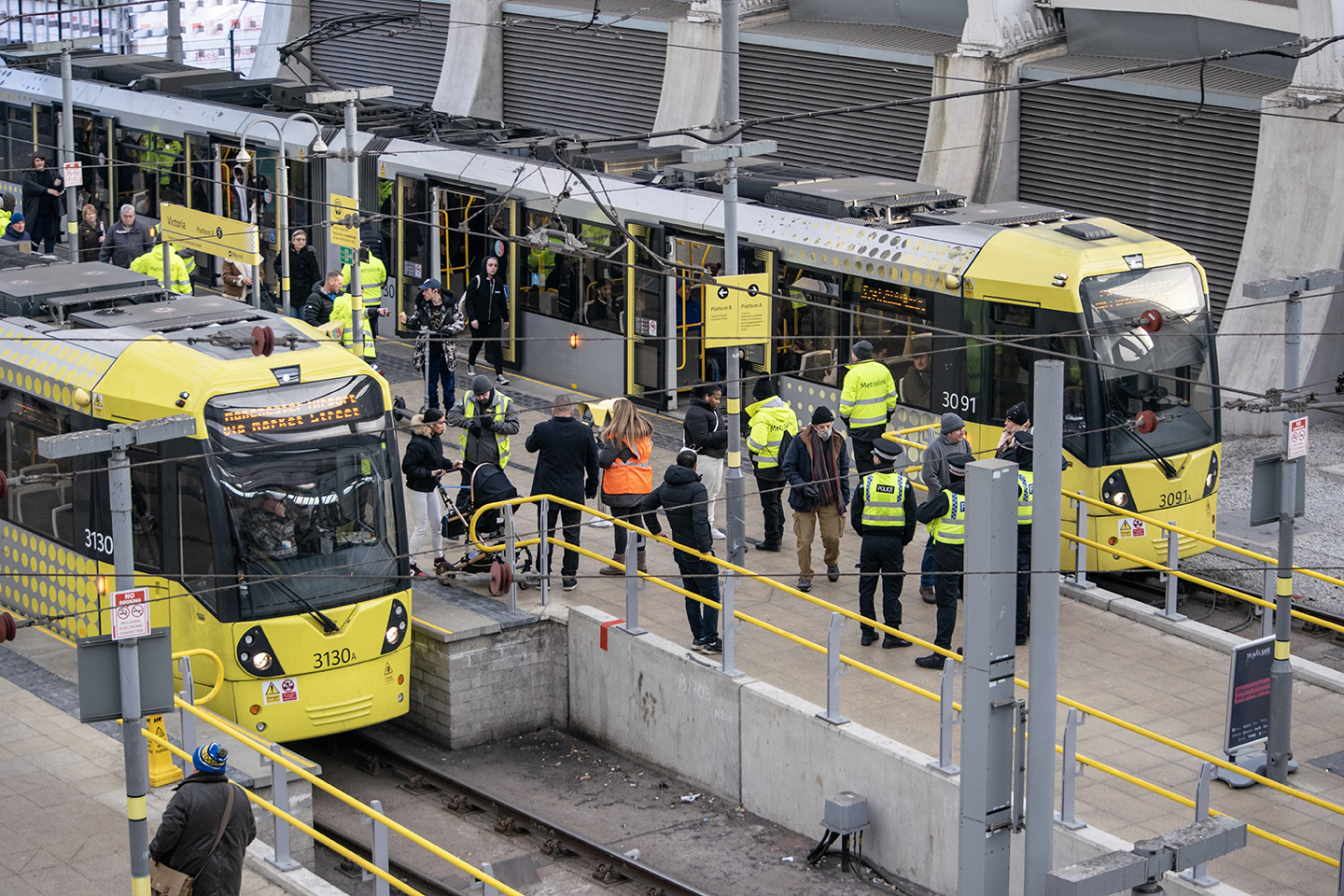
Metrolink trams at Manchester Victoria. Credit: TfGM
Parklife shuttle bus services will run into the evening as required to replace trams, with extra staff on hand.
Services from Soccer Aid at Old Trafford are also affected, with passengers advised to change at Cornbrook for journeys onwards.
ADVERTISEMENT
TfGM’s Interim Chief Operating Officer, Alex Cropper, said: “We apologise for the disruption to Metrolink services this evening and in particular, to those passengers attending Parklife and Soccer Aid who are affected. We are working hard to resolve the issues as quickly as possible and to minimise disruption to passengers.
“Additional staff will be on hand to support passengers across the network. Passengers are advised to check TfGM’s website for the latest travel updates for Sunday evening and Monday morning.”
Metrolink tweeted: “The Bury line remains completely suspended and is expected to remain suspended until the end of service on Sunday 11 June.
⚠️ The Bury line remains completely suspended and is expected to remain suspended until the end of service on Sunday 11 June.
⛏️ Repairs will take place through tonight and into tomorrow morning.
— Manchester Metrolink 🚊 (@MCRMetrolink) June 11, 2023
“Repairs will take place through tonight and into tomorrow morning.
“No tram services will operate from Heaton Park or Bowker Vale stops this evening after @Parklifefest. For return journeys back to the city centre, please walk or use the shuttle bus service. The bus station is located inside the park, accessed via the North Gate exit.
ADVERTISEMENT
“Bus ticket acceptance is in place on the Bury and Rochdale lines this evening.
“However as it is a Sunday night there are a limited number of services operating.”
Tram lines impacted over Parklife weekend
Oldham/Rochdale line is currently suspended between the city centre and Newton Heath and Moston.
East Didsbury line will operate to Exchange Square.
Eccles line will operate to Ashton.
Manchester Airport line will operate to Cornbrook.
Ashton line is experiencing delays.
Altrincham line is experiencing delays.
Bus services accepted trams and travel passes
Tickets and passes can be used on the 17, 18, 41, 52, 53, 56, 66, 90, 95, 97, 98, 112, 117, 118, 119, 135, 156, 163, 524 bus services for the Bury line.
Tickets and passes can be used on the 57, 59, 76, 76a, 81, 83, 114, 149, 181, 182, 409, 411, 415, 471 bus services for the Rochdale line.
Tickets and passes can be used on the 7, 76, 76a 171, 172, 216, 219, 230, 231 bus services for the Ashton line.
Featured image: TfGM

News
Plans unveiled to deliver 50,000 council and ‘genuinely affordable’ homes in Greater Manchester
Emily Sergeant
Plans to deliver 50,000 council and ‘genuinely affordable’ homes in Greater Manchester have been unveiled.
By removing ‘blockers’ to development and transforming disused public land into new housing schemes, Greater Manchester Mayor Bev Craig has set out her plan to tackle the housing crisis and deliver ‘a new generation’ of homes – with 50,000 new ‘genuinely affordable’ homes to be available across the city region by 2039.
It’s expected that 10,000 of these homes will either be built, on site, or in the pipeline with planning permission ready to go by May 2028.
To meet the scale of this ambition and deliver the homes the region needs, Greater Manchester Combined Authority (GMCA) says it will need to ‘pull every lever at [its] disposal’, from remediating brownfield land, to bringing forward dormant sites in public ownership.
That’s why the Mayor will be asking Greater Manchester‘s public bodies to carry out a public land review and identify sites that could be brought forward to deliver homes.
GMCA has already used its Brownfield Housing Fund to support several schemes that are delivering thousands of affordable homes – including social rent homes – as part of the £2 billion Good Growth Fund.
If you’re unfamiliar, the Good Growth Fund is investing in a pipeline of projects to deliver new homes, regenerate town centres, create jobs, and build infrastructure to connect people and places.
“When I was Manchester City Council Leader, I built more council and social homes than Manchester had built in 25 years,” Bev Craig declared. “But we need to go further and faster in every bit of Greater Manchester.
“We will be leading by example when it comes to freeing up disused and dormant public land for development and I’m calling on other Government bodies to join us.
“I know first-hand the security that a Council house brings, and that’s why I am absolutely committed to delivering the Council and social homes that people here in Greater Manchester need, so everyone can have the foundation of a good life in our city region.”
Currently, land supply for 78,585 new homes of all tenures up to 2030 has been identified.
Greater Manchester is in line to receive an initial £1.8 billion from the Government’s Social and Affordable Homes Programme, and the Mayor will meet with Government in the coming weeks to set out joint plans to achieve these ambitions.
Featured Image – Benjamin Elliott (via Unsplash)
News
Government sets out multi-million-pound plan to move UK away from animal testing in science
Emily Sergeant
A £22m push to ramp up the UK’s move away from animal testing in science is set to bring together cutting-edge tech and research.
The latest figures show there were 2.54 million animal testing procedures in Great Britain in 2025, which is down 3.8% on 2024, but with a further update due to be released later this year, the Government is now moving to ‘capitalise’ on that momentum with funding to shift the nation onto alternative testing options.
A dedicated national research hub and nine new high-tech projects are planned to develop ‘better ways’ to test medicines on human biology rather than animals.
According to the Government, this means treatments for conditions like cancer and inflammatory bowel disease (IBD) could be developed ‘faster’ and ‘more precisely’ to not only help patients but crucially also move science away from traditional animal testing.
At the heart of the plans is a new Pre-clinical Translational Models Hub – based in Cambridge and backed by £20 million in Government funding, which will work to build and share models of human tissue, grown from NHS patients, to test new treatments.
The new hub will accelerate the development of testing on ‘organoids’ – tiny, simplified versions of a human gut, tumour or brain, using cells donated by patients.
From beating heart cells in a dish to AI that can predict how drugs move through the body, exciting alternatives to animal testing are transforming medical research.
We're investing £22m to help scientists develop the next generation of life-saving treatments. pic.twitter.com/1EWRQvwySa
— Dept. for Business, Innovation, Science and Trade (@biztradegovuk) August 12, 2026
Because these ‘organoids’ retain crucial features of a patient’s own biology, they will help researchers learn how a real person may respond to a drug and provide additional insights that can complement information that is currently obtained from animals.
Scientists will then be able to use these cutting-edge techniques in their own labs to work out which medicines are worth pursuing.
Overall, it’s hoped that the move will slash the time it takes to get ‘potentially life-changing’ treatments to market.
Alongside the funding for the new Hub, nine cutting-edge projects aimed at identifying new methods of animal-free scientific testing – from beating heart cells in a dish, to lab-grown human ear models, and AI that predicts how medicines move through the body – are being funded.
Sadly, many of these still rely on testing on dogs and monkeys, as it stands.
“This marks another significant step forward in the UK’s move away from animal testing in science and research,” commented Science Minister Chris McDonald.
“This is all about backing our world-leading researchers and innovators to improve lives, giving them the tools they need to deliver more effective treatments for horrendous diseases like cancer, while also preventing the need for animal testing wherever possible.
“It’s also a boost for our life sciences sector, fuelling opportunities for new investment and new jobs, and ensuring Britain is better off.”