The family of the young boy who is believed to have died after being struck by lightning on a football field in Blackpool earlier this week have posted a heartfelt tribute.
It was revealed during the touching tribute that nine-year-old was an organ donor.
In a post on Facebook, Matt Banks – the father of Jordan Banks, who sadly died on Tuesday following a tragic incident in Blackpool during adverse weather conditions – shared a series of previously-unseen family photos and said his son’s “kindness has meant that three other children may be able to live”.
“He always told us he wanted to be able to help other people if he could so was a donor and has donated which we know will be what he wanted,” Mr Banks added.
Mr Banks went on to describe Jordan as the “most amazing” person with the “biggest heart”.
ADVERTISEMENT
“If I ever could have asked for a perfect child, that was Jordan,” he added.
“He always made sure he looked trendy and liked his outfit. His favourite t-shirt was his Cobra Kai top, as he was obsessed with Cobra Kai.”
ADVERTISEMENT
“Not only have I lost my little boy, I have lost my little best mate”.
BBC News
It was known that before he died, Jordan – who was a loyal fan of Liverpool FC – was raising money for mental health services in honour of his uncle who took his own life in 2018, and successfully managed to raise a whopping £2,500 in total by running 30 miles in 10 days.
His efforts attracted the attention of his hero, Liverpool footballer James Milner, who sent him a video congratulating him on his “incredible” work, and said: “Just remember you never walk alone, all the boys are behind you… well done bud you should be very proud”.
ADVERTISEMENT
Lancashire Police also told of how Jordan left sweets on police cars to help cheer officers up during lockdown earlier this year.
Since news of the tragic incident emerged on Tuesday, a number of poignant tributes have made by members of the local Blackpool community, and messages have been pouring in on social media from all across the UK.
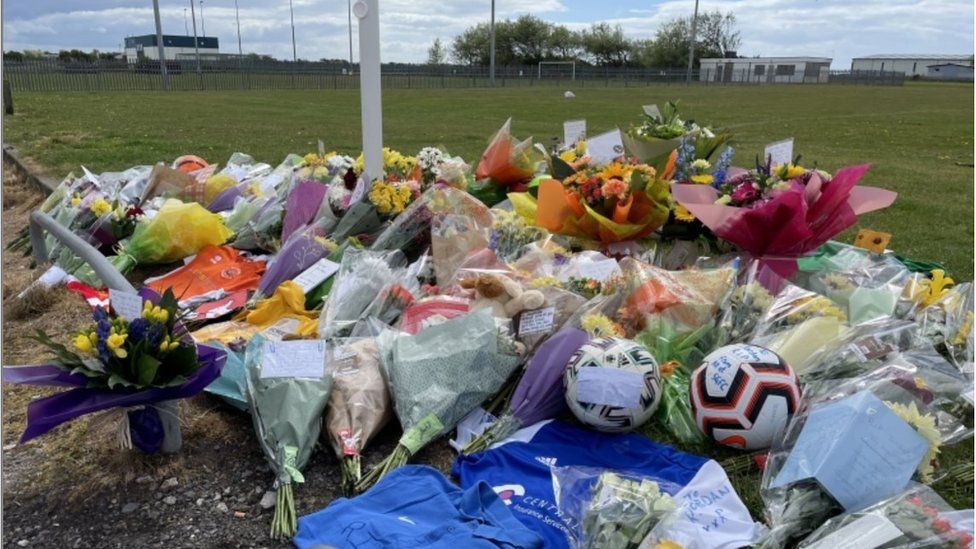
Jordan’s friends have paid tribute with flowers and gifts left at the scene of the incident.
Blackpool Tower was also lit up red and a tweet from the staff at the landmark said: “Yesterday, our community lost one of its brightest lights, so this evening we stand alongside Jordan Banks family, friends and our community to remember a remarkable young man. #LiverpoolFC.”
Tonight, the Blackpool Tower is lit up in red. Yesterday our community lost one of it's brightest lights, so this evening we stand alongside Jordan Banks family, friends and our community to remember a remarkable young man. #LiverpoolFC ⚽️⚽️⚽️⚽️⚽️⚽️⚽️⚽️⚽️ pic.twitter.com/XoGTV7EYG1
Liverpool FC has made a number of tributes to Jordan on social media, first in an initial tweet on Wednesday which read: “The thoughts of everybody at Liverpool Football Club are with Jordan’s family and friends.
ADVERTISEMENT
“Rest in peace, Jordan Banks.”
In a follow-up tribute tweet ahead of the club’s Premier League clash with Manchester United, Liverpool FC said: “You’ll Never Walk Alone, Jordan Banks. Nicknamed ‘mini-Milner’ by his coaches, Jordan was a brilliant person, as well as a passionate footballer.
“We’re all thinking of his loved ones tonight”.
The thoughts of everybody at Liverpool Football Club are with Jordan's family and friends ❤️
Nicknamed ‘mini-Milner’ by his coaches, Jordan was a brilliant person, as well as a passionate footballer. We’re all thinking of his loved ones tonight ❤️
Ahead of Thursday’s match, Liverpool players also wore shirts with “Jordan 7” on the back in tribute to the nine-year-old, and James Milner later dedicated Liverpool’s victory to the youngster.
He tweeted with a series of heart emojis: “A big win for Jordan.”
A GoFundMe page set up for Jordan’s family has already raised nearly £75,000.
News
Everything you need to know about watching the solar eclipse in Greater Manchester
Emily Sergeant
People all across the UK will be able to see an almost total solar eclipse in the sky tomorrow evening.
For the first time this century, with the last one being all the way back in 1999, people in the UK and Ireland – including here in Greater Manchester – will get to see 90-96% of the sun covered by the moon tomorrow (12 August 2026), and if that wasn’t exciting enough as it is, this will be the last chance to do so until 2081.
NASA and Royal Museums Greenwich has confirmed that tomorrow’s solar eclipse will be the most coverage seen from the UK and Ireland since the 1999 event.
But what can astronomy fans in Greater Manchester expect from tomorrow’s eclipse? When will it be happening? How much coverage is our region going to see? And where are some of the best places to watch?
First up, let’s get the basics out the way – what is a solar eclipse? A solar eclipse occurs when the moon moves between the sun and the Earth, blocking the sun’s light either partly or fully.
Although the UK will only see a partial solar eclipse this time, some other countries – such as parts of Iceland, Spain, Portugal, and Greenland – will be lucky enough to witness the spectacle of a total eclipse for a duration of up to two minutes and 18 seconds.
When will it be happening?
The eclipse is set to start at 6:13pm in Greater Manchester, and will run right through to 8:03pm – with the peak happening at 7:10pm.
How much coverage can Greater Manchester expect?
Of course, we always have to preface anything we say about astronomical events like this by saying ‘it depends on the weather’, as we do like in the North West after all, and even though it is the height of summer, that won’t stop the skies from being overcast.
Luckily though, the Met Office is predicting some of the best weather conditions for an event like this in a long time, so it really is worth watching.
Spectators in Manchester will see 91.9% coverage, according to expert sources.
Where are some of the best places to watch the solar eclipse in Greater Manchester?
As a general rule, any open and elevated position with a view to the West will be the best place to catch a glimpse of this rare spectacle.
But across Greater Manchester, we have plenty of those, so some of the most recommended places to see the solar eclipse include Werneth Low, Rivington Pike, or even Salford Quays. There are also a number of dedicated viewing events happening in places like Heaton Park, Platt Fields Park, and Barton Aerodrome to make the most of.
How can I watch the eclipse safely?
If there’s one thing experts are stressing, it’s the need to take correct precautions if you are planning to watch tomorrow.
The most important thing is to wear eclipse glasses and avoid looking directly at the sun.
It’s true that during an eclipse, the sun does appears dimmer therefore making it easier to look at directly, however solar radiation can still reach and damage the retina, often without causing any pain, so you may not realise harm is occurring until it’s too late.
The UK Health Security Agency (UKHSA) advises that there are two safe approaches – specialist eclipse viewers, or indirect viewing methods.
Eclipse glasses or handheld solar viewers must be genuine, sold by a reputable retailer, and have specially designed filters that meet the international safety standard ISO 12312-2:2015(E). They must also have no scratches, tearing, or damage to the lens.
Old pairs may not be reusable, and sunglasses should never be used.
Indirect view methods include viewing the sun’s image projected through a colander or the gaps between tree leaves on to white paper, or using a pinhole pierced in one sheet of card and projected on to another.
Featured Image – Mathew Schwartz (via Unsplash)
News
A rare piglet born at Chester Zoo could help save an entire species from extinction
Danny Jones
A very cute and rare new arrival at Chester Zoo could potentially save the animal’s future, and she might just be one of the cutest little piglets we’ve ever seen.
Say hello to Rana.
A tiny ‘babirusa’ – also sometimes referred to as the ‘pig-deer’ – Rana is an indigenous species found on just four small Indonesian islands, and one which is sadly on the verge of extinction, according to the International Union for the Conservation of Nature.
Part of the threat to the population is due to African Swine Fever (not to be confused with swine flu), which reached these islands around half a decade ago and could see these precious little pigs considered ‘critically endangered’ very soon. But Chester Zoo are working hard to prevent this outcome.
Born this summer, Rana is the baby of mother babirusa Matano, who was herself born at Chester Zoo over a decade ago.
Fast forward 11 years, and she has descendants living in zoos all across Europe, as well as a whole new generation of children here in the UK.
However, she is the first one born in some time, with this particular phylum only ever birthing one or two kids at a time as opposed to a litter like most other pigs.
Described as being like grapefruit “only with legs”, she may be small for now, but she’s growing fast and carries the weight of big hopes and expectations for the rest of her kind.
Chester Zoo conservationists are currently working with partners to protect wild babirusa populations through Action Indonesia‘s Global Species Management Plans.
Helping design camera-trapping projects to monitor babirusas on Sulawesi, and working with other organisations to locate and protect surviving numbers, the aim is to share conservation breeding expertise, with results so far having bred at least 17 babirusas towards national cooperative targets.
For context, only on two occasions were babirusas photographed in the wild during the entirety of 2023-24, hence why efforts have been ramped up even further over the past year or so.
Amy Humphreys, a conservationist at the zoo who is working with Action Indonesia, the country’s government and other groups to combat their decline and rescue this species, says we are in “a race against time” to save these omnivorous, ‘charismatic’ and intelligent pigs.
She goes on to add that “babirusas are important to island ecosystems as they drop seeds as they forage, helping forest regeneration, and they are a key indicator species for overall environmental health, but their situation is bleak.
“We risk losing a truly unique species, one that’s an important part of Indonesia’s cultural and natural heritage and one of the oldest pig species still living […] Rana’s arrival is worth celebrating; her birth is a chance to shine a light on babirusas and show people why they deserve protection.”
It’s uplifting and inspiring stories like this that constantly remind us why we’re fortunate we are to have the award-winning zoo and conservation centre in our region; and if you were wondering whether we’ll be booking a trip soon just in hopes of seeing little Rana running around, you’d be absolutely right.