It has now been confirmed that Greater Manchester’s Clean Air Zone plan has been referred back to the government for review over concerns it will cause “real hardship” for some residents in the region.
It comes after all 10 Greater Manchester councils met to discuss the plan yesterday.
The idea that the plan would be referred back to the government was already on the cards after Greater Manchester Combined Authority (GMCA) issued a statement on the matter last week, with bosses explaining that there is a “fundamental concern” that certain global and national factors may “impact on the ability” of local businesses and individuals to upgrade their vehicles, and whether the current support package agreed with government of £120 million would be sufficient.
The authority said that “emerging evidence” from businesses and trade has highlighted significant challenges related to supply chain issues and inflation.
They also say that more money is needed for taxis, vans, minibuses, and coaches.
In the statement, Eamonn Boylan – the Chief Executive of GMCA – said that they would be seeking approval from the secretary of state for an “urgent” review into the launch of the Clean Air Zone to “identify how a revised policy can be agreed to deal with the supply issues and local businesses’ ability to comply with the plan”.
ADVERTISEMENT
GMCA believes more work is needed to understand whether this could create significant financial hardship for commercial vehicle users.
Mayor Andy Burnham said he is “pleased” that the councils voted for the plan’s referral.
GM has tried in good faith to make the Government’s legal direction work. However, changes in the vehicle market mean it is impossible to proceed on the current basis without causing real hardship to some of our residents.
Taking to Twitter to share the news and comment on the referral confirmation, Mr Burnham said: “I am pleased that Greater Manchester councils have just voted to refer the Clean Air Zone back to the government [as] GM has tried in good faith to make the government’s legal direction work.
ADVERTISEMENT
“However, changes in the vehicle market mean it is impossible to proceed on the current basis without causing real hardship to some of our residents.
“We remain committed to tackling illegal levels of air pollution in GM as soon as possible.
“This decision opens up the space for urgent, joint discussions with the government about potential changes to make the scheme fair for everyone [and] I am listening to people’s concerns and will always stand up for GM.
“I am not the final decision-maker but will do everything I can, working with government, to get this to the right place.
“I know it’s difficult but bear with us and I will keep you posted on progress.”
ADVERTISEMENT
I am listening to people’s concerns and will always stand up for GM. I am not the final decision-maker but will do everything I can, working with Government, to get this to the right place.
I know it’s difficult but bear with us and I will keep you posted on progress.
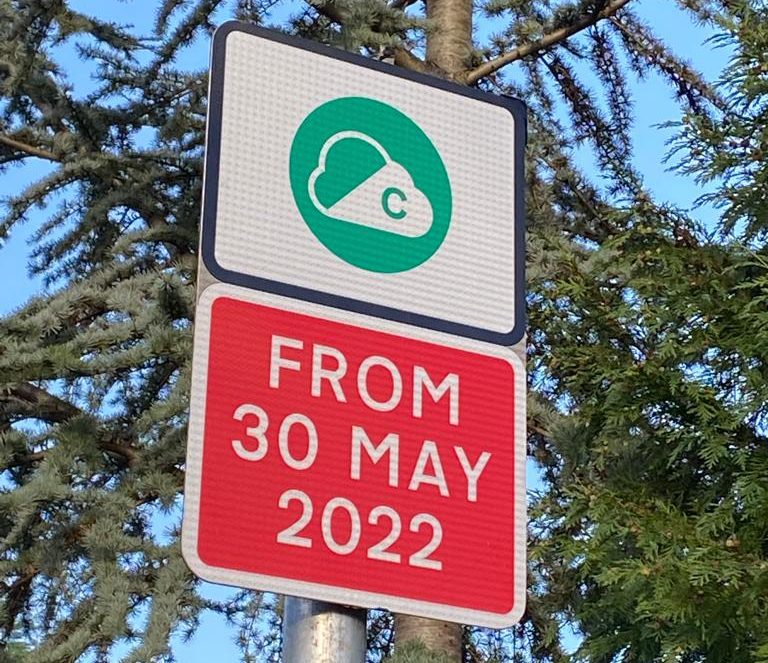
In case you haven’t noticed, signs informing members of the public that the controversial scheme will begin to take effect from 30 May 2022 have been going up across the region over the last couple of months, with the roadside cameras to enforce the new policy across said to be being installed later on this year.
Automatic Number Plate Recognition (ANPR) cameras will be used enforce any non-payment of daily charges that will come with the Greater Manchester Clean Air Zone.
The Greater Manchester Clean Air Zone is said to be “designed to protect everyone’s health by bringing harmful nitrogen dioxide air pollution at the roadside within legal limits as soon as possible.”
While private cars, motorbikes, and mopeds won’t be affected, some vehicles that do not meet emissions standards – known as ‘non-compliant vehicles’ – will be charged to drive in the Clean Air Zone, with charges ranging from £7.50 for taxis and private hire vehicles, and £10 for vans and minibuses, all the way through to £60 for buses, coaches, and HGVs.
Daily charges will also occur for campervans and motorhomes too, depending on the tax class of the vehicle.
ADVERTISEMENT
The Greater Manchester Clean Air Zone is said to be “designed to protect everyone’s health” / Credit: Twitter (@FSBManchester)
As much of the region has started to become more aware of the scheme since signs have gone up, and have begun to learn of the charges involved, this has thus prompted critique and generated widespread conversation on how local businesses will be affected.
The petition is aiming to “stop [the scheme] in its tracks”.
“Can you remember being asked by [Andy Burnham] or anyone in Greater Manchester if you wanted this? We were not. What sort of democracy is that? We need to stop this in its tracks,” the person who set up the petition exclaimed.
Some environmentalists, however, believe the scheme does not go far enough.
You can find out more about the Clean Air Zone charges for different vehicles, and the financial support on offer here.
Featured Image – Wikimedia Commons
News
Manchester pub chain providing lifeline for dementia sufferers with vital support sessions
Danny Jones
A regional pub chain is being rightly praised for providing regular and vital support sessions to those suffering from dementia at two beloved Manchester locations.
The brand in question is Joseph Holt Brewery, which was founded behind an old pub on Oak Street in the Northern Quarter back in 1849, and has gone on to become an instantly recognisable British name.
Serving patrons for the best part of two centuries, their watering holes have always served as important meeting places and community hubs, but one of their current local initiatives is one of the most heartwarming we’ve come across of late.
Dubbed the ‘Get Together Group’, these dementia support sessions, which are now being pioneered at two of their Greater Manchester pubs, are truly setting an example for the kind of grassroots work and outreach that publicans do.
Put simply, the Get Together Group hold sessions for those diagnosed with dementia, and indeed, members of families affected by the disease to meet, discuss and support one another.
Currently being hosted at The Goat’s Gate in Whitefield and The Woodthorpe in Prestwich – both beloved Joseph Holt boozers – the idea was started by Sonia Schofield, 53, who now runs the sessions with a band of dedicated volunteers.
“People just seem to love the warm atmosphere and general sense of community,” says Sonia. “There’s free tea, coffee, and biscuits, along with bingo, a raffle, and some fabulous singers who come along to entertain the group.
“Word has spread that this is such a lively and welcoming space that even people without a direct connection to dementia regularly come along – which is so lovely. It also adds to a sense of community, helps break down stigma around dementia and makes the group feel warm, inclusive, and caring.”
Having worked as part of the brewery for more than three and a half decades since joining as an 18-year-old, this became a passion project of hers after her beloved grandmother, Pam, who had raised her from the age of six, developed dementia in her late sixties.
As is sadly the case for many, it soon became clear that support for those struggling with dementia is unfortunately rather limited, with Royal Voluntary Service figures stating that more than a third of people even just caring for loved ones with dementia receive little or no support following diagnosis.
Goat’s GateThe WoodthorpeHere’s hoping it comes to more pubsWith 125 other establishments, this could be the start of something special. (Credit: CAMRA/Joseph Holt/The Manc Group)
Believed to be the first sessions of their kind held in a pub, the reception to the regular work done by Get Together has meant that it isn’t just people living with the condition directly that now attend: people throughout the local areas are turning to the bi-weekly meet-ups for connection and social interaction.
Sonia goes on to note that because “the atmosphere in a pub is far less formal than, say, a healthcare or community centre setting, this helps reduce anxiety and makes interaction feel more natural.
“Holding a support group in an everyday community venue also shows that people living with dementia are valued members of the community, not defined only by their diagnosis. Just seeing this group of people together is so uplifting.”
Joseph Holt‘s director of pubs, Mark Norbury, said of the scheme: “We are a family business with very strong roots in the communities where our pubs are located. The Get Together Club perfectly reflects Joseph Holt’s values – our pubs are about much more than simply serving drinks. They are welcoming spaces where people can come together, socialise, build friendships, and support one another.
“We are incredibly proud of what Sonia and her fellow volunteers have achieved: creating a vital source of support for those who need it, while also providing a warm, uplifting environment where everyone feels welcome.” Hear, hear.
Joseph Holt continues to extend that homegrown, family-run and community-driven ethos across their pubs, and we sincerely hope we get to more stuff like this popping up at their various wonderful sites across the boroughs.
Featured Images — Supplied (via Joseph Holt Brewery)/The Manc
News
New Mayor Bev Craig announces £20m fund to ‘revitalise’ Greater Manchester high streets
Emily Sergeant
The new Mayor of Greater Manchester has unveiled plans to ‘breathe new life’ into local high streets with a landmark £20 million fund.
Bev Craig says Greater Manchester has enjoyed a decade of rapid economic growth, ‘outstripping’ every other city region in the UK in the process, but now she wants to make sure that everyone can ‘see and feel’ the benefits of that growth where they live.
The new £20m Good Growth High Streets Fund will be made available to local businesses, business groups, and voluntary and community organisations across Greater Manchester to improve their high streets, and will primarily back ideas that can ‘make a real difference’ to good economic growth and restore local pride.
The new fund forms part of the Our High Streets campaign – which will run throughout her first mayoral term to ’empower’ local communities to revitalise where they live, shop, and socialise.
New Mayor Bev Craig has announced a £20m fund to ‘revitalise’ Greater Manchester high streets / Credit: GMCA | Jonny Gios (via Unsplash)
To drive forward this work, Bev is calling on local businesses and groups to join a new High Streets Taskforce, which will help design the ‘ambitious’ plans for the fund and put them into practice across the city region.
Bev launched her high street plans in Middleton yesterday, where she said the ‘passion and ambition’ of local people and the independent business community are already leading to a transformation of the town centre, and there’s potential of even more to come.
“Our high streets are the beating hearts of our communities, and people want to feel pride about where they live,” commented Mayor Bev Craig.
“They are rightly worried and frustrated when they see derelict pubs, boarded-up shops, and dodgy operators, and independent traders moving away. They want to see practical support for local businesses now and that’s why I’m taking action.
“Our new £20 million Good Growth High Streets Fund is all about restoring pride in a vibrant high street, backing our neighbourhoods, and spreading the rewards of good economic growth everywhere.”
The Good Growth High Streets Fund will open for applications later this year.