Hospitality has been pleading for over a week with the Treasury to provide additional financial support following weeks of spiraling booking cancellations – and today, at last, Rishi Sunak has responded.
The Chancellor this afternoon unveiled new measures of financial support for the sector in the form of one-off £6k grants for businesses hit by Covid-19, following a week of mounting criticism that saw him accused of not acting swiftly enough and even ‘going into hiding’.
The new measures announced today will enable businesses in the hospitality and leisure sectors to claim a one-off cash grant of up to £6,000 – but many operators seem to feel that this barely scratches the surface.
Sunak has also said the government will be reintroducing the Statutory Sick Pay Rebate Scheme, which enables small and medium-sized businesses to claim government compensation to cover employees’ sick pay.
However, restaurateurs, landlords and other industry experts have been quick to point out that this isn’t really enough to tide over a sector that relies on Christmas takings to see it through into the spring.
ADVERTISEMENT
Sacha Lord, Manchester’s Night Time Economy Advisor, has been very outspoken when it comes to fighting the corner of Manchester’s small hospitality businesses – many of whom are facing closure without a significant package of support and are hoping to see further measures such as the return of furlough and business rates relief reintroduced.
Following the Chancellor’s announcement, he was quick to tweet his thoughts on the new package, which boiled down to the succinct summary: “It’s not a package. It’s an insult.”
ADVERTISEMENT
We’re providing new support worth £1bn including:
➡️New grants for hospitality & leisure sectors – up to £6,000 per business premises.
➡️Adding £30m to the Culture Recovery Fund to support culture.
Elsewhere, UK Hospitality tweeted their support of the measures, stating: “We’re pleased @RishiSunak has listened to our pleas.
“This is a generous package building on existing support measures to provide an immediate emergency cash injection for those businesses who, through no fault of their own, have seen their most valuable trading period annihilated.”
However, it doesn’t appear that this take has gone down well with the majority of hospitality operators on Twitter – with a torrent of replies to UK Hospitality suggesting many still feel let down and forgotten.
ADVERTISEMENT
Scott McVittie tweeted: “Sounds generous for headlines but that barely covers a fraction of the monthly payroll. @UKHospKate this minimises they crisis we are facing”
Marshall Stephens said: “‘Generous’ I lost that much in cancellations last week.”
Whilst Gareth Walters said: “This is the opposite to the reaction I’ve seen across bar/restaurant businesses – no one using the phrase generous”
The Treasury justifies the pitiful level of support because there are "fewer insolvencies" (insolvency rules have been suspended for two years) and "higher vacancies" (there's a recruitment crisis thanks to Brexit) and hospitality has "more cash in the bank" than March 2020. 1/2
£6k isn’t even a weeks trading. We’re drowning. Every day you don’t lock us down but tell people to stay home we haemorrhage money. We can’t send staff home but we bring no money in. We need a furlough scheme and serious guidance so we can plan what to do
Lazy Lounge added, “Without a furlough scheme, £6,000 isn’t enough to get through 5 days let alone what could quite possible be the next few months.
“Madness! Thousands still going to lose their jobs and many businesses going to disappear.”
ADVERTISEMENT
Whilst Zoey Clarke said, “6k!? What a slap in the face. That wouldn’t cover the wine order for Christmas. How are you claiming this is generous, will it cover just one week’s salary for an SME?! Rent, tax, lost income. Hopeless. Thank God @Sacha_Lord is here.”
Following a week in which the hospitality industry’s pleas have fallen on seemingly deaf ears, it seems there is more still to be done following these announcements – with many hoping they can continue to pile on the pressure to get more support from the Treasury.
Clearly, more needs to be done in order for hospitality to truly feel supported – especially with reports of further restrictions continuing to loom on the horizon.
Rishi Sunak, however, has said that he thinks the government has responded ‘generously’.
ADVERTISEMENT
He told Sky News: “We’ve responded I think generously today.
“The grants that we’ve outlined, up to £6,000 pounds, are comparable to grants that we provided to hospitality businesses when they were completely closed earlier this year so there’s a benchmark for you.”
Feature image – SKY / Albert’s Schloss
News
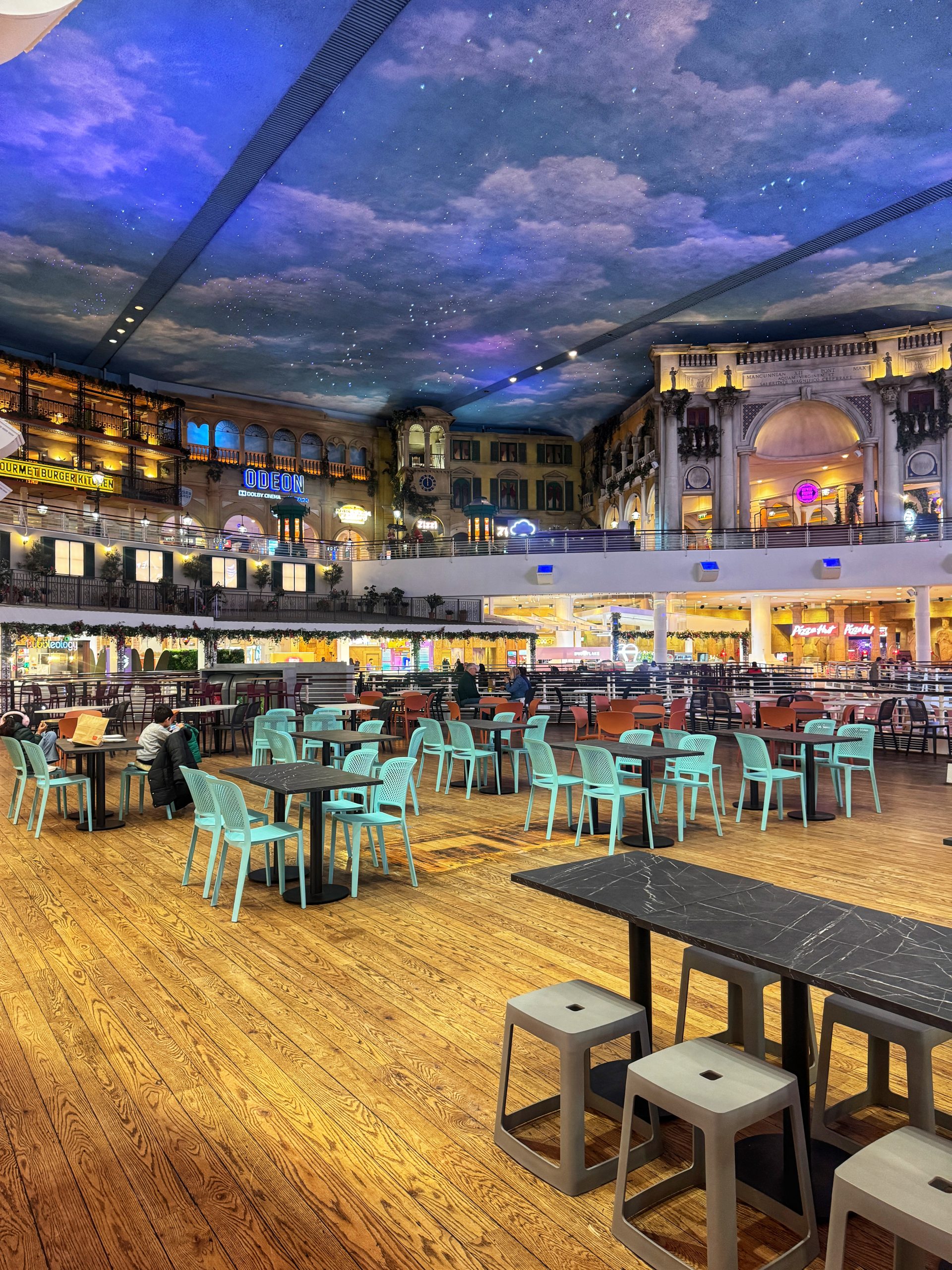
Trafford Centre begins months-long refurb of its iconic The Orient foodhall
Emily Sergeant
A new era for The Orient is on the horizon, as the Trafford Centre has begun its months-long refresh of its iconic foodhall.
Forming part of its ongoing commitment to ‘enhancing the visitor experience’, the Trafford Centre is investing in a major refresh of seating and customer facilities within The Orient – creating a more vibrant and welcoming environment for guests to eat, meet and relax.
Works are now underway and will be delivered in phases over the coming months.
Improvements are being carried out in phases to minimise disruption to shoppers, while creating a more comfortable and contemporary dining environment at the same time.
The refreshed area will increase seating capacity by more than 60%, introducing a range of new seating styles in the process – including banquettes, family-friendly tables, accessible seating for guests with mobility requirements, and dedicated areas equipped with phone and laptop charging facilities.
The Trafford Centre begins months-long refurb of its iconic The Orient foodhall / Credit: The Manc Group
Inspired by The Orient’s longstanding maritime heritage, the design takes cues from a contemporary cruise liner, and the space will also feature upgraded furniture and enhanced lighting, alongside flexible areas designed to encourage visitors to spend more time in there.
There’ll also be modern furnishings and a ‘refreshed’ colour palette to create a brighter and welcoming environment.
“The Orient is one of the most popular destinations within Trafford Centre, welcoming millions of visitors each year,” a Trafford Centre spokesperson said on the refurb.
“This investment reflects our commitment to continually improving the experience for our guests, creating a more modern, comfortable and social environment where visitors can meet, dine and spend time together.
“The improvements will not only significantly increase seating capacity but also deliver a much more flexible and accessible space for all visitors to enjoy.”
Featured Image – The Manc Group
News
Uber has officially started trialling driverless taxis in Manchester
Emily Sergeant
It’s official… driverless taxis have hit the streets of Manchester.
As the leading transportation company looks to bring robotaxis to other major cities around the UK, it has been confirmed that a trial of autonomous vehicles is now underway in Manchester – with the services being operated using the technology of Uber’s partner firms, Pony and Verne.
Uber said it was ‘excited’ to take this first step toward ‘making this technology accessible’ to people across the UK.
The three companies first collaborated on the deployment of a commercial robotaxi service back in March of this year, combining Pony.ai’s autonomous driving system, Uber’s global mobility platform, and Verne’s service ecosystem and operational framework.
At this time, there has been no official application to launch passenger services in Manchester, according to The Guardian.
However, posts on various social media platforms – such as X, LinkedIn, and Instagram – by each of the companies this week have confirmed that trials are underway in the city.
“New technologies play an increasingly important role in the growth of our city region,” TfGM said. “But they need to be introduced responsibly, safely and with real thought about what it means for our residents.
“Safety will always be our top priority, and we will need strong assurances that no vehicles will operate on our roads that pose any risk to residents.”
Manchester, we’re on our way! Today, we’re announcing that we’re partnering with @Verne_robotaxi and @PonyAI_tech to pilot autonomous vehicles in Manchester. Building on our service together in Zagreb, Gen-7 Robotaxis are now testing in Manchester.
We’re excited to take this first step toward making this technology accessible to people across the UK. 🇬🇧
“By bringing together Pony.ai’s proven autonomous driving technology, Verne’s operational and market expertise, and Uber’s global platform, we’re taking an important step toward making autonomous ride-hailing available to more riders in more places.”

 Georgina Pellant -
21st December 2021
Georgina Pellant -
21st December 2021