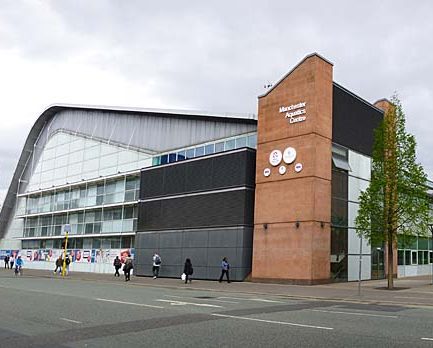
The Manchester Aquatics Centre is set to close its main pool and gym for 18 months.
The huge leisure centre will be almost completely closed to the public from the end of this month until late spring 2023, and it’s all part of a £31 million refurbishment plan for the facility, which will see its swimming pools, gyms and cafe upgraded.
The Manchester Aquatics Centre was purpose-built for the 2002 Commonwealth Games and opened in 2000.
Its initial build cost £32 million, and Manchester City Council is set to spend almost as much again so that it won’t “wither and die”.

The Manchester Aquatics Centre is set to close its main pool and gym for 18 months / Credit: Wikimedia Commons
Speaking back in January, when the plans were first submitted, Councillor Luthfur Rahman said: “This one-off investment will ensure that Manchester Aquatic Centre maintains its place as one of the leading aquatics venues in the UK for the next 20 years and more.
ADVERTISEMENT
Leisure has a crucial role to play in Manchester’s recovery from the social, health and economic impacts of the COVID-19 pandemic and it would be unthinkable to allow this key element of the city’s overall swimming provision, which also contributes to our global sporting reputation, to wither and die.
“But that is what would be likely to happen without serious investment.”

ADVERTISEMENT
The £31 million refurbishments are to ensure the centre won’t “wither and die” / Credit: Manchester City Council
The plans will also mean that the centre’s carbon footprint will be reduced.
The closure, which will come into effect at the end of Friday 26 November, will see everything but the training pool close, with only limited public swimming available.
Members will be able to make use of nearby Better UK leisure centres – including the Sugden Sports Centre, Moss Side Leisure Centre, and Hough End Leisure Centre.
Featured Image – Flickr (Allen Watkin)

News
Manc architects submit plans to demolish 1970s office block and make way for new residential area
Danny Jones
A Manchester-based architects has submitted promising proposals to demolish an old 1970s-era office block and make way for a brand new residential community in Stockport.
The vision seems fairly ambitious and lofty – pun intended – but the potential outcome could be stunning.
Ollier Smurthwaite (OS) Architects are the local practice behind the new housing plans, which will not only provide nearly 300 new homes but also bring part of the Stopfordian skyline down; it’s not often you hear of things getting lower when so much of Greater Manchester just keeps building up.
Sharing the first proper glimpse at what they hope the redeveloped corner of the busy A6 main road will look like, many have been pleased to see familiar red brick and a traditional feel as opposed to more glass towers.
Writing a lengthy caption alongside the social media post, the OS state, “We are preparing a planning application for the St Christopher’s site in Stockport.
“Located at the prominent junction of Wellington Road South and Longshut Lane, the proposal aims to transform the prominent corner by demolishing the existing 10-storey 1970s office block to make way for a new residential community.
“The proposals are for a modern ‘mansion’ block with taller ceilings, more windows, better communal areas and private gardens.”
It remains to be seen at what price point these apartments will be available for.
Promising a total of 278 ‘new dwellings’, the scheme will crucially see the height of the existing plot lowered to fall in line with other neighbouring properties, as St Christopher’s House currently sits well above the nearby terraces and its metropolitan style does stand out against the surrounding brickwork.
The early reception to the proposed plans looks to be largely positive, too, with one user commenting online, “A very nice looking building with character. More of these please”; another went so far as to add, “These are the sort of modern buildings that will become grade listed.”
It’s also worth showcasing what exactly these blueprints look like when they’re brought to life, such as another development over in Longsight:
Render vs Reality. We recently completed our Daisy Bank scheme in Longsight Manchester for 72 new homes. The scheme takes contextual references from Dalton Ellis Hall & Victoria Park Christian Fellowship in the adjacent conservation area.@createstreets@archi_tradition… pic.twitter.com/DasRUtaylh
Safe to say that seeing what businesses trying to regenerate boroughs actually deliver compared to their initial mock-ups is always useful.
The award-winning firm goes on to add that “the building will be deliberately stepped back from the pavement to create a planted tree-lined avenue”, which will also revolve around a central courtyard and residents’ gardens, with ground-floor flats benefitting from private patios.
CGIs of shared communal roof terraces also give the designs that added modern look, with few other places in the vicinity offering this kind of space. It could be a welcome addition to the region that is already going through plenty of change at the minute.
Another big construction scheme is the one being carried out by Capital and Centric over the new Weir Mill district, which could be transformational for the town centre.
Internet signals reportedly ‘100x faster on the moon’ than on some UK trains
Danny Jones
Yes, you read that right: according to a recent study, internet signals on some UK trains are currently estimated to be 100x slower than they would be on… wait for it: the actual MOON.
Give us strength – and by that we mean signal strength.
As per new analysis carried out by Good Business Travel (GBT), research into some of the worst-connected train routes across Great Britain has delivered a rather depressing evaluation of our telecommunications systems and railways.
While some may certainly be better than others, it’s fair to say that we’ve all been there; you’re trying to have a call or use even a crumb of your data on a train before you ultimately give up and start arbitrarily looking through your photo library.
Put a man on the moon ✅ Cure diseases ✅
Get wifi on a fucking train. ABSOLUTELY NOT. NOOOO WAYYYYYY.
As damning and hyperbolic a claim as it might sound, GBT have indeed found that when compared against Ofcom’s benchmark for reliable internet performance (5Mbit/s), not a single train journey consistently meets the regulator’s standard.
Anyone who’s ever done Manchester to London and vice versa will know all too well how frustrating it can be to get a steady signal during your journey.
Never mind, eh? You know, they’re only two of the most modern and digitally-driven cities in the entire country – foolish of us to expect the key North-South link would carry over to internet connection.
Regarding train WiFi, hit and miss is putting it mildly, and even if you’re lucky enough to be on one that actually has a decent signal, it’s only a matter of time before the carriages fill up and throttle everyone’s connection, and it becomes patchy at best.
In what might be one of the slightest consolations ever, you’ll be glad to hear the LDN-MCR speeds are only the seventh worst in the nation, managing just 16% when it came to the average mobile network ‘Good Performance’ by Ofcom standards. You can see the unwanted top 10 leaderboard in full below.
The worst UK train journeys for mobile connectivity
Rank
Route
Average mobile network Good Performance (Ofcom)
1
Basingstoke to Coventry
6%
2
Sheffield to Doncaster
12%
3
Taunton to Leeds
13%
4
London to Edinburgh
14%
5
London to East Midlands Parkway
14%
6
Bedford to London St Pancras Peak
15%
7
London to Manchester
16%
8
London to Glasgow
18%
9
London to Plymouth
24%
10
London to Bournemouth
25%
Put simply, a staggering number of domestic train journeys fail the litmus test for what would be considered even a decent connection.
It’s got to the point now that there are even people starting nationwide campaigns to help generate awareness around upgrading telecoms infrastructure across the UK, with trains being one of the biggest challenges in this country.
Speaking on the report, Good Business Travel’s Client Experience Director, Natasha Inglis, said in a statement: “Millions of people travel by train every week expecting to work, stream, message friends or simply stay connected.
“Instead, they’re met with frozen video calls, emails that won’t send and endless buffering. While improvements to Britain’s rail connectivity have been promised by the government, passengers still have to deal with unreliable coverage every day. There are a few tricks that can help in the meantime.
“Many people don’t realise that sitting on the side of the train facing nearby towns or major roads can improve your signal because you’re closer to mobile masts. It’s also worth switching your phone to 4G instead of allowing it to constantly search for weak 5G signals, which often makes connectivity even less reliable on moving trains.”
But hey, things are slowly getting better if reports are to be believed, with satellite-enabled mobile services gradually being rolled out, meaning traditional ‘deadzones’/signal blackspots may not be as big of a problem as they once were. Touch wood.
For now, we’re just going to keep making sure we’ve got a decent book with us and enjoy taking a break from endless screentime.