Manchester awards prestigious Freedom of the City to 216-year-old local regiment
It's the highest honour that Manchester can bestow and is only given on very rare occasions. The ceremony will take place in St Peter’s Square next month, followed by a parade
The 209 (The Manchester Artillery) Battery, 103rd Regiment Royal Artillery has been given the Freedom of the City award – the highest honour that Manchester can bestow.
The Freedom of the City award, which is only bestowed on very rare occasions, is being given for its extensive and valuable service to Manchester for over 216 years.
Previous recipients of the honour include broadcaster Tony Wilson, the GB Olympic and Paralympic Cycling Team, Sir Bobby Charlton, The Duke of Lancaster’s Regiment, 207 (Manchester) Field Hospital (Volunteers), Professor Sir Andre Geim and Professor Sir Konstantin Novoselov.
The decision to award the Freedom of the City to the 209 (The Manchester Artillery) Battery, 103rd Regiment Royal Artillery was moved by the Lord Mayor at a Special Meeting on 25 November 2020 at the Town Hall.

The public will have the rare opportunity to watch them in action, as the parade departs from St Peter’s Square after the ceremony. / Image: 209 Battery 103 Regt RA via Facebook
The 209 (The Manchester Artillery) Battery, 103rd Regiment Royal Artillery has served in the Boer War, WW1, Gallipoli, Sinai and, on the Western Front since its formation over 216 years ago.
ADVERTISEMENT
Following the prestigious award ceremony, the 209 will march through the city with colours flying, drums beating, and bayonets fixed.
The public will have the rare opportunity to watch them in action, as the parade departs from St Peter’s Square past the Cenotaph, then onto Princess Street, then Cross Street, onto St Mary’s Gate, Deansgate, Peter Street and finally left back to its starting point.
ADVERTISEMENT
There will be barriers in place so that the parade can be enjoyed safely and people are encouraged to follow the parade and to celebrate alongside the 209 (The Manchester Artillery) Battery, 103rd Regiment Royal Artillery.
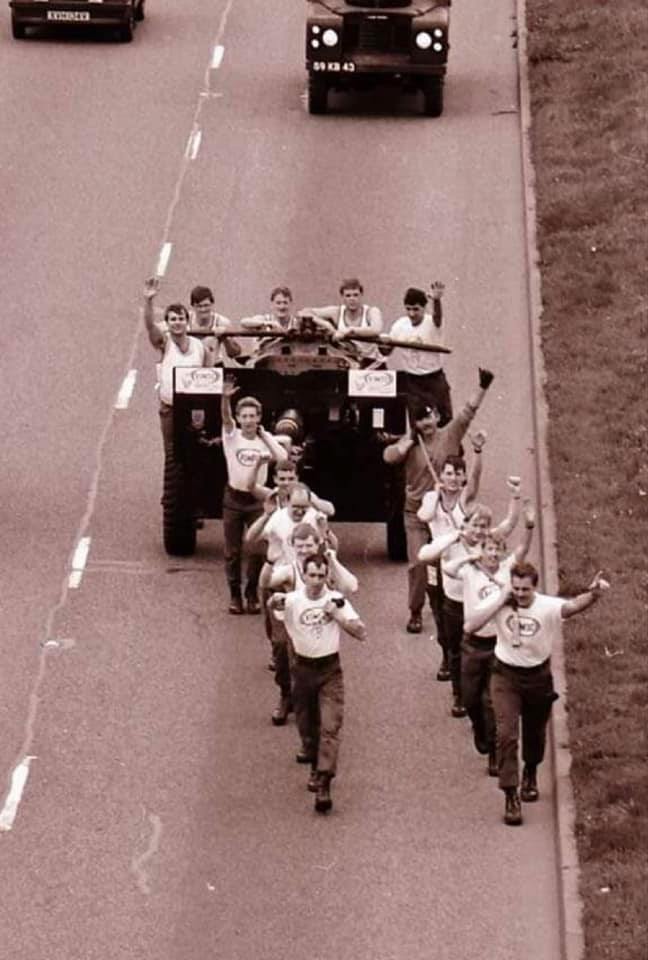
The 209 (The Manchester Artillery) Battery, 103rd Regiment Royal Artillery has served in the Boer War, WW1, Gallipoli, Sinai and, on the Western Front since its formation over 216 years ago. / Image: 209 Battery 103 Regt RA via Facebook
Following a short Service of Blessings performed by Regimental Padre Rev. M.W. Johnstone CF. and an inspection of the Regiment, the Chief Executive Joanne Roney OBE will read the Resolution of Council conferring the Honorary Freedom of the City upon 209 (The Manchester Artillery) Battery, 103rd Regiment Royal Artillery.
Speaking on the decision to bestow the award on the 209, the Lord Mayor of Manchester Councillor Tommy Judge said: “It is a great privilege to award the 209 (The Manchester Artillery) Battery, 103rd Regiment Royal Artillery the Freedom of Manchester.
ADVERTISEMENT
“I would like to congratulate and thank them for their hard work and commitment to the people of Manchester over such a long period of time.

Speaking on the decision to bestow the award on the 209, the Lord Mayor of Manchester Councillor Tommy Judge said: “It is a great privilege to award the 209 (The Manchester Artillery) Battery, 103rd Regiment Royal Artillery the Freedom of Manchester. / Image: 209 Battery 103 Regt RA via Facebook
“The regiment has a long and illustrious history with the city. the Lord Mayor of Manchester Tommy Judge said: “The significance of their work is integral to the history and indeed, the future of Manchester.
“It is a very proud moment as Mayor, and as an ex-serviceman to honour the 209 (The Manchester Artillery) Battery, 103rd Regiment Royal Artillery and, to watch the parade.
Lieutenant Colonel Taylor-Jane Fox added, “209 (The Manchester Artillery) Battery are part of history today. Being awarded the Freedom of the City of Manchester is a great honour; to have the Battery written into the history books of this great city is a huge privilege and every soldier on parade is proud to be part of this significant event.”
The current 209 (The Manchester Artillery) Battery, 103rd Regiment Royal Artillery continues to recruit and train Manchester citizens in readiness for the defence of the country at home and abroad.
ADVERTISEMENT
The ceremony will be attended by The Lord Mayor Councillor Tommy Judge, accompanied by the Lady Mayoress, Carole Judge; the Leader of the City Council, Sir Richard Leese; the Chief Executive of the City Council Joanne Roney OBE; the Master Gunner St James’s Park, Lieutenant General Sir Andrew Gregory KBE CB; Honorary Colonel, 103rd Regiment Royal Artillery, Brigadier Bill Kingdon; and Commanding Officer, 103rd Regiment Royal Artillery, Lieutenant Colonel Taylor-Jayne-Fox.
Feature image – 209 Battery 103 Regt RA via Facebook
News
Government sets out multi-million-pound plan to move UK away from animal testing in science
Emily Sergeant
A £22m push to ramp up the UK’s move away from animal testing in science is set to bring together cutting-edge tech and research.
The latest figures show there were 2.54 million animal testing procedures in Great Britain in 2025, which is down 3.8% on 2024, but with a further update due to be released later this year, the Government is now moving to ‘capitalise’ on that momentum with funding to shift the nation onto alternative testing options.
A dedicated national research hub and nine new high-tech projects are planned to develop ‘better ways’ to test medicines on human biology rather than animals.
According to the Government, this means treatments for conditions like cancer and inflammatory bowel disease (IBD) could be developed ‘faster’ and ‘more precisely’ to not only help patients but crucially also move science away from traditional animal testing.
At the heart of the plans is a new Pre-clinical Translational Models Hub – based in Cambridge and backed by £20 million in Government funding, which will work to build and share models of human tissue, grown from NHS patients, to test new treatments.
The new hub will accelerate the development of testing on ‘organoids’ – tiny, simplified versions of a human gut, tumour or brain, using cells donated by patients.
From beating heart cells in a dish to AI that can predict how drugs move through the body, exciting alternatives to animal testing are transforming medical research.
We're investing £22m to help scientists develop the next generation of life-saving treatments. pic.twitter.com/1EWRQvwySa
— Dept. for Business, Innovation, Science and Trade (@biztradegovuk) August 12, 2026
Because these ‘organoids’ retain crucial features of a patient’s own biology, they will help researchers learn how a real person may respond to a drug and provide additional insights that can complement information that is currently obtained from animals.
Scientists will then be able to use these cutting-edge techniques in their own labs to work out which medicines are worth pursuing.
Overall, it’s hoped that the move will slash the time it takes to get ‘potentially life-changing’ treatments to market.
Alongside the funding for the new Hub, nine cutting-edge projects aimed at identifying new methods of animal-free scientific testing – from beating heart cells in a dish, to lab-grown human ear models, and AI that predicts how medicines move through the body – are being funded.
Sadly, many of these still rely on testing on dogs and monkeys, as it stands.
“This marks another significant step forward in the UK’s move away from animal testing in science and research,” commented Science Minister Chris McDonald.
“This is all about backing our world-leading researchers and innovators to improve lives, giving them the tools they need to deliver more effective treatments for horrendous diseases like cancer, while also preventing the need for animal testing wherever possible.
“It’s also a boost for our life sciences sector, fuelling opportunities for new investment and new jobs, and ensuring Britain is better off.”
Elbow get behind campaign to save Jodrell Bank from closure
Danny Jones
Manc band Elbow are among the latest to get behind the campaign to save Jodrell Bank Observatory from closing permanently.
The Greater Manchester natives famously played a sold-out gig at the important scientific and cultural landmark for a very special live album recording well over a decade ago, and know all too well the site’s national and, indeed, global heritage.
Choosing the Observatory and the rare chance to perform a show in the shadow of the world-renowned James Lovell Telescope, it probably remains one of their most significant standalone UK date ever.
With that in mind, the local lads have been left just as worried by the news of its impending closure as everyone else, and have therefore issued a fresh appeal to help keep it open.
Posting a timely statement on social media, the group wrote: “Jodrell Bank has long been close to elbow’s heart. In 2012, the band played beneath the Lovell Telescope for one of the most memorable shows in our history.
“The recent news that funding for the e-MERLIN radio telescope network is set to end in 2028 puts the future of the scientific work at Jodrell Bank under serious threat. It is a remarkable place, with an extraordinary history, and one that continues to play an important role in science, culture and education.”
In addition to reliving clips and images from the historic live set all the years later, they also pointed people towards their ‘elbow – Live at Jodrell Bank‘ album documentary, which has now been made available online for the very first time as part of wider efforts to raise awareness around the cause.
Directing people to key online resources shared by the institution and astrophysics centre itself following their unfortunate update late last month, the push to not only find the funding but sustain support for the facility continues to ramp up throughout the world of science, arts and industry.
For anyone who somehow missed the news – 2028 being the current deadline handed down as per budget cuts across the sector – concerned parties here in the North West and all over the country have since started petitioning to save Jodrell Bank Observatory from shutting down for good.
In addition to being described as a “huge blow” to the field by the Royal Astronomical Society (RAS), some have even gone so far as to describe the decision as a form of “vandalism” when it comes to research and British culture as a whole.
Having also served as the host venue for the annual bluedot Festival since 2016, the multi-genre science and arts celebration could soon be forced to find a new home.
The battle is far from over yet, and the community has time to rescue Jodrell Bank Observatory from its fate, but it will take lots of money and more notable public figures to make it happen.
Once again, you can do your bit by signing the petition mentioned above right HERE.