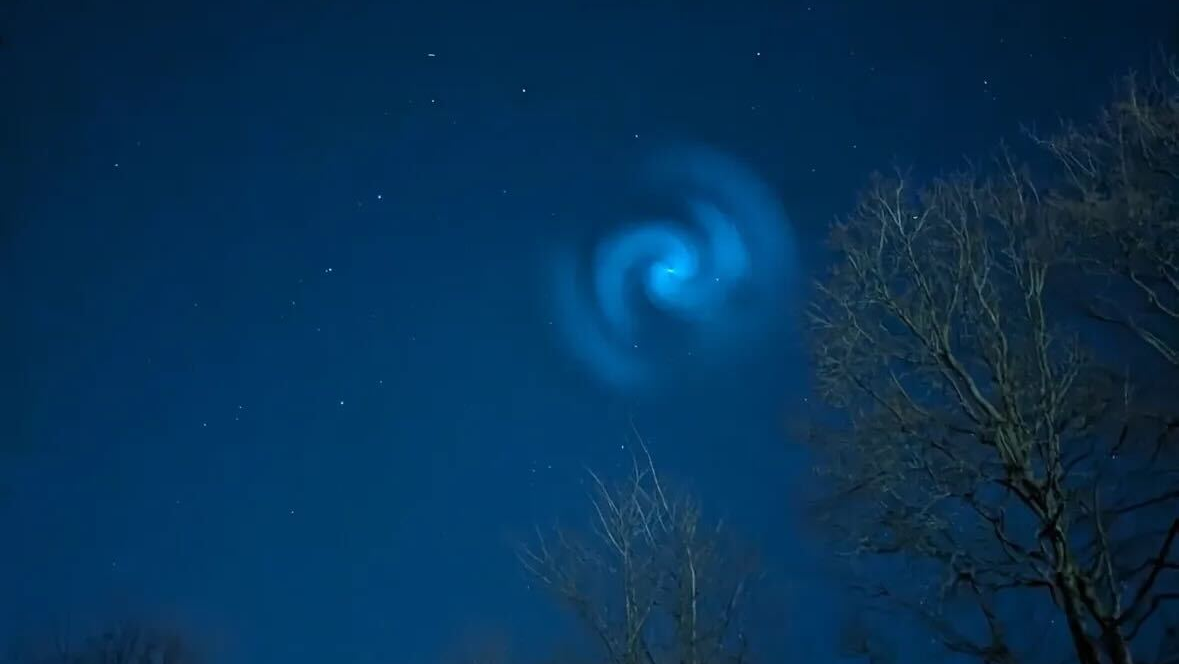
Anyone spot that strange out-of-this-world-looking spiral in the sky last night? Lots of us did here in Greater Manchester and, as it turns out, so did lots of people up and down the country.
In fact, it was sighted all over the world.
If you’re anything like us and guilty of being quick to overreact – most of us are just excitable big kids who still daydream about shooting off to a different planet – you’ll be forgiven for having quickly jumped to the conclusion that it was aliens or some other kind of fantastical phenomenon.
Come on, who wouldn’t see this and start to wonder?
However, we hate to spoil your fun but it wasn’t some kind of UFO or something from another universe – but is that what they want us to think?…
ADVERTISEMENT
Just kidding; after countless people hopped on social media to question what on Earth (or rather not) was going on with the sky and post their own pictures of the strange spiral, one reason was quickly put forward by numerous users and news outlets.
It didn’t take long for those in the US, or who are at least privy to whatever random interstellar nonsense Elon Musk is up to at the minute, to point out that a SpaceX launch had just occurred.
ADVERTISEMENT
On Monday, 24 March, the American aerospace company launched their Falcon 9 rocket just before 6pm GMT and the spiral-like shape, which was visible for several minutes before fading, is believed to have been caused by leftover fuel released by the rocket during the second phase of its launch.
With SpaceX having already shown off how their rockets can now return to Earth, the subsequent fuel plume, on the other hand, freezes instantly and the light transmitting through the atmosphere is the “likely” reason behind this strange spiral illusion, according to the Met Office and other experts.
We've received many reports of an illuminated swirl in the sky this evening 💫
This is likely to be caused by the SpaceX Falcon 9 rocket, launched earlier today. The rocket's frozen exhaust plume appears to be spinning in the atmosphere and reflecting the sunlight, causing it to… pic.twitter.com/4a9urgZceR
So whilst it may not be as sci-fi as your imaginations were hoping for, it is still a showcase of how far we’ve come in terms of technological advancements and creating visuals that would previously feel inexplicable and probably lead to the man on the street to tell his mates, ‘I saw something last night’.
Musk’s relationship with returning President Donald Trump is one that causes concern across large sections of the political landscape and as for his continued space-age innovation, many are deeply worried about the pollution and wider environmental impact caused by several of his companies.
But to circle back: no, it wasn’t some alien portal – just rocket fuel.
Incredible time-lapse.
Tonight, a glowing spiral appeared in the sky over the UK and Europe, likely caused by frozen fuel released from a SpaceX rocket’s second stage after launch. The pattern was visible for several minutes before fading.pic.twitter.com/jL7CXKmXCl
Government sets out multi-million-pound plan to move UK away from animal testing in science
Emily Sergeant
A £22m push to ramp up the UK’s move away from animal testing in science is set to bring together cutting-edge tech and research.
The latest figures show there were 2.54 million animal testing procedures in Great Britain in 2025, which is down 3.8% on 2024, but with a further update due to be released later this year, the Government is now moving to ‘capitalise’ on that momentum with funding to shift the nation onto alternative testing options.
A dedicated national research hub and nine new high-tech projects are planned to develop ‘better ways’ to test medicines on human biology rather than animals.
According to the Government, this means treatments for conditions like cancer and inflammatory bowel disease (IBD) could be developed ‘faster’ and ‘more precisely’ to not only help patients but crucially also move science away from traditional animal testing.
At the heart of the plans is a new Pre-clinical Translational Models Hub – based in Cambridge and backed by £20 million in Government funding, which will work to build and share models of human tissue, grown from NHS patients, to test new treatments.
The new hub will accelerate the development of testing on ‘organoids’ – tiny, simplified versions of a human gut, tumour or brain, using cells donated by patients.
From beating heart cells in a dish to AI that can predict how drugs move through the body, exciting alternatives to animal testing are transforming medical research.
We're investing £22m to help scientists develop the next generation of life-saving treatments. pic.twitter.com/1EWRQvwySa
— Dept. for Business, Innovation, Science and Trade (@biztradegovuk) August 12, 2026
Because these ‘organoids’ retain crucial features of a patient’s own biology, they will help researchers learn how a real person may respond to a drug and provide additional insights that can complement information that is currently obtained from animals.
Scientists will then be able to use these cutting-edge techniques in their own labs to work out which medicines are worth pursuing.
Overall, it’s hoped that the move will slash the time it takes to get ‘potentially life-changing’ treatments to market.
Alongside the funding for the new Hub, nine cutting-edge projects aimed at identifying new methods of animal-free scientific testing – from beating heart cells in a dish, to lab-grown human ear models, and AI that predicts how medicines move through the body – are being funded.
Sadly, many of these still rely on testing on dogs and monkeys, as it stands.
“This marks another significant step forward in the UK’s move away from animal testing in science and research,” commented Science Minister Chris McDonald.
“This is all about backing our world-leading researchers and innovators to improve lives, giving them the tools they need to deliver more effective treatments for horrendous diseases like cancer, while also preventing the need for animal testing wherever possible.
“It’s also a boost for our life sciences sector, fuelling opportunities for new investment and new jobs, and ensuring Britain is better off.”
Elbow get behind campaign to save Jodrell Bank from closure
Danny Jones
Manc band Elbow are among the latest to get behind the campaign to save Jodrell Bank Observatory from closing permanently.
The Greater Manchester natives famously played a sold-out gig at the important scientific and cultural landmark for a very special live album recording well over a decade ago, and know all too well the site’s national and, indeed, global heritage.
Choosing the Observatory and the rare chance to perform a show in the shadow of the world-renowned James Lovell Telescope, it probably remains one of their most significant standalone UK date ever.
With that in mind, the local lads have been left just as worried by the news of its impending closure as everyone else, and have therefore issued a fresh appeal to help keep it open.
Posting a timely statement on social media, the group wrote: “Jodrell Bank has long been close to elbow’s heart. In 2012, the band played beneath the Lovell Telescope for one of the most memorable shows in our history.
“The recent news that funding for the e-MERLIN radio telescope network is set to end in 2028 puts the future of the scientific work at Jodrell Bank under serious threat. It is a remarkable place, with an extraordinary history, and one that continues to play an important role in science, culture and education.”
In addition to reliving clips and images from the historic live set all the years later, they also pointed people towards their ‘elbow – Live at Jodrell Bank‘ album documentary, which has now been made available online for the very first time as part of wider efforts to raise awareness around the cause.
Directing people to key online resources shared by the institution and astrophysics centre itself following their unfortunate update late last month, the push to not only find the funding but sustain support for the facility continues to ramp up throughout the world of science, arts and industry.
For anyone who somehow missed the news – 2028 being the current deadline handed down as per budget cuts across the sector – concerned parties here in the North West and all over the country have since started petitioning to save Jodrell Bank Observatory from shutting down for good.
In addition to being described as a “huge blow” to the field by the Royal Astronomical Society (RAS), some have even gone so far as to describe the decision as a form of “vandalism” when it comes to research and British culture as a whole.
Having also served as the host venue for the annual bluedot Festival since 2016, the multi-genre science and arts celebration could soon be forced to find a new home.
The battle is far from over yet, and the community has time to rescue Jodrell Bank Observatory from its fate, but it will take lots of money and more notable public figures to make it happen.
Once again, you can do your bit by signing the petition mentioned above right HERE.