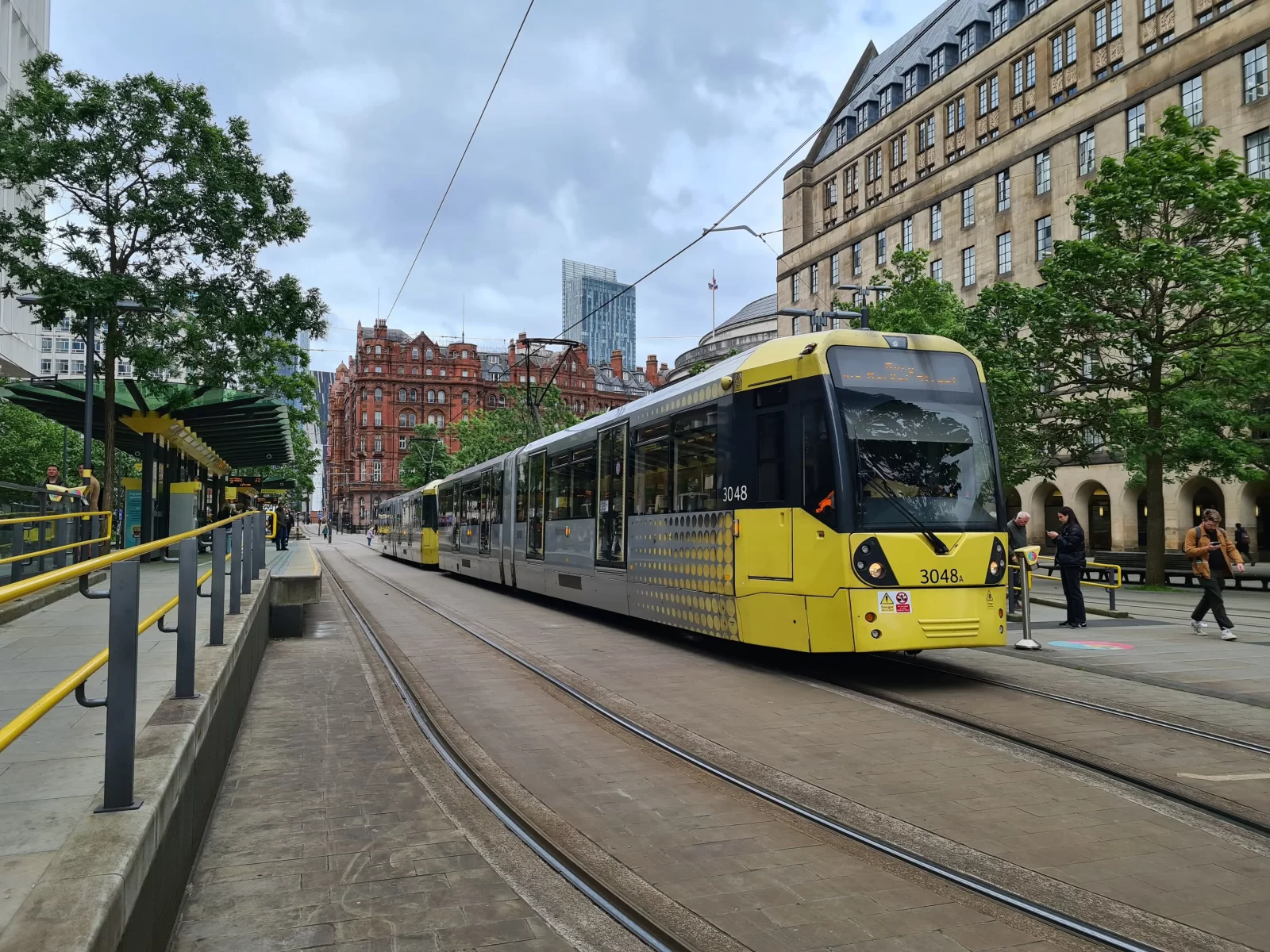
Major disruption is on the horizon, as no trams are set to run on a major Greater Manchester line for two weeks this month.
As the next phase of the ongoing £150m investment into Greater Manchester’s tram network gets under way this month, essential track replacement work is set to be be carried out in a bid to make the network ‘safer’ and ‘more resilient and reliable’ for years to come.
Due to improvement works on the Oldham-Rochdale line – which is being carried out between Monsall and Newton Heath & Moston – there will be no trams between Manchester Victoria and Rochdale town centre for two weeks, starting from this Saturday 16 May right through to Friday 29 May.
The work being carried out will involve replacing sections of track and improving drainage along the route.
The track foundation will also be replaced where needed, as well as work to correct the alignment and level of the track.
ADVERTISEMENT
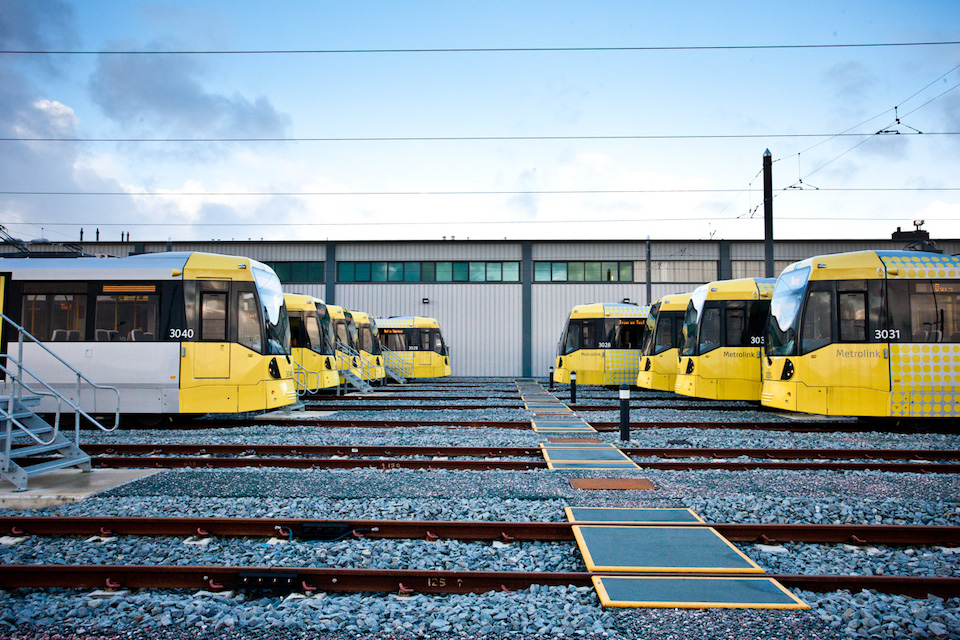
No trams will be running on a major Greater Manchester line for two weeks from this weekend / Credit: TfGM
Transport for Greater Manchester (TfGM) has conceded that this is a ‘big and complex job’ – with 290 new concrete sleepers and 2,000 tonnes of pea gravel being used, and more than 5,000 tonnes of ballast set to be replaced.
But, when the work is done, it’s aiming to make journeys ‘smoother and more reliable’ for passengers, while improving the condition of the track for the long-term.
ADVERTISEMENT
While the work is being carried out and the line is closed, bus replacement services will be in place between Victoria and Rochdale Town Centre, and more frequent Bee Network bus services will also call at the bus stops near each tram stop too, however tram tickets will only be accepted on the replacement bus, not on numbered bus services.
Elsewhere, work at Derker will also take place at the same to ‘minimise disruption’.
The track was made safe following a landslip in summer 2024, but now, a longer-term solution will see teams drive steel sheets into the ground to hold it in place and prevent further movement, before further work will be needed later in the year to complete the job.
ADVERTISEMENT
And to top it off, from Monday 25 to Friday 29 May, improvement work to update equipment that has been in place since the line opened in 1992 will also take place at Piccadilly Gardens, and that means no trams will run between St Peter’s Square/Market Street and Piccadilly during this time.
Customers may need to change trams, take a short walk, or hop on the free bus to continue their journey.
Tram services will resume as normal from the start of service on Saturday 30 May, and passengers travelling during this period are urged to ‘plan ahead’.
Everything you need to know about the planned works is on the TfGM website here.
Featured Image – Janus Boye
City Centre
Manchester’s ‘busiest’ road set to close for annual safety inspections this weekend
Emily Sergeant
The Mancunian Way is set to close for its annual safety inspections this weekend.
As Manchester City Council looks to ‘improve’ what is, by far, one of Manchester’s busiest and most-used roads, given the fact it is the main thoroughfare in and out of the city centre, it has been confirmed that a two-day closure of Mancunian Way is set to take place this weekend so that essential inspection works can be carried out.
With an estimated 15 million journeys taken along this road annually, the Council says it’s vital that inspections are conducted to keep traffic flowing.
Taking place over the weekend, both carriageways and their slip roads will be out of use from 6am on Saturday 27 June until 6am on Monday 29 June.
The closure will run from the Chester Road roundabout and Fairfield Street.
🚧 Mancunian Way Annual Maintenance
The Mancunian Way and its slip roads will be closed on 27–28 June for essential inspections and repairs.
— Manchester City Council (@ManCityCouncil) June 22, 2026
Fully signed diversions will be in place during this time for vehicles travelling in both directions, the Council has confirmed – with diversion routes planned for Trinity Way, Great Ancoats Street, Bridgewater Viaduct, Whitworth Street West, Whitworth Street, and Fairfield Street.
Of course, this does mean that some disruption to the public is expected, with anyone travelling in and out of the city centre told to plan their journeys ahead of time, however the Council has chosen for the closures to be overnight so that any disruption is kept to a low a level as possible.
“Because of the tens of thousands of vehicles we see use the Mancunian Way every day, ensuring its proper maintenance and upkeep is essential”, commented Councillor Mandie Shilton Godwin, who is the Executive Member for Clean Air, Environment and Transport at Manchester City Council.
“There will be a level of disruption which is why we’d urge people to plan their journeys ahead and find an alternative route which avoids the closure.
“Thank you to everyone ahead of your patience as we carry out these essential works.”
Featured Image – Geograph
City Centre
Audio North’s Artist of the Month – Aaron Dinning | June 2026
Thomas Melia
Aaron Dinning is an indie-pop act whose songs span the highs and lows of relationships, and now he’s Audio North’s latest Artist of the Month.
Born in County Durham, studied in Leeds, and now the curator of a live music events organisation based in Manchester, Dinning sure knows a thing about northern music.
With hits to his name already like ’24’, ‘Look Who’s Holding The Gun Now!’, this queer musician is gearing up to release a deluxe edition of his sophomore EP Boys Become Men.
If his name feels familiar to you, that’s because it probably is, as Aaron Dinning has performed at a multitude of venues across the north – including Feel Good Club, Popup Bikes, and The Proud Place.
Now, Dinning chats to Audio North about his upbringing and music journey, as he accepts the title of Artist of the Month for June.
An interview with Aaron Dinning – Audio North’s Artist of the Month | June 2026
Aaron Dinning is making his mark in the Manchester music scene with his indie-pop tracks / Credit: Press Shots via Emily Atherton (Supplied)
You were born in County Durham and now live in Manchester. How have those two places shaped you as an artist?
I think there’s such a contrast in the environment of those two places. Durham was so formative for me growing up, back then I didn’t have the autonomy to vocalise it but now I see Chester-Le-Street specifically as such a ‘small town mindset’ kind of place.
If I stayed at home, I would never be the artist I am today. That’s not to say that growing up somewhere like that isn’t just as important as the place which makes you feel accepted. You can’t have such a strong desire for one without a disdain for the other.
What does being a northern musician mean to you?
I think being northern, to me, just means breaking the mould and showing that if I can do it, anybody can. It means building my career on my own terms, it’s taught me to unapologetically be myself, on and off stage.
I always say that I want to write the songs I needed when I grew up because there was nobody like me from the North. Sometimes it still feels like I’m the only one too.
To me, if I can write a song, or put on a performance that resonates with a 15-year-old kid who’s still figuring out who they are or who they love, that’s the most fulfilling thing that can come from sharing my art.
This Northern talent is from Country Durham, studied in Leeds and is now based in Manchester / Credit: Press Shots via Jack Garrod (Supplied)
The music industry can feel very London-centric at times. Have you found being based in the North to be an advantage or a challenge?
It’s a bit of both really. Yes, London is where the majority of the big names in music are, but in my mind, I always compare it to that scene in Baby Reindeer when the guy says ‘You find yourself a background artist in a cast of millions’ (niche).
I like that the industry isn’t as saturated as London up here, but I can see that changing in years to come. The North has always been where it’s at and truly where all these major labels should be looking for who’s up next because you might just find a gem like me waiting to be found.
Is there a northern artist who made you think, “If they can do it, so can I”?
Definitely Sam Fender. I know it’s a bit of a cliche nowadays, but I absolutely love him and he’s what I think of when it comes to a classic northern success story.
I’ve seen him six times and the last time at St James’ Park was a completely different calibre of show to when I saw him at Boiler Room in 2019 and paid fifteen quid for the ticket.
Me and him are completely different, but I imagine we had a similar sort of upbringing in the terms of characters we knew growing up in rougher areas. I feel like he cracked the mainstream so well with his first album and he’s only gotten better since. I’d want my first album to have the same kind of critical acclaim as his.
Dinning fuses his sexuality throughout his music, being an openly queer pop musician / Credit: Press Shots via Tom Hargreaves (Supplied)
What made Manchester feel like the right place for the next chapter of your career?
ADVERTISEMENT
I recorded my entire EP here whilst I was still living in Leeds with Toby Ollis Brownstone from the beginning of 2024. That year and a half which I spent travelling back and forth in Manchester made me love the city and loathe commuting.
I knew I wanted to move to Manchester when I got invited to play the Queer as F*ck open mic on Valentine’s Day in 2025. That was the first show I played accompanying myself on the guitar, I agreed to play three hours before doors and completely fumbled my way through the set.
The feeling of the room was like nothing I’d experienced before, to come to a show in another city I had never played in and feel so welcomed, at home and accepted by a room full of likeminded people, felt like a feeling I could only replicate in Manchester.
Has living in Manchester changed your songwriting at all?
Generally speaking, I’ve been playing guitar a lot more since moving here. I feel like there’s a naive fresh start that comes along with moving to new places and feeling like your life’s going to drastically change.
ADVERTISEMENT
Becoming the Producer of SoFar Manchester helped me feel integrated and I’ve met so many cool people doing that job while spotlight my friends who are artists and bring them to the city that I fell in love with – It’s all very full circle.
I’ve brought Romy Taylor, Caitlin Doran, Sophie Green, and GRACEY over to play SoFar events and they’re all equally amazing creatives who are based in Leeds, like I once was.
The ’24’ singer has played gigs in unusual Manchester city centre locations like Popup Bikes in Ancoats / Credit: Credit: Press Shots via Emily Atherton (Supplied)
What do you think Manchester does better than anywhere else when it comes to music?
I think Manchester is such a hot pot of different styles and genres. I think the thing it does best is spotlight LGBTQ+ artists. Not just in music, but drag is somewhere I look to when I think of performance, and the queens in the village are truly a sign of resilience and individuality.
I’ve had more shows just for being queer in Manchester than anywhere else I’ve lived, there’s so many freelance creatives, charities and gig promoters who are looking out for LGBTQ+ artists to celebrate, even making entire lineups out of us.