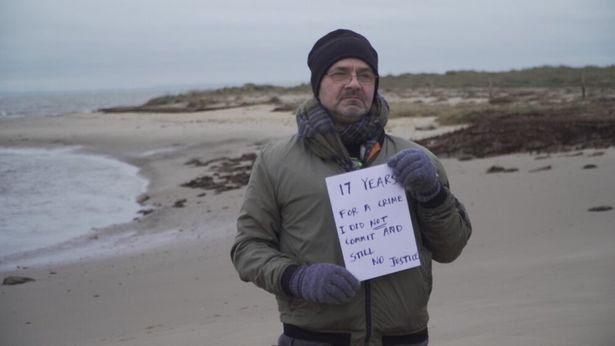
A man who spent 17 years in prison for a rape he has continued to claim he did not commit has now been granted a fresh appeal after DNA was linked to an alternative suspect.
57-year-old Andrew Malkinson from Grimsby was convicted by a jury verdict of 10-2 of strangling and raping a woman in Little Hulton in Salford back in 2003, and was jailed for life following a trial at Manchester Crown Court in February 2004.
The victim – who had been walking home alone in the early hours of 19 July 2003 – was sexually assaulted after being throttled until the point of unconsciousness, and also suffered a broken neck and a fractured cheekbone during the attack.
There was no DNA or other forensic evidence linking Mr Malkinson to the crime at the time, and the prosecution case relied mainly on identification evidence from eyewitnesses.
This is why he has always maintained his innocence and insisted it was a case of mistaken identity.
ADVERTISEMENT
New DNA evidence could clear ‘innocent’ man who spent 17 years in prison for Salford rape / Credit: APPEAL
Mr Malkinson had twice been refused an appeal in the past after applying for his case to be reviewed by the Criminal Cases Review Commission (CCRC) – which is the body responsible for investigating alleged miscarriages of justice – but after being released on license from prison back in 2020, scientific techniques have advanced, and this has potentially lead to some new evidence.
The legal team at the charity APPEAL was able to commission new DNA testing that revealed the presence of unknown male DNA in samples taken from the victim and her clothing, and this “breakthrough” has therefore cast doubt on Mr Malkinson’s conviction.
ADVERTISEMENT
APPEAL Director Emily Bolton said “the battle for justice is not yet over”, adding that the CCRC “will now form its own view of the fresh evidence and we hope they will agree that Andy’s conviction cannot now be regarded as safe.”
Mr Malkinson says he “finally has the chance to prove his innocence”.
“I am innocent. Finally, I have the chance to prove it. I only have one life and so far 20 years of it has been stolen from me. Yesterday I turned 57 years old. How much longer will it take?” – Andy on his CCRC referral decision
— APPEAL @we-are-appeal.bsky.social (@we_are_APPEAL) January 24, 2023
“I am innocent,” Mr Malkinson questioned in a statement provided by his legal representatives.
ADVERTISEMENT
“Finally, I have the chance to prove it thanks to the perseverance of my legal team at APPEAL. I only have one life and so far 20 years of it has been stolen from me. Yesterday I turned 57 years old. How much longer will it take?”
As well as the case having being referred back to the CCRC this week, in light of new information, Greater Manchester Police (GMP) confirmed last month that it had arrested a 48-year-old man from Exeter on suspicion of rape, but he has since been released under investigation.
Addressing Mr Malkinson’s case, CCRC chairwoman Helen Pitcher said: “The new results raise concerns about the safety of these serious convictions.
“It is now for the Court of Appeal to decide whether they should be quashed.
Our client Andy Malkinson, who spent more than 17 years in prison maintaining his innocence, is at last given the chance to clear his name.
— APPEAL @we-are-appeal.bsky.social (@we_are_APPEAL) January 24, 2023
“New evidence can come to light years after a conviction, and in the ever-changing world of forensic science, it is crucial an independent body can undertake these enquiries and send cases of concern back to court.
ADVERTISEMENT
“Following Mr Malkinson’s application, we used our special powers and expertise to re-examine this case, instructing experts to undertake state-of-the-art DNA testing.”
Victim named and murder investigation launched after young woman is killed in Newton Heath stabbing
Emily Sergeant
The victim of a street stabbing in Newton Heath this week has been named for the first time as a murder investigation continues.
It comes after officers from Greater Manchester Police (GMP) responded to reports of a disturbance at around 2am yesterday (Thursday 15 October) on Dorking Avenue, in the Newton Heath area of Manchester, and when they arrived on the scene, they found a woman in her 20s with serious injuries that were ‘consistent with a stabbing’.
Despite best efforts of all emergency services involved, the young woman was sadly pronounced dead at the scene.
As the murder investigation progresses, the woman has now been publicly named and a photo of her has been released for the first time.
She has been named as 26-year-old Alisha Samuels.
At this time, one man, aged 25, has been arrested on suspicion of murder, and a man and woman, aged 61 and 38, have been arrested on suspicion of assisting an offender, and they all remain in custody – with officers continuing their enquiries to establish the full circumstances of this incident.
Alisha’s family have asked for privacy whilst they deal with the devastating loss of their loved one, GMP has stated.
“We are continuing to urge people who may have information in relation to this incident to please come forward to support our investigation and bring justice for Alisha,” the police force said in a public appeal.
Anyone who may have witnessed the incident, or has mobile phone, CCTV, or doorbell footage, is urged to call GMP on 0161 856 5464, or contact them via the Major Incident Public Portal here.
Alternatively, you can contact Crimestoppers on 0800 555 111
Featured Image – GMP (Family Handout)
News
Former supply teacher jailed for multiple upskirting and AI sex offences across Greater Manchester
Emily Sergeant
A former supply teacher has been jailed for multiple upskirting and AI sex offences in schools across Greater Manchester.
Abusali Rahman – a British national of Bangladeshi ethnicity from Salford – appeared in Bolton Crown Court this week for his sentencing after first being charged with, and then pleading guilty to, several offences.
The offences are including, but not limited to, 12 counts of taking an indecent photograph/pseudo-photograph of a child (images obtained by upskirting), three counts of making indecent photograph / pseudo-photograph of a child (making AI-generated images), and one count of attempting to meet girl under 16 following sexual grooming.
The offences are alleged to have taken place between December 2023 and June 2025, according to Greater Manchester Police (GMP).
Twelve girls have been identified in relation to the upskirting offences – aged between 13 and 16 at the time of the alleged offending – at seven high schools in three Greater Manchester boroughs (Bury, Bolton, and Salford).
GMP says it has remained in close contact with the schools, local authorities, and other partners throughout the investigation to ensure all appropriate support is in place for those who need it.
Additionally, the court also heard how Rahman amassed a collection of images of young girls, using AI and other methods to sexualise them.
The images numbered more than 300 in total, ranging from Category A to Category C classifications, and Rahman would post these on social media, often alongside humiliating and disgusting captions.
Rahman was sentenced to six years in prison, and will also be subject to a 20-year Sexual Harm Protection Order.
A former supply teacher has been jailed for child sex offences in schools across Greater Manchester / Credit: GMP
Detective Constable Lisa McGaffin, from GMP’s Bolton Child Protection Team, described Rahman’s crimes as ‘absolutely abhorrent’.
“My thoughts throughout this process have always been with the young girls who have been subject to such indignity,” DC McGaffin said following the sentencing this week. “Their welfare and support will always be a priority for us.
“While working as a teacher – someone who young children should trust and be safe with – Rahman repeatedly took secret photos for his own sick gratification, before posting images online which showed his total disregard for the girls’ respect and dignity.

 Emily Sergeant -
26th January 2023
Emily Sergeant -
26th January 2023