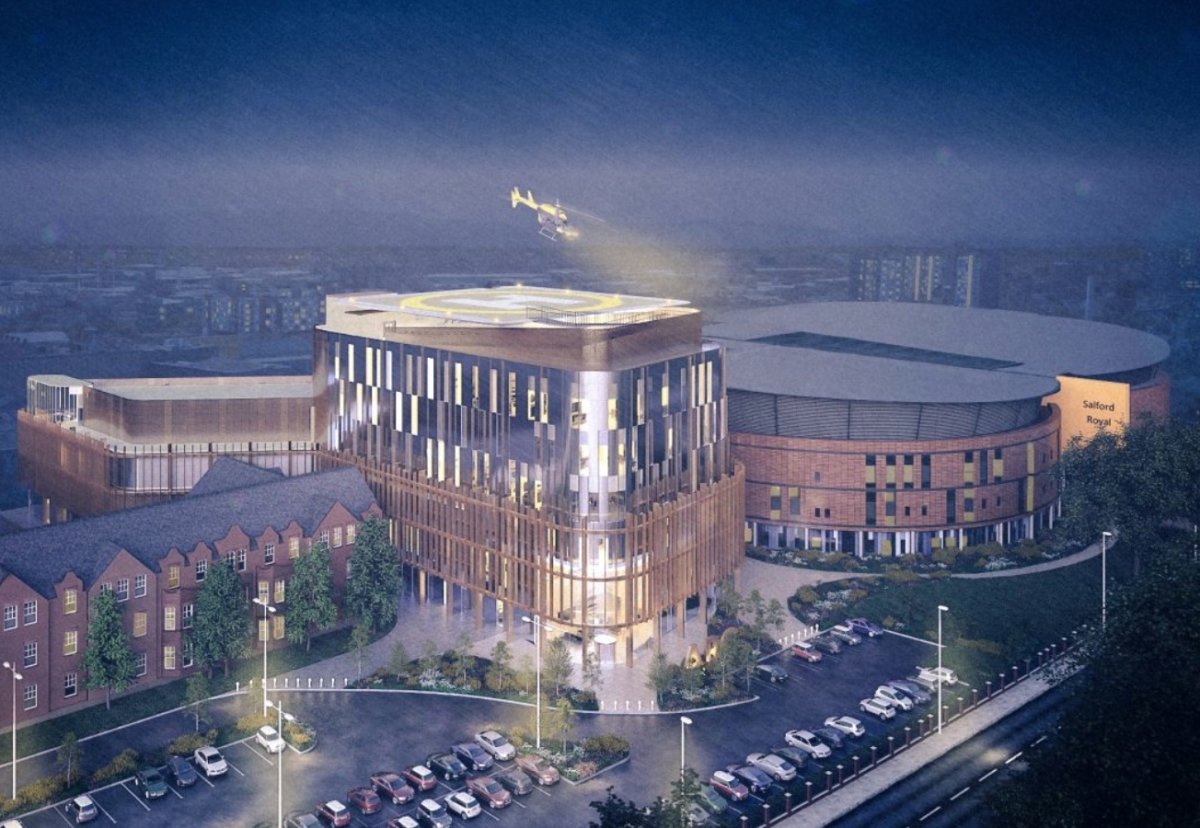
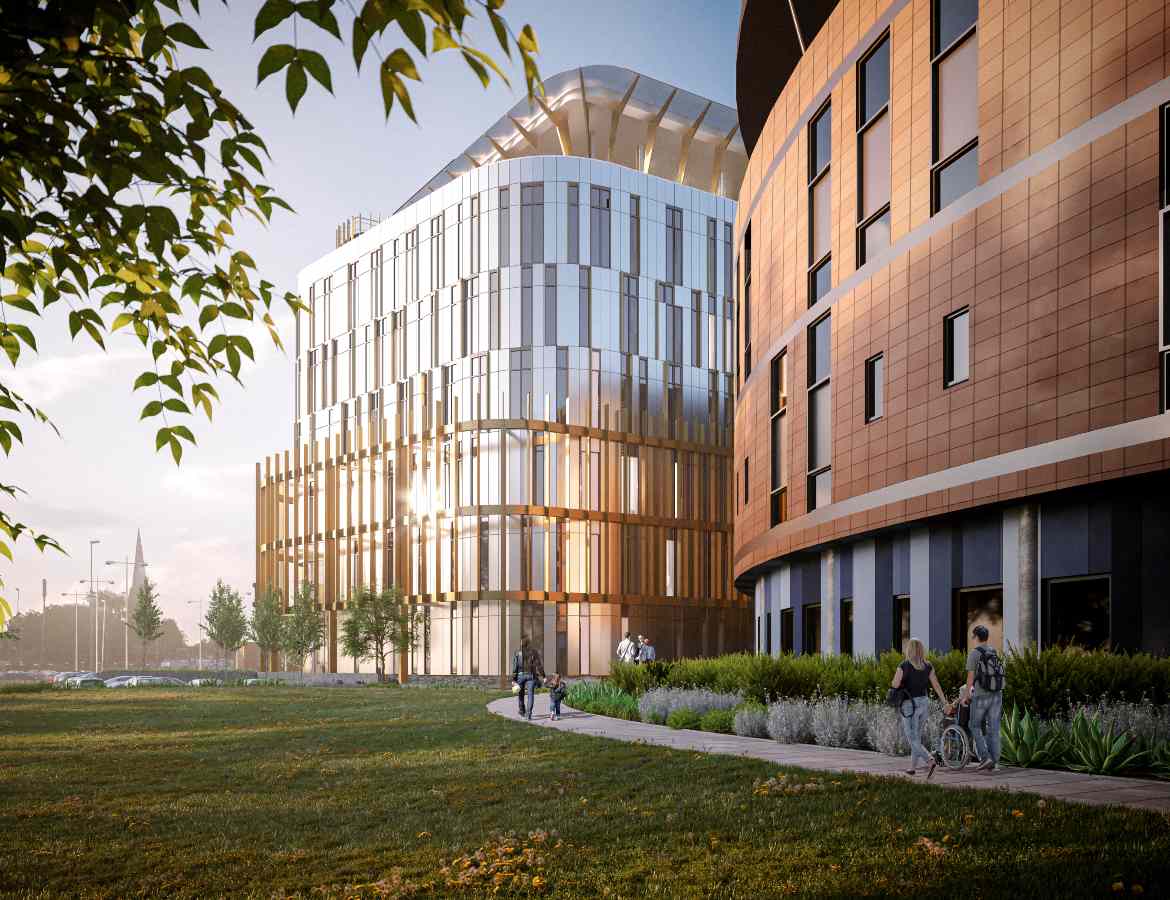
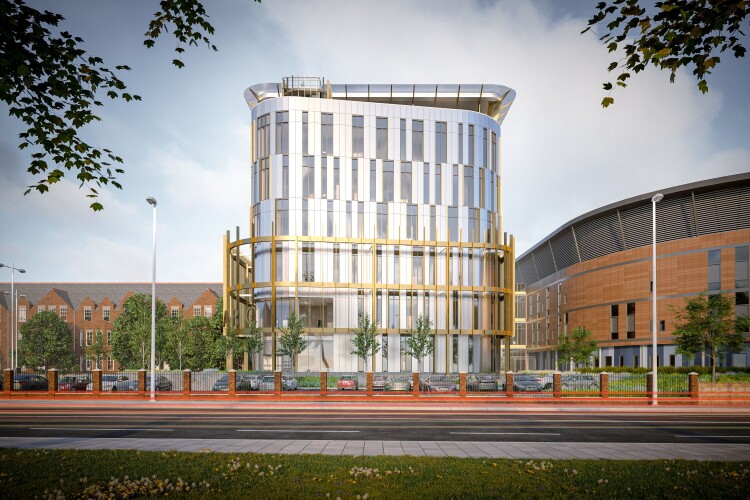
Work is set to begin on a brand new £68 million “state of the art” trauma centre to expand the services at Salford Royal Hospital.
Following planning permission for the project – which was granted back in December 2019 – ground will be broken on the new six-storey development today, making Salford Royal a central hub for 90% of major trauma operations across Greater Manchester and a provider of support for people involved in serious incidents, such as car crashes or life-changing falls.
The new centre will be named the James Potter Building in honour of the hospital’s recently retired long-standing chairman.
Once complete, the new centre is expected to treat around 400 patients a year and is set to include a resuscitation area, five emergency theatres, inpatient beds, diagnostic imaging and even a helipad, which means that seriously ill patients will reach the site even quicker for potentially life-saving treatment.
It will also make Salford Royal a hub for high risk emergency general surgery for patients in Bolton and Wigan.
ADVERTISEMENT
Speaking on the start of construction Raj Jain – CEO of the Northern Care Alliance NHS Group, which runs Salford Royal – said: “This important facility has been many years in the planning with a number of our local, regional and national partners and it’s great to now be just weeks away from the official start date of construction.
“We are proud to be the major trauma centre for Greater Manchester and this centre and the amazing state of the art facilities and our specialist clinical teams within it will allow us to provide trauma care and services to an additional 400 trauma patients per year and help save more lives.
ADVERTISEMENT
“Our partnership with Bolton NHS Foundation Trust and Wrightington, Wigan and Leigh NHS Foundation Trust will see us use this facility as the home for a new single-service for high risk emergency general surgery.
“This new team will strive to provide a general surgery service with the best outcomes in the UK”.
BAM / Northern Care AllianceBAM / Northern Care Alliance
He continued: “We are of course currently working through the most challenging of times as we deal with the pressures and challenges of the COVID-19 pandemic [but] the start of construction work is extremely welcomed and fills us all with excitement about the fantastic future that we can start to create for major trauma and complex general surgery services.”
ADVERTISEMENT
Rob Bailey – Healthcare Construction Manager at the company behind the construction work, BAM – said: “We have worked extensively on the design and programme with the trust to understand fully what their requirements are, and focus completely on what matters to them to provide a high quality building in which their patients are cared for and their staff can provide that care.
“That is how buildings should be delivered, with the outcomes the client wants placed at the centre.”
Health minister Edward Argar added: “I am pleased work is underway on this major development to provide state of the art new facilities and ensure patients can access specialised, life-saving treatment.
“The £68m new hospital at Salford Royal will be one of the 48 hospitals which we’re backing to deliver by 2030 as part of the biggest hospital building programme in a generation and strategic long-term investment in the future of our NHS.”
The new development is predicted to take until Summer 2023 to complete.
News
Victim named and murder investigation launched after young woman is killed in Newton Heath stabbing
Emily Sergeant
The victim of a street stabbing in Newton Heath this week has been named for the first time as a murder investigation continues.
It comes after officers from Greater Manchester Police (GMP) responded to reports of a disturbance at around 2am yesterday (Thursday 15 October) on Dorking Avenue, in the Newton Heath area of Manchester, and when they arrived on the scene, they found a woman in her 20s with serious injuries that were ‘consistent with a stabbing’.
Despite best efforts of all emergency services involved, the young woman was sadly pronounced dead at the scene.
As the murder investigation progresses, the woman has now been publicly named and a photo of her has been released for the first time.
She has been named as 26-year-old Alisha Samuels.
At this time, one man, aged 25, has been arrested on suspicion of murder, and a man and woman, aged 61 and 38, have been arrested on suspicion of assisting an offender, and they all remain in custody – with officers continuing their enquiries to establish the full circumstances of this incident.
Alisha’s family have asked for privacy whilst they deal with the devastating loss of their loved one, GMP has stated.
“We are continuing to urge people who may have information in relation to this incident to please come forward to support our investigation and bring justice for Alisha,” the police force said in a public appeal.
Anyone who may have witnessed the incident, or has mobile phone, CCTV, or doorbell footage, is urged to call GMP on 0161 856 5464, or contact them via the Major Incident Public Portal here.
Alternatively, you can contact Crimestoppers on 0800 555 111
Featured Image – GMP (Family Handout)
News
Former supply teacher jailed for multiple upskirting and AI sex offences across Greater Manchester
Emily Sergeant
A former supply teacher has been jailed for multiple upskirting and AI sex offences in schools across Greater Manchester.
Abusali Rahman – a British national of Bangladeshi ethnicity from Salford – appeared in Bolton Crown Court this week for his sentencing after first being charged with, and then pleading guilty to, several offences.
The offences are including, but not limited to, 12 counts of taking an indecent photograph/pseudo-photograph of a child (images obtained by upskirting), three counts of making indecent photograph / pseudo-photograph of a child (making AI-generated images), and one count of attempting to meet girl under 16 following sexual grooming.
The offences are alleged to have taken place between December 2023 and June 2025, according to Greater Manchester Police (GMP).
Twelve girls have been identified in relation to the upskirting offences – aged between 13 and 16 at the time of the alleged offending – at seven high schools in three Greater Manchester boroughs (Bury, Bolton, and Salford).
GMP says it has remained in close contact with the schools, local authorities, and other partners throughout the investigation to ensure all appropriate support is in place for those who need it.
Additionally, the court also heard how Rahman amassed a collection of images of young girls, using AI and other methods to sexualise them.
The images numbered more than 300 in total, ranging from Category A to Category C classifications, and Rahman would post these on social media, often alongside humiliating and disgusting captions.
Rahman was sentenced to six years in prison, and will also be subject to a 20-year Sexual Harm Protection Order.
A former supply teacher has been jailed for child sex offences in schools across Greater Manchester / Credit: GMP
Detective Constable Lisa McGaffin, from GMP’s Bolton Child Protection Team, described Rahman’s crimes as ‘absolutely abhorrent’.
“My thoughts throughout this process have always been with the young girls who have been subject to such indignity,” DC McGaffin said following the sentencing this week. “Their welfare and support will always be a priority for us.
“While working as a teacher – someone who young children should trust and be safe with – Rahman repeatedly took secret photos for his own sick gratification, before posting images online which showed his total disregard for the girls’ respect and dignity.

 The Manc -
22nd February 2021
The Manc -
22nd February 2021