Lots of activities fall victim to Manchester’s infamously wet weather. But theatre performances aren’t usually one of them. Yet last week, I found myself in a stormy Salford Quays, being told by a soaking-wet stage manager that the play I was supposed to review was off because the actors’ umbrellas kept threatening to break.
Unlike most plays, Contact is performed outdoors – and fair weather is an unusually important factor in the play’s success. Thankfully, the second time I ventured over to Media City, the clouds had parted and the sun was shining: creating the perfect climate for outdoor, immersive theatre.
As I arrived, the group that became the play’s audience were sprawled across the steps in front of the BBC building, sorting out the smartphone app essential to how Contact works. This tech provides the audio for the play, which is synced across each of the audience’s and actors’ phones. The actors never speak aloud – we hear their voices in our ears through a pre-recorded soundtrack.
Audio-walking theatre has been growing fast due to the pandemic, as theatres have been closed and social distancing measures enforced. It’s something that Manchester has embraced, with two audio-theatrical offerings launched this year already.
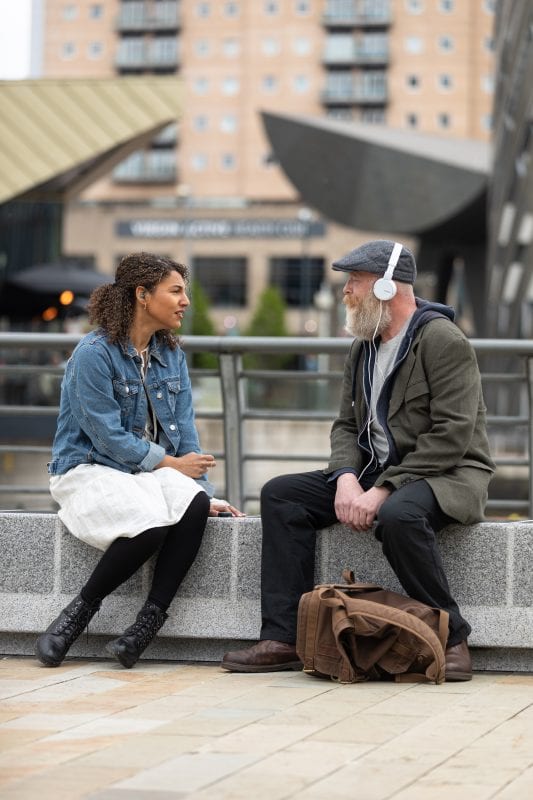
Chloe Gentles and Cellan Scott in Contact (Phil Tragen)
The elements that make up these plays – listening through headphones, being outdoors, walking around, engaging with passers-by, the weather – are all distinct and unusual things to bring to theatre under any circumstances. Combining them all into one performance seems ahead of its time.
ADVERTISEMENT
The experience of being both watcher and watched, audience and performer, is very strange. It’s the sort of thing that would fit brilliantly in the arty, edgy Edinburgh Fringe. However, participating in such immersive live theatre definitely requires a confidence (which I’m not sure I have).
Contact, originally a French play written in three weeks at the start of lockdown and now brought to Manchester, is about Sarah, who, when out on her daily walk, meets her guardian angel. Her deepest fears and anxieties then start to bubble to the surface. The audience follows Sarah as she sits, walks, and thinks. It’s a strange experience, as the clearly demarcated lines between reality and fiction blur. Walking past people drinking and eating, the audience becomes part of the performance, and creates its own spectacle for passers-by.
Manchester-based theatre company ThickSkin have created an audio-walking play series called #WalkThisPlay, with the first episode ‘Keep Going then Vanish’ set in a big loop around central Manchester. The play physically drives you around the city as you search for something you’ve lost, that you keep forgetting, that you know you need to find. As you walk, your location triggers the next part of the story.
What’s most exciting about these plays is the opportunity to experience theatre again after such a long time. #WalkThisPlay doesn’t involve any live performance from professional actors, but as you walk around, listening to the evocative voices of Danielle Henry and Esme Bayley, you become the live element of the experience, immersing yourself in the world of the show. This is heightened in Contact by watching actors perform live in front of you: I couldn’t help but shiver with anticipation as the play started. There is no substitute for live performance.
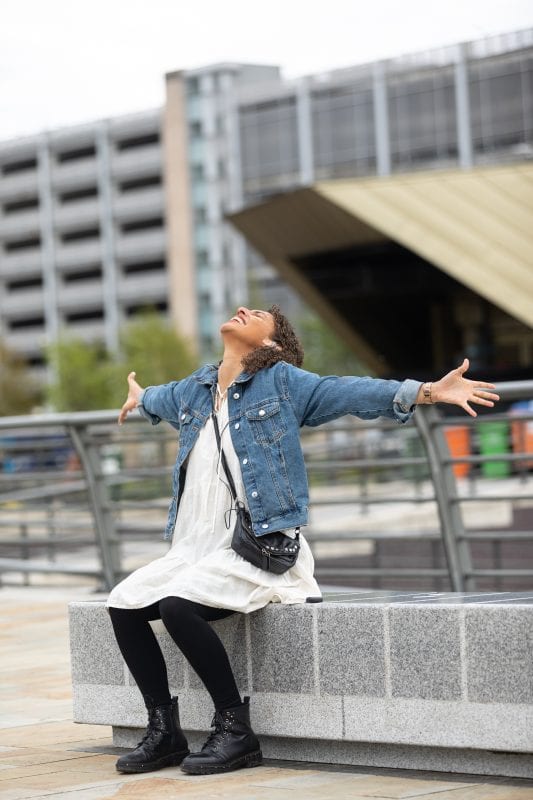
Chloe Gentles in Contact (Phil Tragen)
Aliveness becomes all-encompassing in outdoor theatre like this. Smells, the breeze on your face and in your hair, a spot or two of rain: all become noticeable. As you walk, directed through your ears, you take in your surroundings in a different way. ‘Keep Going then Vanish’ directs you through the “black and white alley” of St Ann’s Passage, to stop in front of the old Theatre Royale, and to listen to the voices of those buried beneath St John’s Gardens.
ADVERTISEMENT
The technology surrounding the experience is both simple and complicated. The #WalkThisPlay series uses GPS tracking on your smartphone to map your movements, and when you reach a hotspot, the next part of the story plays. Contact relies heavily on very tight syncing of the audio in the audience’s ears to the actors’ performances. It’s possible as well to listen to the show in a different language, but still exactly synced with the performance (just as foreign language films are dubbed into English and vice versa).
These plays are very different experiences. #WalkThisPlay, simply an audio play with technology enabling you to interact with the story, is more internal and more personal. You aren’t sharing the experience with anyone (although it would be easy to do the walk with friends, each listening on their own phones). Contact, with its live performance, seems an elevation of #WalkThisPlay, pushing the concept further (perhaps than is comfortable).
They exist as a way to experience theatre in a year without it, but more than that, they’re charting a path forward in what theatre could be in the future. This is what I’m excited for.
Contact featured images: Phil Tragen 2021
Contact is running until 27 June in Salford and central Manchester. For more information and tickets, head to the show’s website.
#WalkThisPlay’s first episode is available for free on the Echoes app. The second play, ‘Monuments’, will be available from 30 May.Click here for more details.
Theatre
A new stage adaptation of a Virginia Woolf classic is coming to Manchester
Danny Jones
With both World Book Day and International Women’s Day having only just passed, it feels like perfect timing for a UK tour of a new theatrical adaptation of one of the most important works of feminist writing ever to have just been announced: Mrs. Dalloway.
And, of course, it’s being brought to Manchester.
The legendary modernist novel by Virginia Woolf has already been adapted for stage and screen multiple times, but this most recent version has been hailed as “cinematic”, “immersive”, and striving to be just as ‘radical’ as the original masterpiece itself.
It’s one of the latest shows coming to Storyhouse in Chester for a world premiere, before heading out across the UK for just a select few special performances.
A co-production between said Storyhouse, as well as Harlow Playhouse and CutToTheChase Productions, it’s been co-created by award-winning director Jen Heyes, with help from Olivier Award-winning writer and performer, Kit Green.
Green takes up the role not only of the titular and long-studied character for this bold reimagining of Clarissa, but will also feature as husband Richard Dalloway, tragic supporting character Septimus Warren Smith, and others.
Bookworms and English literature students will likely have come across the name at least in passing, even if they haven’t read it for themselves, and it still remains just as striking now as it was when first published back in 1925.
Elsewhere referred to as The Hours in her diary entries, the text inspired a 2002 Hollywood movie using that ‘original’ working title starring Nicole Kidman, Julianne Moore, and Meryl Streep – all of whom play women whose story mirrors that tale and/or troubles of Virginia Woolf in some way.
Most famously, however, it was also turned into an eponymous British film in the late 90s, with Vanessa Redgrave as an older Mrs Dalloway and Natascha McElhone as her younger self.
Virginia WoolfThe first major version of Mrs Dalloway on film (1997)Green embodying one of many rolesCredit: Topfoto/NTB (via NDLA)
Both have little cult followings of their own, as you would expect from anything with the famous writer’s name attached to them, but theatre fans have every reason to be very excited about this next take.
Speaking ahead of the inaugural performance of the play, director Jen Heyes said in a statement, “I wanted audiences to step inside Woolf’s world and see it in a way they won’t expect.
“We’ve mixed theatre, film, and bold reinterpretations to create something alive, surprising, moving, and entertaining. My hope is that people leave the theatre carrying the story with them long after the lights go down.”
Following the Cheshire debut on Friday, 29 May, running until 6 June, the production will head to Harlow in Essex, and Wilton’s Music Hall in London, before landing at beloved local theatre, cinema and arts space, HOME, over on First Street this autumn.
The stage version of Mrs. Dalloway will be in Manchester from 24-26 September (Thurs-Sat); you can grab your tickets HERE. We’ve been spoiled by some VERY good new material of late…
Watching Mamma Mia! at Manchester Palace Theatre proved once again why this ABBA-powered musical remains one of the most beloved shows in modern theatre.
The audience arrived ready for a party, and the cast delivered an energetic, feel-good performance packed with humour, heart, and, of course, a catalogue of iconic pop songs.
At the centre of the story is Sophie Sheridan, a young bride-to-be, determined to discover the identity of her father before her wedding day. Secretly, she invites three men from her mother Donna’s past to the island, creating chaos, comedy, and emotional revelations along the way.
The plot is famously light… but it provides the perfect framework for a soundtrack built entirely on hits by the iconic Swedish pop band ABBA.
Mamma Mia! brought infectious energy to Manchester’s Palace Theatre / Credit: Brinkhoff / Moegenburg (Supplied)
Jen Griffin leads the company as Donna Sheridan with warmth and a commanding stage presence. Her stand-out performance balances humour with vulnerability, culminating in a powerful rendition of ‘The Winner Takes It All’.
As Sophie, Lydia Hunt brings youthful excitement and a clear, expressive vocal performance, making her character’s search for identity both believable and engaging.
Donna’s loyal friends provide much of the show’s comedy (and cheers from the crowd). Rosie Glossop plays Rosie with scene-stealing wit and excellent comic timing, particularly during ‘Take a Chance on Me’, while Sarah Earnshaw gives Tanya glamorous confidence and sharp humour. Together the trio create the emotional backbone of the show, portraying friendship that feels authentic and affectionate.
The three possible fathers are played by Luke Jasztal as Sam, Richard Meek as Harry, and Mark Goldthorp as Bill. Each bringing their own unique character personality to the role, helping the storyline unfold with plenty of charm. Meanwhile, Joe Grundy plays Sky with relaxed confidence opposite Sophie.
Visually, the production captures the sunny escapism audiences expect, with bright Mediterranean colours, lively choreography, and a cleverly simple island set that transports the audience far from the streets of Manchester. Ouzo anyone?
By the time the encore begins, with the cast returning in glittering costumes for a joyous ABBA medley including ‘Dancing Queen’ and ‘Waterloo’, the audience is firmly on its feet.
The show last night felt less like a typical theatre evening and more like a celebration. It may not be subtle, but Mamma Mia! remains addictively entertaining.
Featured Image – Brinkhoff / Moegenburg (Supplied)