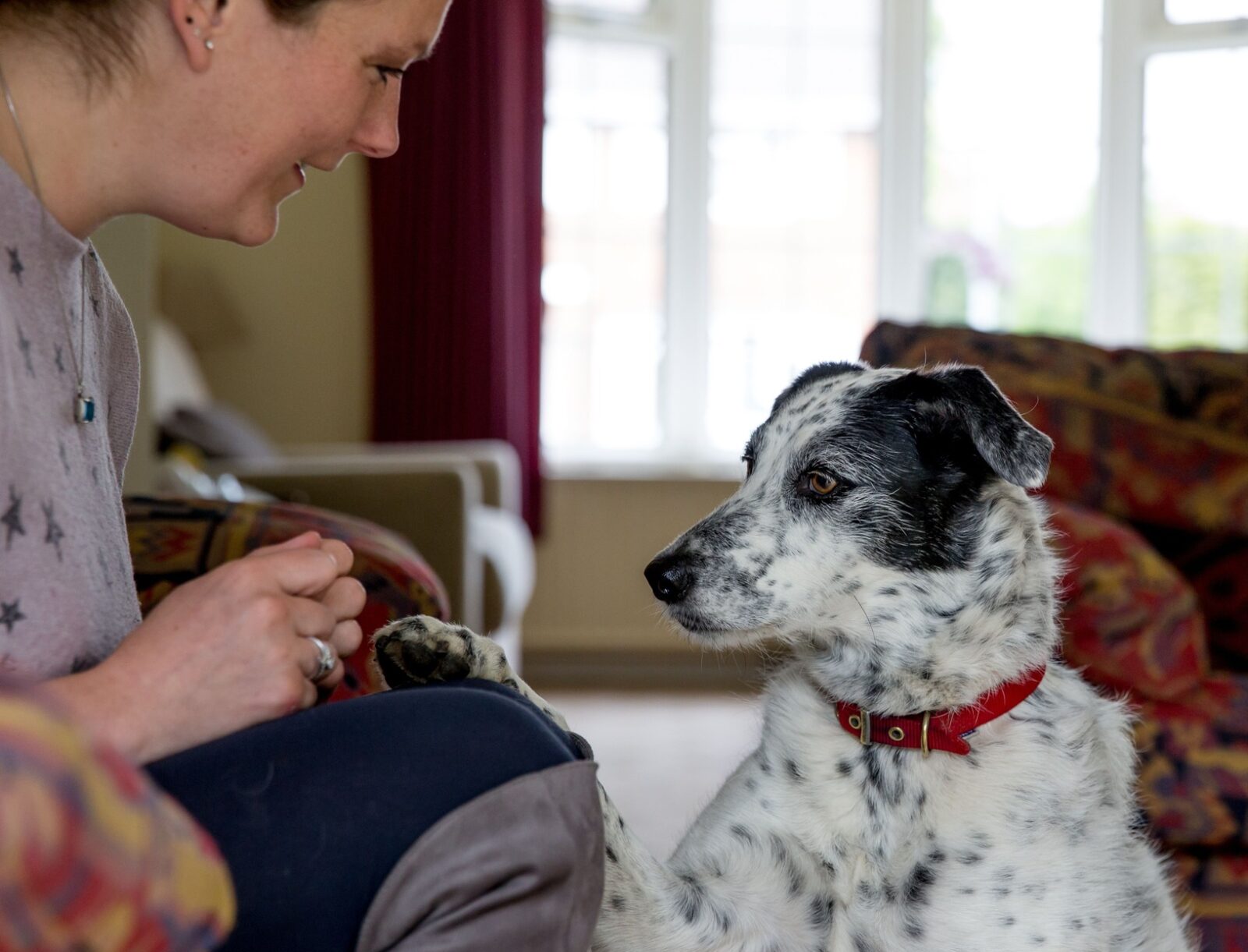
Dogs Trust is in urgent needs of more foster carers in Greater Manchester to temporarily-care for the dogs of domestic abuse survivors.
After sadly seeing an 88% increase in demand from owners in need post-COVID, the Dogs Trust Freedom Project – which was launched back in 2019, and is a specialist pet fostering scheme run by the UK’s largest dog welfare charity – is appealing for more dog-lovers to become foster carers, so that it can lend a hand to even more survivors of domestic abuse.
The Dogs Trust Freedom Project has already provided foster homes for 147 dogs in the North West since being launched, and it’s services have enabled survivors to access safe accommodation without the fear of what may happen to their dog if they cannot take them with them.
“Sadly, there is a strong link between domestic abuse and abuse to pets,” explained Joanne Jackson – Regional Manager at the Dogs Trust Freedom Project.
“Research shows pets will often be used by a perpetrator as a tool to threaten or coerce their partners.”
ADVERTISEMENT
Become a foster carer for our #FreedomProject and you’ll help a survivor of #domesticabuse flee to safety without the fear of what would happen to their dog. 💛
She added that this is “incredibly frightening” for survivors.
“As many refuges are unable to accept pets, survivors are understandably concerned about their dog’s safety when they need to escape.
ADVERTISEMENT
“While we already have fantastic volunteer foster carers in place in the region, we urgently need the dog loving public to come forward to volunteer.
“Foster carers to help us support people and their pets when they need it most.”
Dogs Trust is in urgent needs of more foster carers in Greater Manchester / Credit: Dogs Trust
How can I volunteer?
The Dogs Trust Freedom Project says it is particularly looking for volunteers who are at home during the day – potentially people who are retired, or work from home – and they must have had some prior experience of caring for dogs.
ADVERTISEMENT
They will also need to be able to commit to fostering a dog for at least six months, although holiday cover can be provided.
All pet food and the cost of veterinary treatment is covered by Dogs Trust too.
The charity explains that involvement in fostering through the project is always kept completely confidential to a bid to protect both the dogs and the foster carers, and dogs are not fostered within the area that the owner is from.
The foster carer will not know who the owner is or where they live.
The dog welfare charity has sadly seen an 88% increase in demand from owners in need post-COVID / Credit: Dogs Trust
Think you’ll be able to lend a hand?
ADVERTISEMENT
If you think you can help or would like more information on the service, then head on over to the Dogs Trust Freedom Project website here, call 0808 196 6240, or you can apply online.
Featured Image – Dogs Trust
Trending
Two North West cities named among the ‘noisiest’ in the UK – including Manchester
Emily Sergeant
A new analysis has revealed a list of the noisiest cities in the UK, and two Greater Manchester locations are in the top five.
From blaring sirens and car horns, to house parties, barking dogs, and loud neighbours, escaping the noise of a city can feel almost impossible – even in your own home.
No matter whether you live in the hustle and bustle, or you’re out in the sleepier suburbs, noise can keep you up at night, disturb your peace, and lead to frustration. But just how loud are Greater Manchester’s cities compared to the rest of the UK? In a bid to get to the bottom of it, Alpine Hearing Protection has done some research to compile a top 10 list.
And both Salford and Manchester have found themselves not just within the top 10, but within the top five… and to make matters worse, Salford has actually claimed the number one spot.
The reason Salford has found itself at the top of the list, according to the research, is because it sits at the intersection of several major transport and urban hubs, with major motorways running through or around the city including the M60, M61, and M62.
Major rail routes also run through the city – including via Salford Crescent – which sees 16 million passengers every year, and also leads to Manchester Airport.
Top 10 noisiest cities in the UK
Salford
Portsmouth
Manchester
Southampton
London
Leeds
Stoke-on-Trent
Wakefield
Newcastle upon Tyne
Bradford
Parts of Salford are also very built-up, making pockets of the city noisy – especially in the concentrated centre where traffic, construction, nightlife and commercial activity get loud.
And of course, like any growing city, construction noises have been noted as ‘particularly bothersome’ for residents where major developments are springing up.
Manchester is third on the list of noisiest cities, due to many of the same reasons as Salford.
But the difference being that Mancunians are noted as one of the many reasons why the city is so loud – with residents making 5,301 noise complaints across Manchester between January 2024 and January 2025, and Hulme identified the loudest area with 304 complaints.
As well all know, Manchester is also home to many universities, which brings an active nightlife scene to the region, especially in the city centre, and in recent FOI data, it was revealed that the University of Manchester saw 2,049 noise complaints in the last five years.
Motorists warned of common winter driving habit that could land them with annoying fines
Emily Sergeant
With the temperatures drastically dropping now as we head into winter, motorists are being warned against a common driving habit.
On a wintry morning when the windscreens are frozen and your hands are equally as frozen too, it’s pretty common for drivers to start the engine, turn the heater right up, and remain stationary for several minutes to warm the car up before setting off on their journey… but did you know that doing this could see you, inadvertently, fall foul of the law?
That’s right – as ridiculous as it sounds, leaving your car engine running ‘unnecessarily’ while parked on a public road is illegal.
And to make matters worse, the rules on ‘engine idling’, as it’s known, apply regardless of whether the driver is using the heating, waiting for someone, or simply sitting in the vehicle.
Known as a stationary idling offence, Rule 123 of the Highway Code states that drivers must not leave a vehicle’s engine running unnecessarily while it is stationary on a public road, and according to the rule, a fixed penalty of up to £80 can be issued, right there and then.
Motorists are being warned of a common winter driving habit that could land them with annoying fines / Credit: PickPik | Wikimedia Commons
Fines will only be handed out if a motorist is stopped by a police officer who asks them to switch the engine off, and they fail to comply.
“However tempting it might be to sit in a vehicle with the engine running and the heater on to warm up, we strongly advice against it,” commented RAC senior policy officer Rod Dennis.
“As well as polluting the air and wasting fuel, drivers who leave their engines idling unnecessarily on a public road also risk an on-the-spot fine of £80. On cold mornings, the best approach is to clear any ice or snow properly and ensure windows are fully de-misted before setting off, then get on your way and let the car warm you up.”
There are some exceptions to the rule, however, as keeping the engine running is permitted in certain circumstances.
This includes when a vehicle is stationary because of traffic conditions, when the engine needs to run so a mechanical fault can be investigated, or if certain work is being carried out on the side of the road.

 Emily Sergeant -
5th August 2022