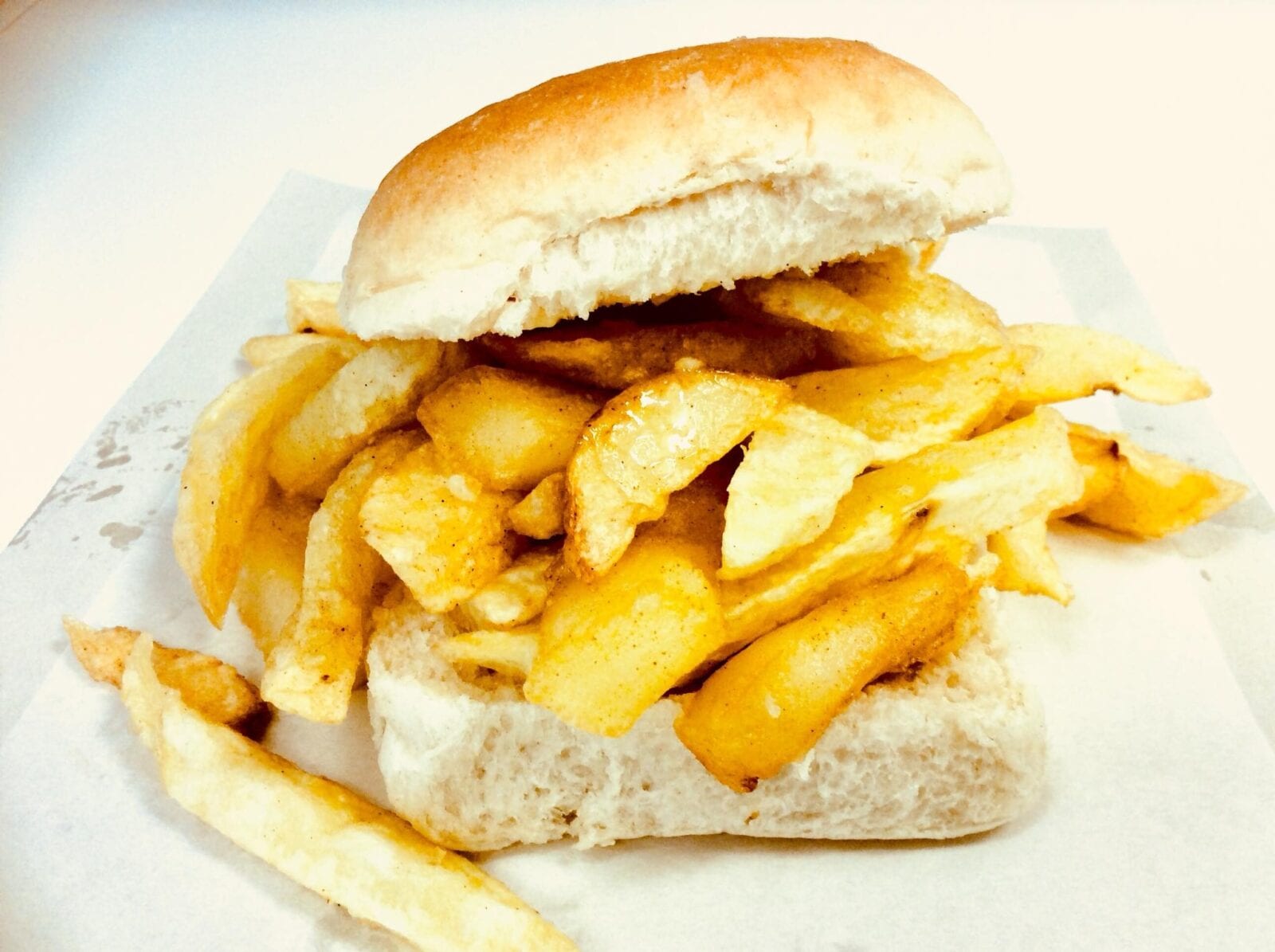
It’s been the subject of fierce debate for many years, but what exactly is a bread roll stuffed with chips inside actually called?
Is it a chip cob, a chip barm, a chip roll, a chip sandwich, or something else entirely?
There’s plenty of different regional names for the delicacy, but today – on what is National Fish & Chip Day 2020 – Britain has spoken, and for the firs time, the correct name for this legendary culinary delight can be revealed.
Bosses at takeaway delivery app Foodhub have been scratching their heads like the rest of the country over the delicious dilemma, so to put an end to the arguments, they surveyed the nation to find out the answer to the question that all food fans have been discussing, debating and fighting about for ages.
After much deliberation and a painstaking count of the votes, Foodhub has officially declared the king of takeaway snacks as the ‘Chip Butty’.
ADVERTISEMENT
According to the 2,000 takeaway fans surveyed by Foodhub in August this year, asking the hotly-debated question of chippy connoisseurs everywhere from John O’Groats to Lands End, a resounding 58% of the nation – four times more than any other option – say that chips served in a bread roll should be called a Chip Butty.
That sounds like a win for us Northerners, right?
ADVERTISEMENT
Dissecting the results further, Wil Chung – spokesperson for Foodhub – said: “For years, people have argued that it should be called either a chip roll, chip cob, chip barm or a myriad of other titles, but Britain has spoken, and we finally have an overwhelming consensus from the majority of the nation – it is, officially called a Chip Butty.
“The second most popular title for the Chip Butty is chip roll, with 11% of the vote. In third place is chip sandwich, with 6% of the vote, followed by a chip bap (5.75%), chip barm (4.85%) and chip cob (4%).
“There were also regional differences in opinion on this iconic water cooler debate, as you’d expect. For instance – in the North-west there was very little in it between Chip Butty and Chip Barm, Chip Butty winning the vote by just 2%. In London, while Chip Butty was favourite, Chip Roll was also up there with more than 1 in 5 people opting for that choice, and in the East Midlands around Leicester and Nottingham, while Chip Butty took the most votes, chip cob was a close second with almost 3 in every 10 people opting for that title.”
ADVERTISEMENT
One other thing that is certain, Britain is still very much in love with the classic fish and chips, but across the regions though, there are again some differences in how we like to eat it.
Salt and Vinegar is the overwhelming choice when choosing toppings for the nation’s favourite meal. In the North West, mushy peas (57%) and gravy (24%) feature highly on fish and chips fans must-haves agenda, in London, mayonnaise (25%) and curry sauce (24%) are the big condiment choice.
The nation is also split about how best to eat fish and chips, with 33% saying they prefer to eat it from the paper and 35% saying they’d rather eat it from a plate. Some 44% of us eat our fish and chips with a traditional knife and fork, though almost one in five of us like to eat it with an iconic chippy-style wooden fork.
When it comes to fish itself, a medium sized, lightly battered cod fillet with a medium-sized portion of chunky chips is overwhelmingly the nation’s favourite.
Whatever way, it all tastes like a Friday to us – enjoy your National Fish & Chips Day, Manchester.
Trending
Two North West cities named among the ‘noisiest’ in the UK – including Manchester
Emily Sergeant
A new analysis has revealed a list of the noisiest cities in the UK, and two Greater Manchester locations are in the top five.
From blaring sirens and car horns, to house parties, barking dogs, and loud neighbours, escaping the noise of a city can feel almost impossible – even in your own home.
No matter whether you live in the hustle and bustle, or you’re out in the sleepier suburbs, noise can keep you up at night, disturb your peace, and lead to frustration. But just how loud are Greater Manchester’s cities compared to the rest of the UK? In a bid to get to the bottom of it, Alpine Hearing Protection has done some research to compile a top 10 list.
And both Salford and Manchester have found themselves not just within the top 10, but within the top five… and to make matters worse, Salford has actually claimed the number one spot.
The reason Salford has found itself at the top of the list, according to the research, is because it sits at the intersection of several major transport and urban hubs, with major motorways running through or around the city including the M60, M61, and M62.
Major rail routes also run through the city – including via Salford Crescent – which sees 16 million passengers every year, and also leads to Manchester Airport.
Top 10 noisiest cities in the UK
Salford
Portsmouth
Manchester
Southampton
London
Leeds
Stoke-on-Trent
Wakefield
Newcastle upon Tyne
Bradford
Parts of Salford are also very built-up, making pockets of the city noisy – especially in the concentrated centre where traffic, construction, nightlife and commercial activity get loud.
And of course, like any growing city, construction noises have been noted as ‘particularly bothersome’ for residents where major developments are springing up.
Manchester is third on the list of noisiest cities, due to many of the same reasons as Salford.
But the difference being that Mancunians are noted as one of the many reasons why the city is so loud – with residents making 5,301 noise complaints across Manchester between January 2024 and January 2025, and Hulme identified the loudest area with 304 complaints.
As well all know, Manchester is also home to many universities, which brings an active nightlife scene to the region, especially in the city centre, and in recent FOI data, it was revealed that the University of Manchester saw 2,049 noise complaints in the last five years.
Motorists warned of common winter driving habit that could land them with annoying fines
Emily Sergeant
With the temperatures drastically dropping now as we head into winter, motorists are being warned against a common driving habit.
On a wintry morning when the windscreens are frozen and your hands are equally as frozen too, it’s pretty common for drivers to start the engine, turn the heater right up, and remain stationary for several minutes to warm the car up before setting off on their journey… but did you know that doing this could see you, inadvertently, fall foul of the law?
That’s right – as ridiculous as it sounds, leaving your car engine running ‘unnecessarily’ while parked on a public road is illegal.
And to make matters worse, the rules on ‘engine idling’, as it’s known, apply regardless of whether the driver is using the heating, waiting for someone, or simply sitting in the vehicle.
Known as a stationary idling offence, Rule 123 of the Highway Code states that drivers must not leave a vehicle’s engine running unnecessarily while it is stationary on a public road, and according to the rule, a fixed penalty of up to £80 can be issued, right there and then.
Motorists are being warned of a common winter driving habit that could land them with annoying fines / Credit: PickPik | Wikimedia Commons
Fines will only be handed out if a motorist is stopped by a police officer who asks them to switch the engine off, and they fail to comply.
“However tempting it might be to sit in a vehicle with the engine running and the heater on to warm up, we strongly advice against it,” commented RAC senior policy officer Rod Dennis.
“As well as polluting the air and wasting fuel, drivers who leave their engines idling unnecessarily on a public road also risk an on-the-spot fine of £80. On cold mornings, the best approach is to clear any ice or snow properly and ensure windows are fully de-misted before setting off, then get on your way and let the car warm you up.”
There are some exceptions to the rule, however, as keeping the engine running is permitted in certain circumstances.
This includes when a vehicle is stationary because of traffic conditions, when the engine needs to run so a mechanical fault can be investigated, or if certain work is being carried out on the side of the road.

 Emily Sergeant -
4th September 2020