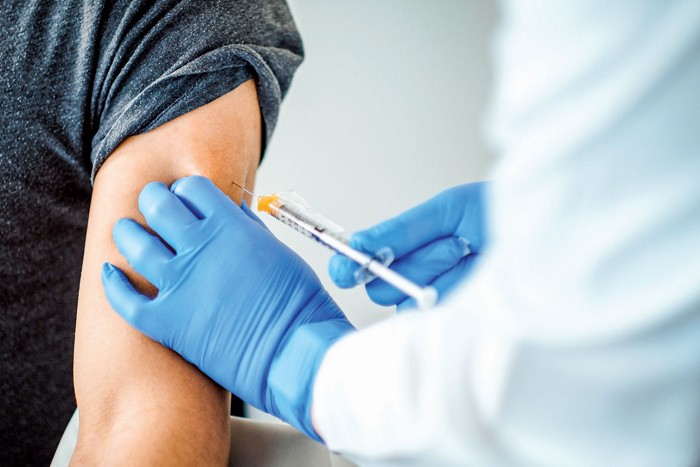
The UK government has today announced who will be first in line to receive the newly-approved Pfizer/BioNTech COVID-19 vaccine.
Care home residents and their carers will be first in line to be vaccinated against COVID-19 in the UK.
The Joint Committee on Vaccination and Immunisation (JCVI) has confirmed its priority list for the first phase of the UK’s mass vaccine rollout in a press conference this morning.
It follows the earlier news that the UK has become the first country in the world to approve the Pfizer/BioNTech COVID-19 vaccine for use, with the Department of Health and Social Care confirming it has been given the go-ahead by the health regulator MHRA for the vaccine to become administered from next week.
Pfizer and BioNTech reported final trial results on 18th November, showing its vaccine was 95% effective in preventing coronavirus (COVID-19), with no major safety concerns.
ADVERTISEMENT
Studies have shown the jab works in all age groups.
It has also been confirmed today that the government has secured 40 million doses of the vaccine, and patients need two doses.
— Department of Health and Social Care (@DHSCgovuk) December 2, 2020
JCVI’s priority list for the first phase of the vaccine rollout is as follows:
Residents in a care home for older adults and their carers
All those 80 years of age and over& frontline health and social care workers.
All those 75 years of age and over
All those 70 years of age and over&clinically extremely vulnerable individuals.
All those 65 years of age and over.
All individuals aged 16 years to 64 years with underlying health conditions which put them at higher risk of serious disease and mortality.
All those 60 years of age and over.
All those 55 years of age and over.
All those 50 years of age and over.
Two groups will not receive the vaccine – Pregnant women, and children under 16.
The JCVI stated: “Women should be advised not to come forward for vaccination if they may be pregnant or are planning a pregnancy within three months of the first dose”, adding that “following infection, almost all children will have asymptomatic infection or mild disease” and therefore do not require a vaccine.
ADVERTISEMENT
However, it will be available for “those children at very high risk of exposure and serious outcomes, such as older children with severe neuro-disabilities that require residential care”.
The first #COVID19 vaccine for the UK, developed by @pfizer/@BioNTech_Group has today been given approval for use following a thorough review carried out by the MHRA.
Dr June Raine – Chief Executive of the UK’s Medicines & Healthcare Regulatory Agency (MHRA) – said the regulator used a rolling review to complete its assessment of the vaccine in the shortest time possible, with hundreds of experts poring over more than a thousand pages of data.
She also stressed that no corners were cut in this rapid assessment.
But instead, the clinical phases of the trial were completed in an overlapping fashion, with separate items working in parallel to deliver the review, stating the testing was “equivalent to all international standards”.
Dr Raine added: “The public can be absolutely confident that the standards that we have worked to are equivalent to standards around the world.”
ADVERTISEMENT
You can find more information regarding the UK’s approval of the Pfizer/BioNTech COVID-19 vaccine here.
___
For the latest information, guidance and support during the coronavirus (COVID-19) pandemic in the UK, please do refer to official sources at gov.uk/coronavirus.
#HandsFaceSpace
News
Council announces return of FREE firework displays in Manchester parks
Emily Sergeant
The skies over Manchester will light up once again, as free firework displays are set to return to several of the city’s parks.
You may remember that major fireworks events throughout the city had been paused following the COVID-19 pandemic, due to funding challenges, with Manchester City Council choosing to invest in a range of other community-focused events across throughout the autumn season instead, rather than one-off firework celebrations.
But now, once this November rolls around, all of that is set to change.
That’s because, on Saturday 7 November, free fireworks events will return to Heaton Park, Wythenshawe Park, and Platt Fields Park.
First up, there will be a reduced-noise, low-impact display at 5pm for families and SEND audiences, and a main fireworks display then to follow a little later at 8pm.
The Council has announced the return of free firework displays in Manchester parks / Credit: Unsplash
Each of the three parks will host lantern making workshops in the weeks leading up to the events too, with family-friendly lantern parades taking place ahead of the 8pm firework shows.
The Council says that the return of the free fireworks events reflects residents’ recent feedback about what they want to see in their community and how they want funding to be distributed.
“It’s a chance, at the start of the shorter days and beginning of the dark winter months, to come together and resume a much-loved annual tradition as well as enjoying an evening of safe entertainment and spectacular fireworks displays,” Manchester City Council said in a statement.
Councillor Basat Sheikh, who is the Executive Member for Neighbourhoods, added: “We are delighted to announce and welcome the return of our much-loved fireworks celebrations.
It’s the first time they’ve returned since the COVID-19 pandemic / Credit: Elisha Terada (via Unsplash)
“Our parks should be shared spaces that create opportunities for Manchester people to gather, which is why bringing back the fireworks displays was top of our agenda. And we also recognise the importance of community which is why we will also continue to invest in a wide range of activities in our parks throughout the year.
“The return of these events is a wonderful opportunity for families and communities to create lasting memories and enjoy the long-standing tradition of fireworks in our parks in a safe way.”
Additional entertainment will be announced for each park in the coming weeks too, so keep your eyes peeled for more.
Featured Image – Alex Jones (via Unsplash)
News
Stockport man admits to drugging and raping his wife without her knowledge for more than 20 years
Emily Sergeant
A man in his 60s from Stockport has admitted drugging and raping his wife in a ‘horrific’ 20-year campaign of abuse.
According to Greater Manchester Police (GMP), the man – who cannot be identified in order to protect the life-long anonymity of the victim – previously admitted five counts of rape, three counts of sexual assault, six counts of assault by penetration, and one count of sharing intimate photos or film.
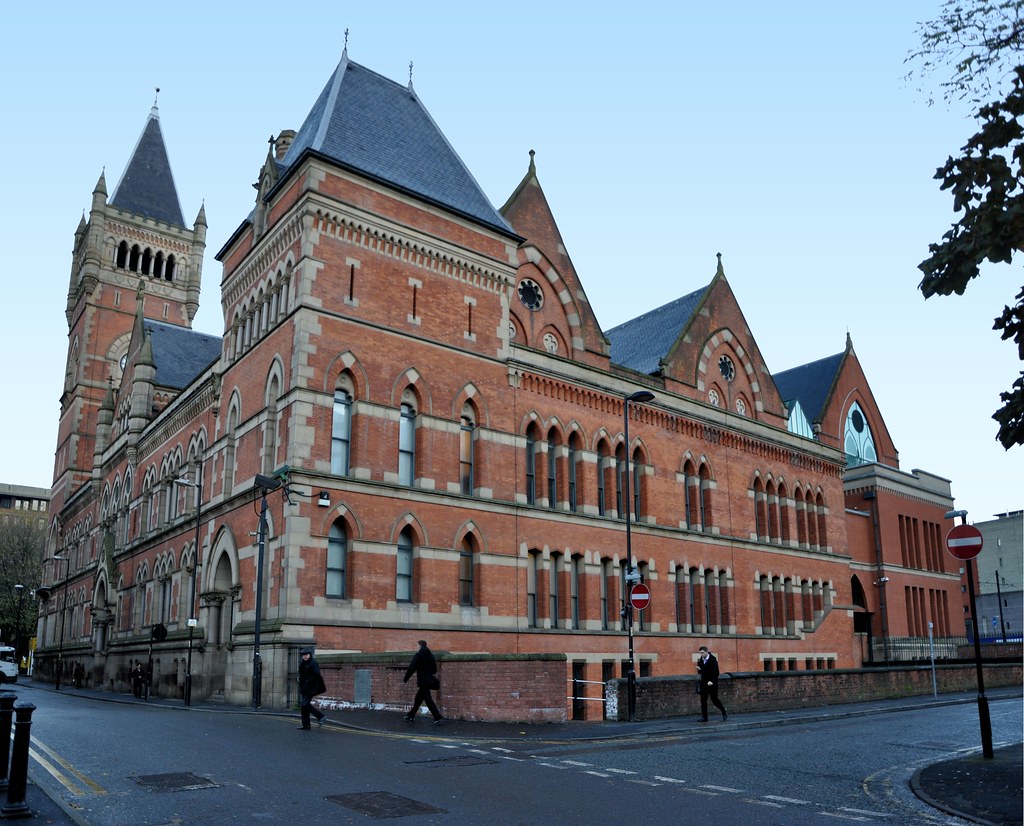
And now, during an appearance at Manchester Minshull Street Crown Court yesterday (14 September), he pleaded guilty to a further 45 charges.
This makes it 60 charges in total the man has now pleaded guilty to.
Some of the charges he pleaded guilty to yesterday include a further 16 counts of rape, nine counts of assault by penetration, seven counts of sexual assault, and four counts of attempted rape, amongst several others.
Speaking following the court appearance yesterday, GMP’s Assistant Chief Constable, Rick Jackson, said: “Our focus remains on supporting the victim of this horrific campaign of abuse through what is a very complex investigation.
“Specialist support continues to be provided to the victim at the centre of this case.
“If you are concerned you or someone you know may be affected by drug-facilitated sexual abuse, please know that you do not need proof, certainty, or a clear memory to be taken seriously.
“You are not expected to understand exactly what has happened or who was involved in order to be taken seriously. If you feel that something has happened, then please report it or ask for help.”
GMP reiterates that anyone who does choose to report sexual abuse does not need a full account or clear memory, can share as much or as little as they feel able, and will be supported by trained officers, as their ‘immediate’ safety and wellbeing will be the ‘priority’.
They may also speak to a support organisation first and decide later whether to involve police.
Saint Mary’s Sexual Assault Referral Centre – Services are available on a 24-hour basis, and can be accessed by calling 0161 276 6515.
Greater Manchester Rape Crisis – Call on 0161 273 4500 or email [email protected]

 The Manc -
2nd December 2020
The Manc -
2nd December 2020