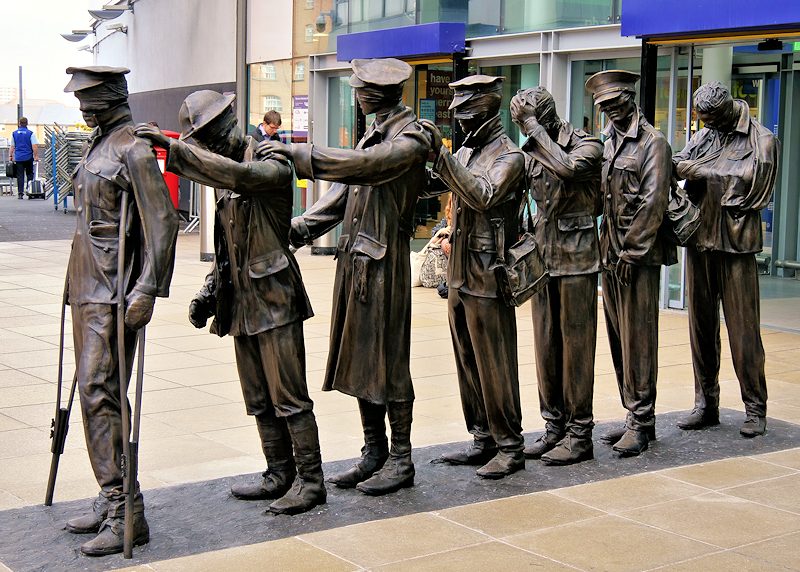
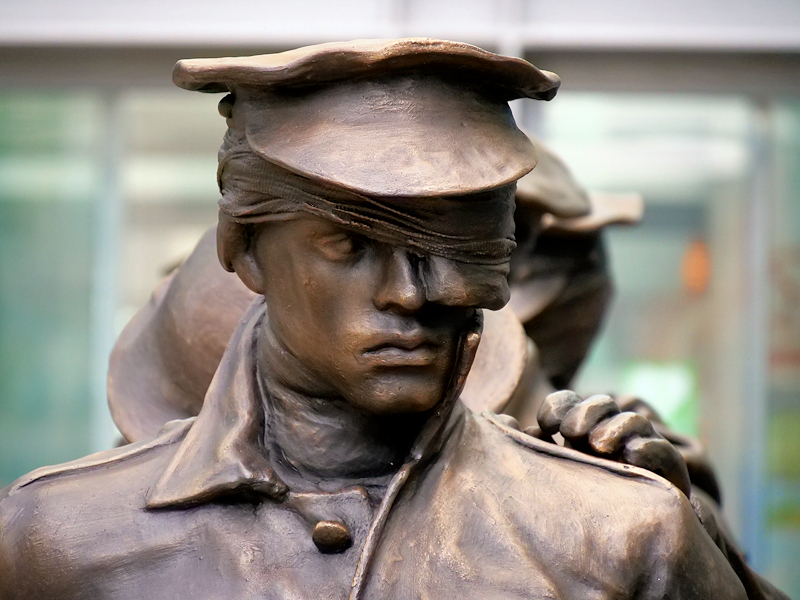
The bronze sculpture right outside the front of Manchester Piccadilly station depicting seven life-sized soldier figures wearing blindfolds and guiding one another has been well-received by many for its “moving” subject matter since it was first erected back in October 2018, and has been described as “striking” for its interaction with passers-by at eye level – but what exactly does it mean?
What’s the message behind it? And why is it here in Manchester city centre?
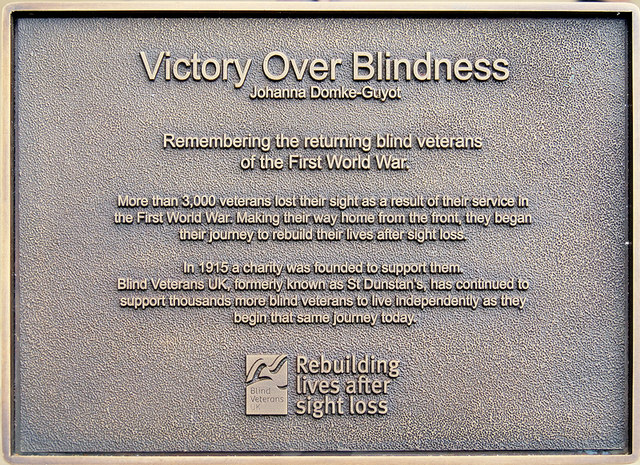
Commissioned by national ex-service person sight loss charity, Blind Veterans UK, to mark the centenary year of the First World War in 2015 and realised by artist and sculptor Johanna Domke-Guyot, ‘Victory Over Blindness’ is a poignant memorial to soldiers who suffered loss of sight whilst fighting overseas.
ADVERTISEMENT
The industrialised nature of the First World War – which lasted from 1914 to 1918 and saw the deaths of an estimated 886,000 British and Commonwealth military personnel, as well as countless more injured – made for unfathomable human suffering, with around 30,000 of the wounded discharged with damaged or defective eyesight and of these, 3,000 were left permanently blinded.
This came as a result of a number of circumstances, particularly the dreaded Mustard Gas attacks, as well as head injuries, shrapnel from artillery fire, stray bullets and fractures all contributing to the growing number of men returning from the war with sight loss.
ADVERTISEMENT
And so, to serve as a stark reminder of these tragedies, the statue was commissioned.
Wikimedia Commons
Unveiled in October 2018 to “commemorate the amazing achievements” of the blind veterans supported by Blind Veterans UK since the end of WWI, the ‘Victory Over Blindness’ statue depicts seven blinded soldiers leading one another away from the battlefield with their hand on the shoulder of the man in front.
The phrase ‘victory over blindness’ was first used by Blind Veterans UK founder, Sir Arthur Pearson, and is a motto that continues to guide the charity’s principles today.
ADVERTISEMENT
Inspired by a photograph the sculptor Johanna Domke-Guyot saw of WWI veterans, blinded in combat, leading one another from the front, what makes ‘Victory Over Blindness’ different from other statues or sculptures of lifelike individuals is that it was decided it should be situated on the ground and at eye level to engage passers-by, rather than on a plinth or platform.
This choice was primarily made to highlight the notion that the sacrifices of those on the frontline in WW1 should not be forgotten.
“People will be able to touch them, I want it to become a people’s piece,” Ms Domke-Guyot said.
Wikimedia Commons | Geograph – David Dixon
Although Blind Veterans UK is a charity located in London and Brighton – and now in Llandudno too – Manchester was chosen as the site to host the memorial permanently as it was known as a disembarking point for many soldiers returning from the war with life changing inflictions.
“There is no more appropriate location for this statue.” a statement on the Blind Veterans UK website reads.
ADVERTISEMENT
“The convalescent camp at Heaton Park in Manchester treated and trained thousands of wounded First World War soldiers and sailors, including many with sight loss [and] we hope that it will continue to inspire the people of Manchester, and beyond, for many years to come”.
The statue is an empowering testament to the ability to overcome physical afflictions and serves as a reminder of the crucial role that charities play in rehabilitating wounded soldiers.
Over two years on, ‘Victory Over Blindness’ continues to strike a chord with Mancunians.
Featured Image – Flickr
Trending
Data reveals Manchester hotel prices have ALREADY surged by 462% on rumoured Oasis tour dates
Emily Sergeant
Manchester hotel prices have apparently already surged by 462% on rumoured Oasis tour dates, some new data has revealed.
Of course, absolutely nothing is set in stone yet and we are still yet to receive any form of announcement.
But with rumours having been swirling for months now that Oasis will be touring again in 2027, and several videos shared on the band’s social media platforms this week also hinting at that, it’s been revealed that searches for ‘when are Oasis tickets going on sale?’ have soared by 5,000% in the last seven days alone.
After recent data has pointed towards soaring searches for tickets, the experts at SeatPick decided to analyse the average cost of accommodation in Manchester on the suspected concert nights in June 2027 to uncover if prices have surged along with the searches.
Data reveals that Manchester hotel prices have already surged by 462% on rumoured Oasis tour dates / Credit: The Manc Group | Simon Emmett (Press Picture)
And lo and behold, it appears that they have.
The ticketing platform has revealed that hotel prices have surged by up to 462% during Oasis’ rumoured concert nights in Manchester.
The rumoured weekend date of 19 and 20 June has experienced the most noticeable price surge – with a two-star hotel costing an average of £216 for just one overnight stay.
The data also reveals that the rumoured finale on the 27 June has just a £95 difference between two-star hotels (£200) and five-star hotels (£295).
“Our analysis uncovered an enormous markup for local accommodation on nights that Oasis is rumoured to perform in Manchester,” explained Gilad Zilberman, who is the CEO at ticket platform SeatPick.
“Being aware of these accommodation costs and additional expenses can help fans plan and avoid being caught off guard by inflated prices on concert nights.
“To find the best deals on hotels, concertgoers should scan budget chains in the city or look slightly outside of the centre in hotspots served by local bus routes or regional trains, such as Salford and Trafford.
“Booking early might also be beneficial for fans dedicated to seeing the band perform.
“You can opt for free cancellation options, in case rumoured dates change, or you’re no longer able to attend.”
Featured Image – Point3D (via Unsplash)
Trending
Aldi confirms ‘special’ 62-hour closure of all its 1,000+ stores across UK
Emily Sergeant
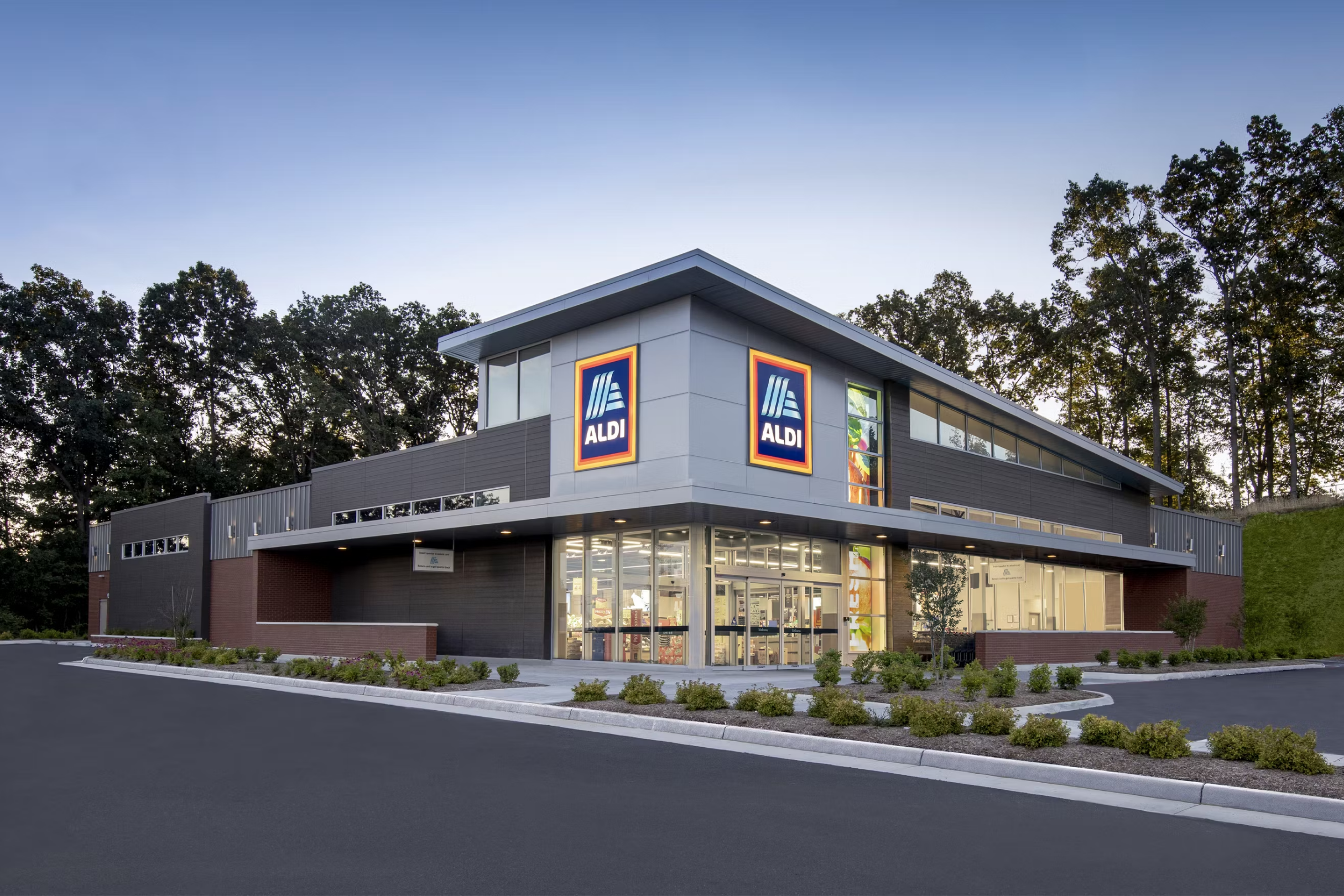
Aldi has announced that it’ll, once again, be closing the doors of all of its stores across the UK for 62 hours this year.
Christmas is always known to be one of the busiest periods of the year for the retail industry, and Boxing Day has a reputation for being the ultimate day for shopping deals and discounts in the UK – but this year, just like it has done on several years in the past, Aldi has made the decision to close all of its stores nationwide on this bank holiday.
The supermarket retailer says it wants to thank its colleagues ‘for all their hard work’ throughout the year by giving them some extra time to spend with their families.
This means that all Aldi stores will be closed on both 25 and 26 December.
That’s not all though, as stores will also be closed on New Year’s Day, and will reopen once again on Saturday 2 January 2027.
Aldi has announced a ‘special’ 62-hour closure of all its UK stores / Credit: Aldi UK
Opening hours at different Aldi stores across the UK will vary in the lead-up to Christmas, so it’s important to check the times for your local store, but the retailer has confirmed that most branches will be operating extended hours to ‘ensure customers can stock up ahead of the big day’
In the interim period between Christmas and New Year, stores will reopen as usual on Sunday 27 through to Wednesday 30 December, with reduced hours also likely on Sunday and New Year’s Eve.
Speaking on the decision to shut up shop for a full 62-hour period this festive season, Rachel Geary, who is the Communications Director at Aldi UK, said: “Christmas is a special time for our customers, but it is also one of the busiest periods of the year for our teams.
“Our colleagues work incredibly hard to ensure customers can pick up everything they need ahead of the big day.
“We never take that effort for granted. Closing our stores on Boxing Day is one way of saying thank you and giving colleagues a proper chance to rest, switch off and spend more time with the people closest to them.”

 Emily Sergeant -
1st November 2021
Emily Sergeant -
1st November 2021