Whenever anyone thinks of the Suffragette movement, particularly in Manchester, one of the first names to come to mind is Emmeline Pankhurst.
Her story is well known – a girl from Moss Side, born into a politically active family, was introduced to the suffrage movement aged just 14 and ultimately helped British women to win the vote and create historic change.
The Pankhurst’s name today is synonymous with women’s suffrage, as are the Kenneys of Saddleworth.
But in the early years of the suffragette movement, before it had a name and was just a few pesky women making some political noise, there was another figure – oft-forgotten – who inspired the women around her to make history.
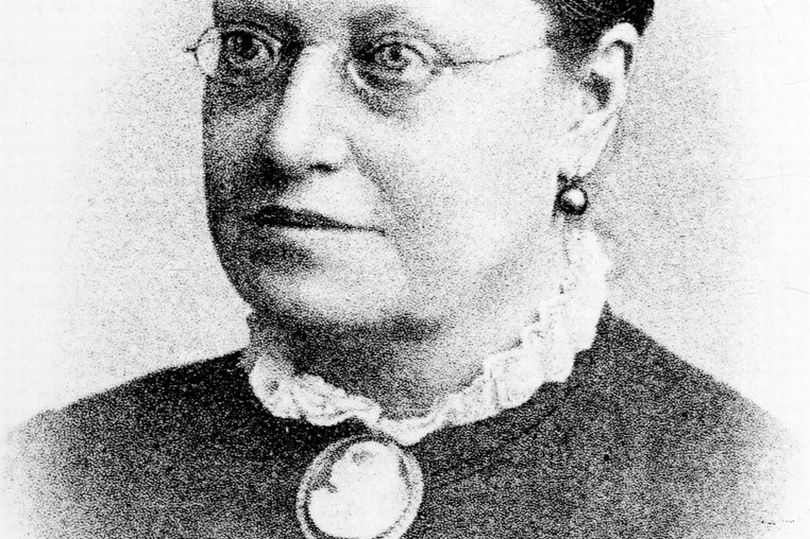
Her name was Lydia Becker and she hailed from Accrington.
Born in 1827 to a large middle-class family, as a young girl Becker was home-schooled alongside her siblings and took a big interest in nature and botany.
She often wrote to Charles Darwin with questions and the two developed a friendly correspondence, with Lydia sometimes sending him samples of plants from around Manchester to study.
ADVERTISEMENT
But as well as growing into a noted botanist, as a young woman she was fascinated by politics and got involved in the suffrage movement at a very early stage.
Having studied in great detail the reproductive science of plants, in particular the bisexual and hermaphrodite species, she soon turned her mind to the gender politics of society.
Inspired by a fellow sister scientist, Barbara Bodichon, who had published a paper entitled The Enfranchisement of Women in 1866, Lydia moved to found the Manchester Women’s Suffrage Committee – the first of its kind in the country.
Not much time after founding her committee, Lydia heard about a local woman – a widow – whose name had appeared by accident on an electoral roll. Sensing an opportunity, she and Lily Maxwell went to the polling station together and demanded she be allowed to cast a ballot. She was, and it caused a ruckus.
Spurred on, soon enough Lydia was encouraging all female heads of household to do the same – and was ultimately instrumental in bringing their petitions to court.
The following year, she was one of the central organisers and speakers at the first-ever meeting of the National Society for Women’s Suffrage and soon found herself undertaking speaking tours across the country.
This was years before the Pankhursts and at a time when it was completely unheard of for women to get involved in politics in any way. To even suggest that a woman should vote in elections was to completely put yourself out on a limb.
Simply put, politics was for men – it was not considered ‘ladylike’ for a woman to stand up in a public place and spout her opinions. Lydia didn’t let this put her off, though.
She simply ignored the naysayers (and there were a lot of them) and kept on going on her tours up and down the country after forming the Women’s Suffrage Journal in 1870, alongside Jessie Boucherett.
At one of these meetings in 1874, there was a young girl sitting in the audience. A fifteen-year-old Emmeline Pankhurst, who from that day forward would be completely committed to the cause after hearing Lydia speak.
As the movement began to gather pace, one thing that set Lydia apart from her counterparts was her ardent support for the vote of single and unmarried women. These women, she argued, were more in need of the vote than their married counterparts (who ultimately secured the vote first in 1918).
It was a point on which she and Emmeline Pankhurst were to disagree, but just as with everything else, Lydia stuck to her guns on her opinions – no matter what ridicule she faced. And there was a lot.
Just as women today who speak or act out against the status quo are often maligned (Jameela Jamil springs to mind, but there are many more), Lydia was subject to merciless teasing – particularly from politicians and the press.
ADVERTISEMENT
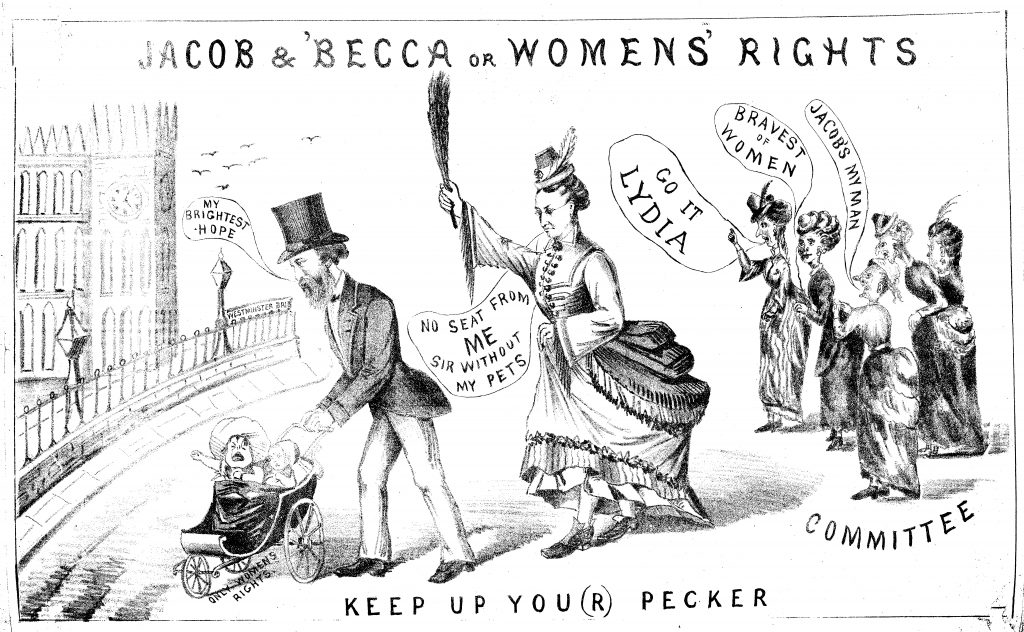
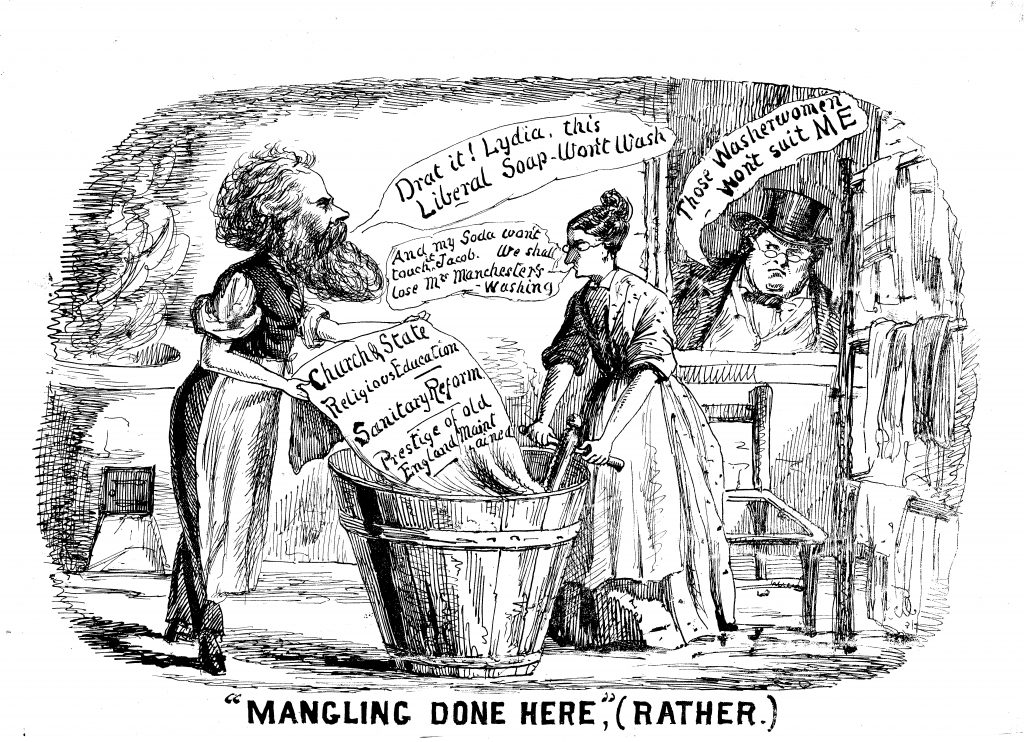
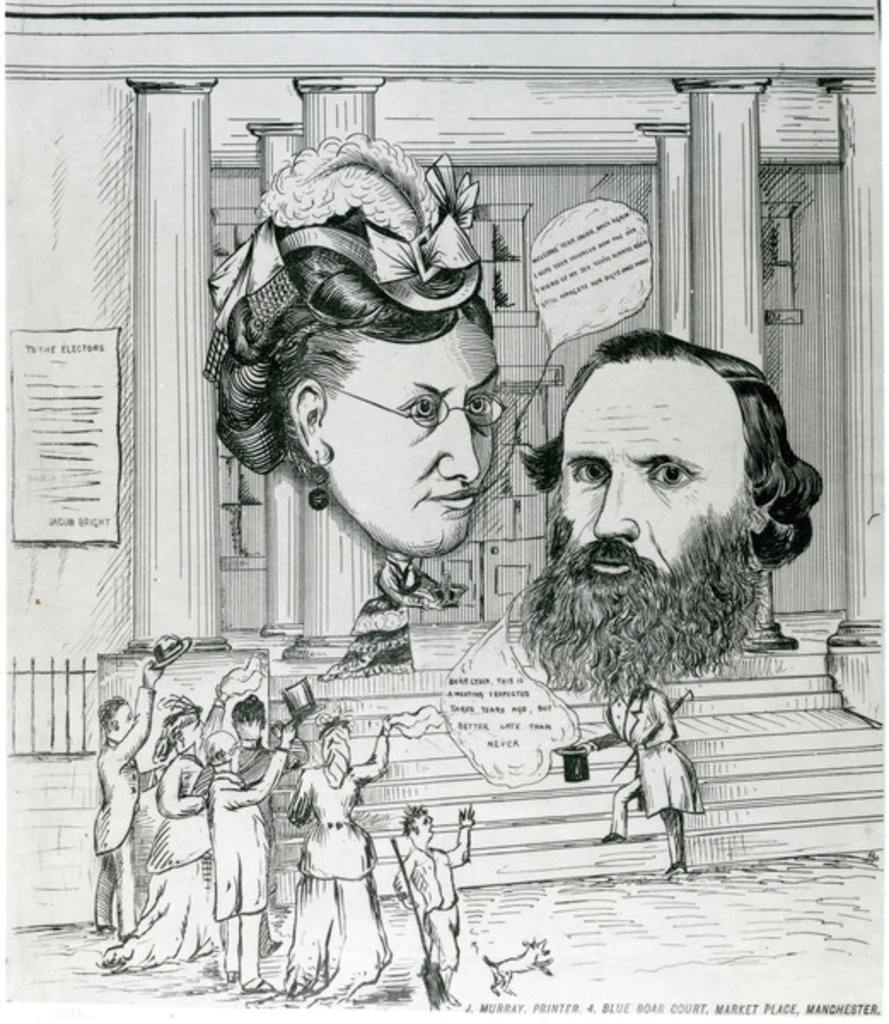
She wore wire-framed glasses and was made into somewhat of a caricature by cartoonists, who ridiculed her “extreme” views and looks. One cartoon cruelly depicted her being thrown out of parliament wrapped in the Women’s Suffrage Bill.
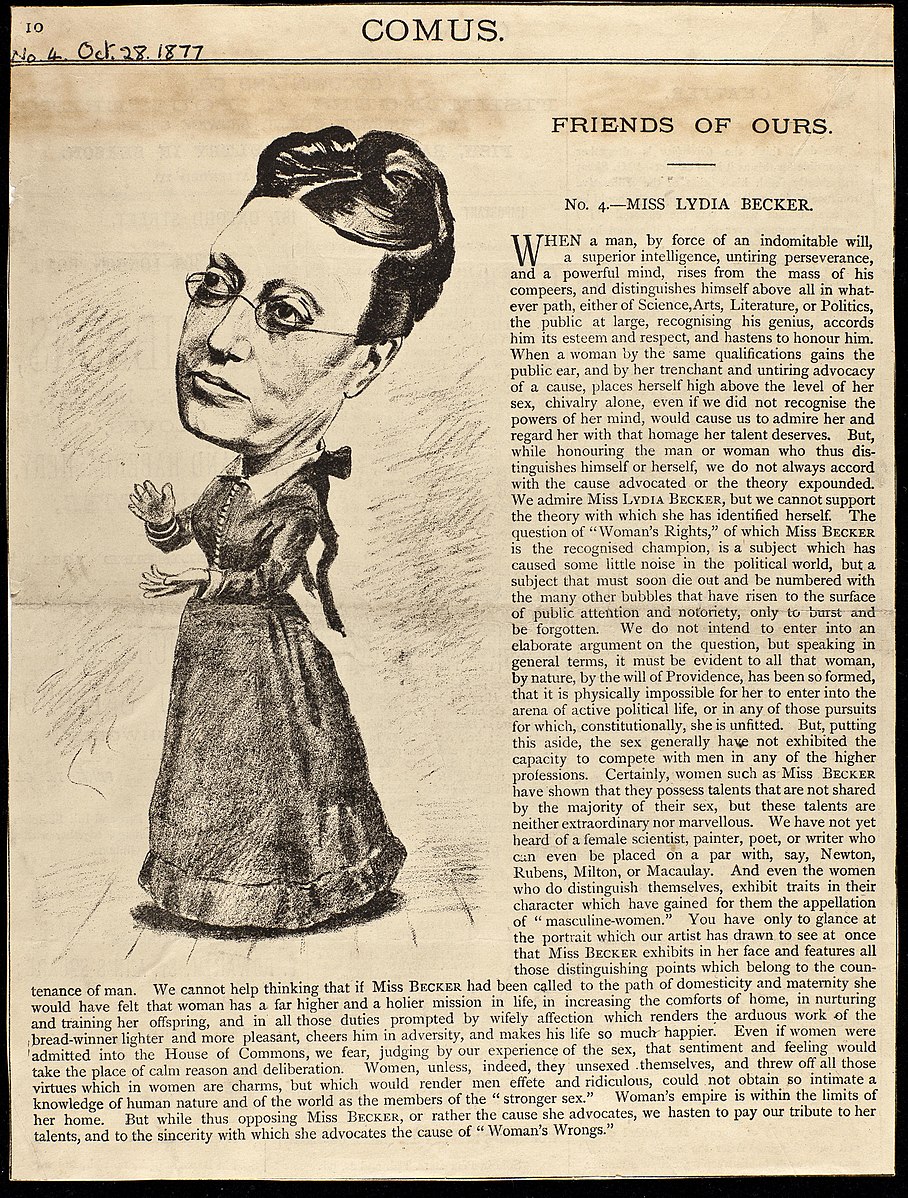
She also used her position as an educationist to champion the idea that there was no difference in the intelligence levels of men and women, a position that was considered truly revolutionary at the time.
She passed away aged 63 at Aix-les-Bains in 1890, and her name can be found today on a family headstone in St James, Altham. Quite rightly, it can also be found on the Reformers’ Memorial in Kensal Green Cemetery, London, alongside other great reformers and innovators.
Although Lydia died several decades before women would win the right to vote, if it wasn’t for her then we might still be the second-class citizens we were in the 1800s.
Roger Fulford best sums it up In VotesforWomen: TheStoryofaStruggle, when he writes: “The history of the decades from 1860 to 1890 – so far as women’s suffrage is concerned – is the story of Miss Becker.”
ADVERTISEMENT
A true pioneer and an inspiration for many women, her name deserves to be remembered.
Liam Broady is on the comeback – here’s why you need to watch out for him at Wimbledon
The Manc
Local tennis player Liam Broady is quietly rising back up the ranks on the ITF Tour, and here’s why we think you should watch out for him come Wimbledon 2026 this summer.
He is physical proof that the ATP Tour ranking means so much to a player’s career.
The Stockport-born tennis player has suffered many injury setbacks since turning pro in 2014. With a host of ankle and back injuries plaguing his playing career, he has had to turn to the ITF (International Tennis Federation) Tour to climb the rankings once again.
He is currently placed at 283* on the ATP (Association of Tennis Professionals) Tour after reaching two semi-finals in the space of a month.
With wins on two of Portugal’s hard courts in Faro and Santo António, the 32-year-old has climbed from rank 303 at the start of the year to under the threshold in less than three months.
His hard work on outdoor courts is paying off as his seeding is slowly improving, and his opponents are becoming less of a challenge.
For the unititated, the ATP ranking is decided by a points system that determines your playing level, and therefore who you can possibly draw, with lower seeds getting tougher games as they need more points, and vice versa.
These point tallies factor into every win, loss, serve, and shot as it propels you up or down the table.
With an injury over Christmas, the Stopfordian Team GB player came back stronger for the start of the annual tournament calendar and now looks to be in fighting form on the ITF Tour.
He’s definitely had to tackle some obstacles over the years, both on and off the court…
Competing solely on outdoor hard courts to gain his fitness levels back is necessary, but the grass courts – his speciality – will come around with time and consistent form, with Wimbledon being his home tournament and his highlight of the competitive calendar.
His career best ranking was 93, after becoming the first British wildcard entry to beat an ATP top five player in 2023 when defeating Casper Rudd on Wimbledon’s centre court.
His win against the Norwegian in round two sent him into the top 100 rankings for the first time, and into the shining spotlight alongside British tennis stars.
The adverse effects of time away from the tour are clear to see with Broady’s peaks and dips in the table below; this means taking a hit to player motivation, game-to-game momentum and teamworking within doubles pairs.
Liam Broady’s career rankings progression chart. (Credit: ATP Tour)
It is a likely situation for players to neglect their doubles career without the added stress of injury, so if they are to arise, it does not just impact individual physicality levels but also communication between doubles pairs.
A fellow British player with similar injury problems is Emma Raducanu, who rose to fame with a shocking US Open grand slam win as a qualifier. Since her win, she has had multiple surgeries, which saw her plummet down WTA (Women’s Tennis Association) standings due to time spent off court.
The issues that come with injury upsets can make a career really difficult to reclaim, even at a young age; tour rankings can be brutal on game time and match opponents, such as Broady’s Wimbledon draw against Holland’s Van De Zandschulp and Raducanu’s recent draw against American no.3 Anisimova.
We hope to see Team GB’s athletes fit and ready to fight on tour, and we have a strong feeling we’ll see native talent Broady back in the spotlight where he belongs.
Gig review | KEO at the O2 Ritz in Manchester – Sometimes you just KNOW…
Danny Jones
Fontaines D.C., Turnstile, Wunderhorse, Sleep Token, Neck Deep; sometimes it only takes a few listens and a live show to KNOW that a band is going to catch fire and go on to be huge – for Audio North and KEO, it only took a few.
But having now seen KEO for a third time, collectively, we’re more convinced than ever that they’re going to be massive.
Sadly, a prior engagement meant that we just missed catching the support act, Tooth (though we did hear great things rumbling around the eager young crowd), but there was no chance we were going to miss this lot show off how very good they are at what they do.
And there was absolutely no chance they were going to disappoint us, either…
We first caught this fast-rising post-grunge outfit live in action at Kendal Calling last year, where they somehow turned a daytime slot on the Woodlands stage into a moody mid-evening mosh.
They had even less fully produced and officially released music out then, but then we had the pleasure of watching them at The Key Club in Leeds this past October, and they were even better; punchier, more graduated at their game, and their fandom seemed plenty strong already.
As it turns out, that same progression proved true in Manchester, as KEO played their biggest headline show to date, and that same cult following only appeared more fervent than ever.
They might be based down in the capital, with roots in Portugal, brothers Finn and Conor having grown up there, but they certainly know a thing or two about how to please a Northern audience.
Of course, we’re sure they go off just as hard down in the capital – in fact, we’re certain they do – but the response they got from two sold-out rooms full of Yorkshire folk and us equally discerning Mancs felt like they had well and truly passed the litmus.
With flying colours, may we add.
Everything from the raw ’90s rock feel to the aesthetic hits just right. (Credit: Audio North)
It’s also worth noting that these London lads have built up this hype like very few ever manage to do: by developing a sterling live reputation right from the off and putting top-notch shows first.
For those unaware, they only just released their first five-track EP, Siren, back in June 2025, yet they’ve been packing out venues and festival stages pretty much since day dot, with die-hards growing their love for the band via performance and initially only learning the lyrics through social clips and snippets online.
While some have questioned why they’ve been chosen to headline this year’s Neighbourhood Festival here in Manchester city centre before they’ve even dropped a debut album, you only need to hear the entire Ritz screaming back the lyrics to ‘I Lied, Amber’, ‘Thorn’ and ‘Hands’ to know they fit the bill.
Frontman Finn pours so much unbridled power and emotion into his vocals, guitarist Jimmy Lanwern didn’t even need to look to know that his riffs were ripping the roof off, and they’ve quickly moved far beyond the early Wunderhorse parallels – they’re their own beast just waiting to be fully woken.