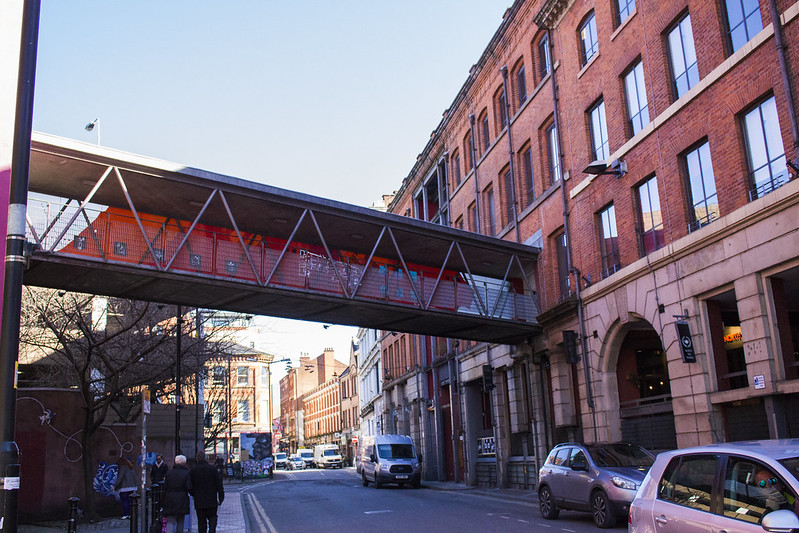
Tib Street is a built-up blend of bakeries, bars, florists, cafes, newsagents and sex shops nowadays. It’s an intriguing and peculiar old part of town that seems to have a bit of everything.
But it wasn’t always this way.
For many years, this slender stretch of Northern Quarter had a single definitive trade that used to attract Mancunians in their thousands: animals.
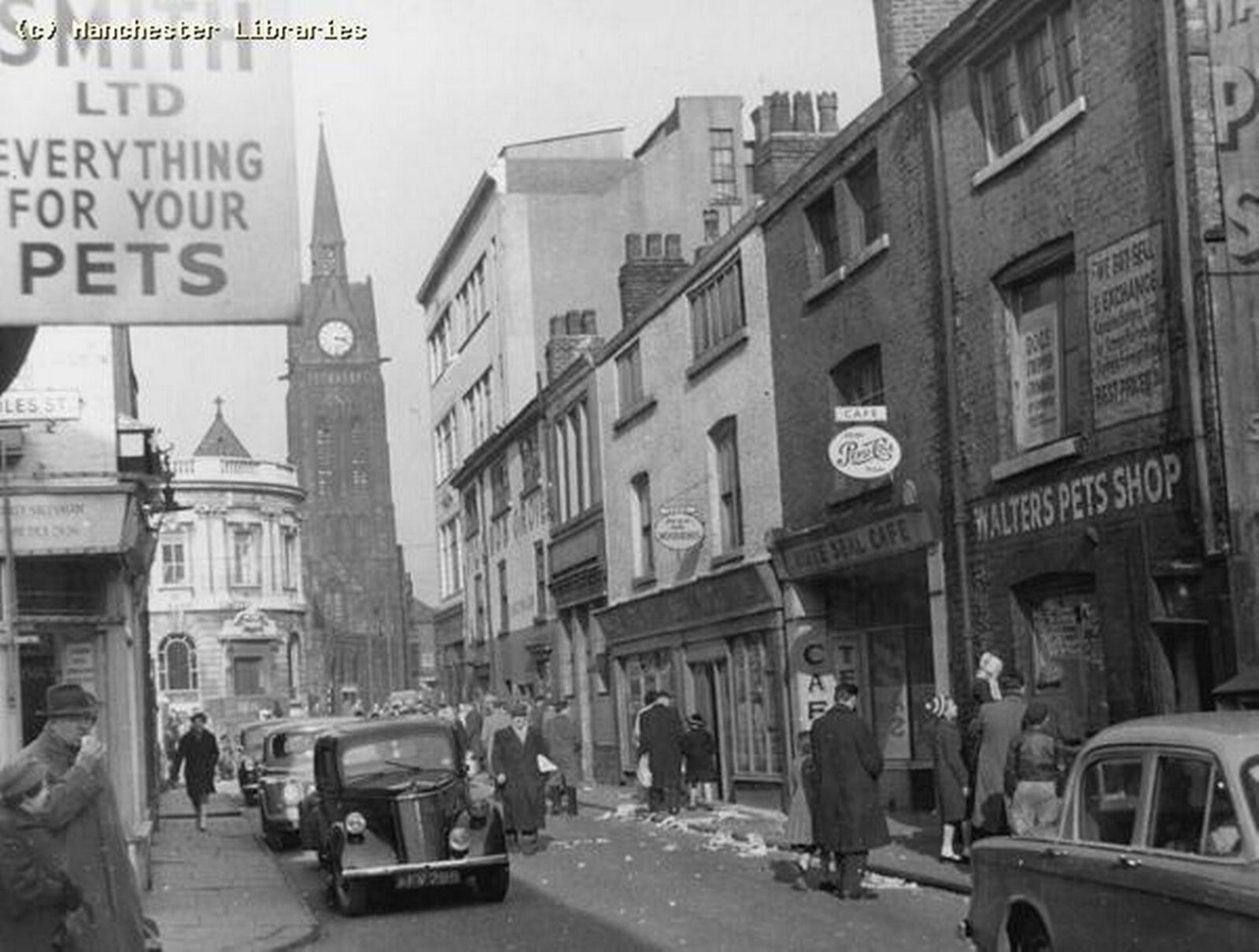
Established as an agricultural space in the 1800s, Tib Street gradually morphed into a pet shop paradise during the early 20th century; a cavalcade of creatures peeking out from behind the windows that lined the street.
Hayley Flynn, the founder of Skyliner and a walking encyclopaedia of Manchester history, has previously dived into the history of the area on her walking tours, having discovered that Tib Street was a truly ‘wild’ part of the city.
ADVERTISEMENT
“There’s always been animals on Tib Street since it was established around the 1800s,” Hayley explains.
“But it became less about agriculture and pigs, and more about pets when the area became more developed in the early 1900s.
ADVERTISEMENT
“There’s still one pet shop there today but it was the arrival of the Arndale in the mid to late 1970s that saw most of the area close down and businesses move out.
“The area then became what we have today partly through the natural process of gentrification, partly down to arts-led regeneration.”
One of the most prominent traders in Tib Street’s heyday was a man name Walter Smith – who owned one of the longest-running pet shops in the area.
ADVERTISEMENT
He eventually sold it to another family, the Browns, but they kept the original name – and the original founder’s legacy survives in a painting titled “Mr Smith’s Dream” created by artist Liz Scrine.
“The Dream piece is based on Under Milk Wood by Dylan Thomas and the plan was the create the dreams of the animals in the pet shops in further lightboxes along the same wall, but the project was never completed,” Hayley informs us.
“So, we have this one piece that seems quite abstract as a standalone installation.”
Tib Street’s markets became bigger and more diverse throughout the 1900s.
As the areas began to attract five-figure attendances on Friday evenings, the pubs opened earlier to accommodate growing numbers of traders.
ADVERTISEMENT
“Around Tib Street could draw crowds of up to 10,000 on a Friday night, much of this was market footfall around Smithfield, especially the Shudehill side (the wholesale fish markets on High Street),” Hayley tells us.
“Then to serve the workers of the markets the pubs opened very early in the morning – so it was something of a 24 hour city in that respect.
“Teenagers relied on the markets for entertainment and a social space, and it was popular with sex workers too, so it was a bit of a wild place at times.”
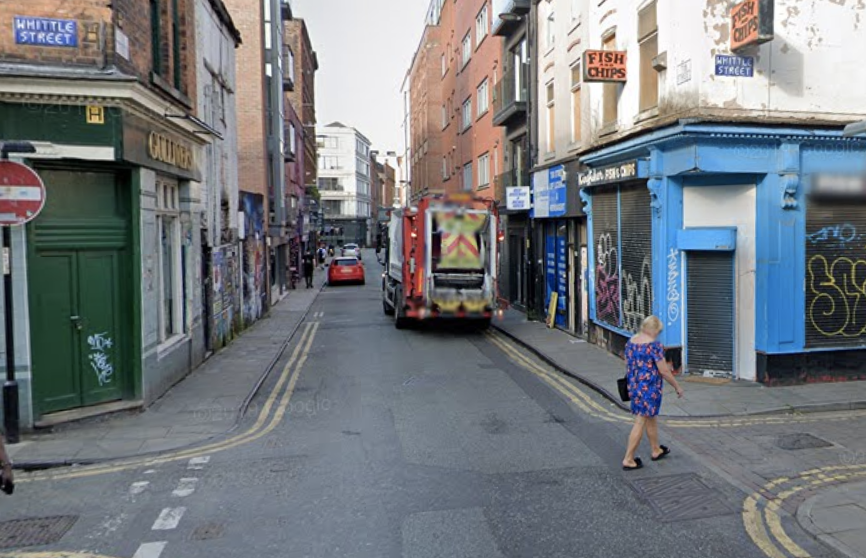
Google
Much of the animal trade and pet shops shut down on Tib Street in the seventies, but the concealed structure of the street rendered it ideal for explicit stores to pitch up for patrons; away from city residents’ prying eyes.
“The pet shops and other independents along Tib Street were a very popular day out right up until the 70s,” says Hayley.
ADVERTISEMENT
“Even later on, strange independent traders who managed to survive in the area for a while longer drew in crowds, there was a latex mask shop that was popular with the younger crowd.”
Modern Tib Street is no longer a round-the-clock fiesta of beasts and booze, but if you crane your neck upwards, the relics of its past are in plain view.
Perched gently on the buildings, you’ll see a pandemonium of painted parrots.
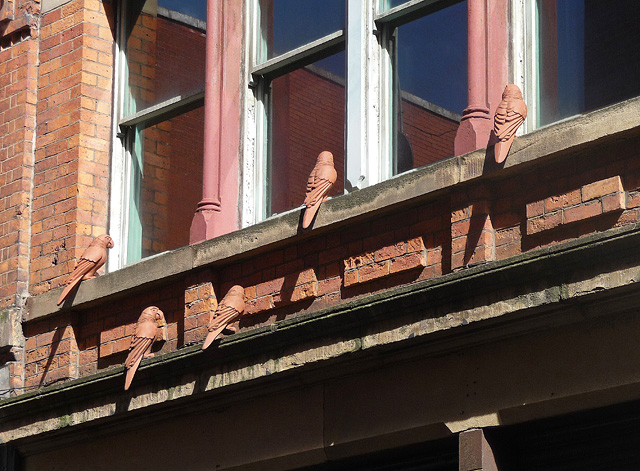
“The birds form part of the same art trail as Mr Smith’s dream, they’re looking back into the building wondering where to go now that the pet shops are closed,” Hayley explains.
“They’re the Sulking Parrots of Tib Street, and have found themselves homeless. There are other birds like this hidden around the Northern Quarter to look out for, from doves to toucans.
ADVERTISEMENT
“They’ve been handing around since the late 90s but have been surprisingly overlooked, suppose that’s just testament to the fact we should always look up.”
To discover more about the amazing history of Manchester, you can take a walking tour with Skyliner – led by Hayley herself.
Tours are resuming later this month following lockdown; currently limited to five people due to group restrictions.
We’ve found some of the best Chinese food in town – being served out of a snooker hall
Danny Jones
Yes, you heard us right: we’ve stumbled across one of our favourite new places for Chinese food just on the outskirts of Manchester city centre – it just so happens to be served out of a best-in-class snooker hall.
And that really is just the tip of the iceberg here.
Some of you may have heard about and/or seen it already, but we’ll admit we were a little late to the party when it comes to Club 200, a.k.a. the pool, snooker, darts, mahjong club and more, which has so many different things rolled into that it’s really more a Russian doll than a Chinese restaurant or sports venue.
The hook speaks for itself: a place where people spend just as much time practising with chopsticks as they do their cues, as it really isn’t a gimmick, as some pessimistic folk would have you think – the food is banging and so are the vibes in general.
Not only is this quite literally the best snooker club in Manchester – complete with everything from classic American billiards and Chinese 8-ball to king-size snooker tables that the Ronnie O’Sullivan has played and won on, to a special AI system you won’t find anywhere else – it is SO much more than that.
Whilst the backroom was packed with everyone from casuals to those looking to get their pro certification via the official Q Tour, and lads in the front were practising their arrows, as co-owner Simon admitted they get almost just as many darts regulars these days, a storm was cooking up in the kitchen.
It would be unfair to say this place doubles as a bar and restaurant, because we really couldn’t get over how well put together this menu was.
‘Café 200’s food offerings involve classics like fried rice and chow mein dishes, to the kind of sides you could expect from your local Chinese chippy, but it’s even more authentic exports that really impress.
For instance, the beef ho fun seemed to be a big hit with everyone; we loved the salty seafood udon as well (a great chew on those noodles), and we know plenty of people still searching for proper Hong Kong-style French toast – they might just find it here.
Speaking of the special administrative region, which has a twisting and turning but nevertheless rich culinary culture all of its own, that last dish had us hopping with joy.
You’re looking at baked Portuguese rice: a Macau speciality rooted in the region’s colonial history.
We’ve never quite had anything like it before, even in all of our years eating this kind of cuisine around the 10 boroughs, but we haven’t stopped thinking about it since.
And then there’s everything else they do, from karaoke and bingo nights to catering for birthdays and other functions, or even just serving as a cool, somewhat tucked-away spot to watch the footy and other live sport come the weekend.
You can tell this place has built up a real community over the last 18 months or so, and while the food speaks for itself, it’s the sheer abundance and variety going on that makes it especially charming to so many.
Speaking of jack-of-all-trade venues, we stumbled across a similar multi-talented one over in Salford not so long ago, too…
‘Manc the Biff’: the Co-op Live crowd made the Clyro boys welcome on debut
Danny Jones
It feels like we’ve been waiting a long time to welcome Biffy Clyro back to Manchester, and they really didn’t disappoint on their Co-op Live debut.
Here’s our review of what was a proper rock show.
After a strong lineup of support acts with The Armed and Soft Play (formerly Slaves) injecting plenty of early energy into the crowds, already knew two things: the Scots wouldn’t disappoint, and a Manc crowd NEVER lets you down.
We knew everyone was on top form from the moment the Kilmarnock icons stepped out on stage under a swathe of blankets to the opener from their latest album, Futique.
Once the curtain was eventually lifted during ‘A Little Love’, which has quickly become one of the most popular singles for some time, you could see the sea of fans below start bouncing.
Rolling into the likes of ‘Hunting Season’ and Only Revolutions classic, ‘The Captain’, those bounces quite quickly turned into a healthy-sized pit, and those up in the stands with us finally got on their feet.
That was maybe our only complaint: we love seeing a seated section pretending they’re in standing from their start, but we get it and each to their own, of course.
In fact, the same goes for the rest of the session players joining them on the road this year.
One thing we weren’t expecting was quite how cool the production levels were going to be. We’ve never been Biffy fans for their creativity when it comes to toying with stage design or lighting rigs, but they threw in some fun effects regardless.
Highlights from the night included ‘Tiny Indoor Fireworks’, ‘Bubbles’, and ‘Black Chandelier’, though we were sad not to hear ‘Victory Over The Sun’, and it was especially gutting that one of our favourite tracks from the new record, ‘True Believer’, didn’t end up on the setlist.
Again, you can’t have anything – we’re just glad we got to be there and see a truly great British rock band proving that they are well and truly an arena-level band.
Lastly, even after all the years and an X-Factor cover trying its hardest to take the credit away from them, ‘Many of Horror’ is still an unbelievable rock ballad, and d’ya know who is an unbelievable rock band? “Biffy. F***ing. Clyroooooo.”