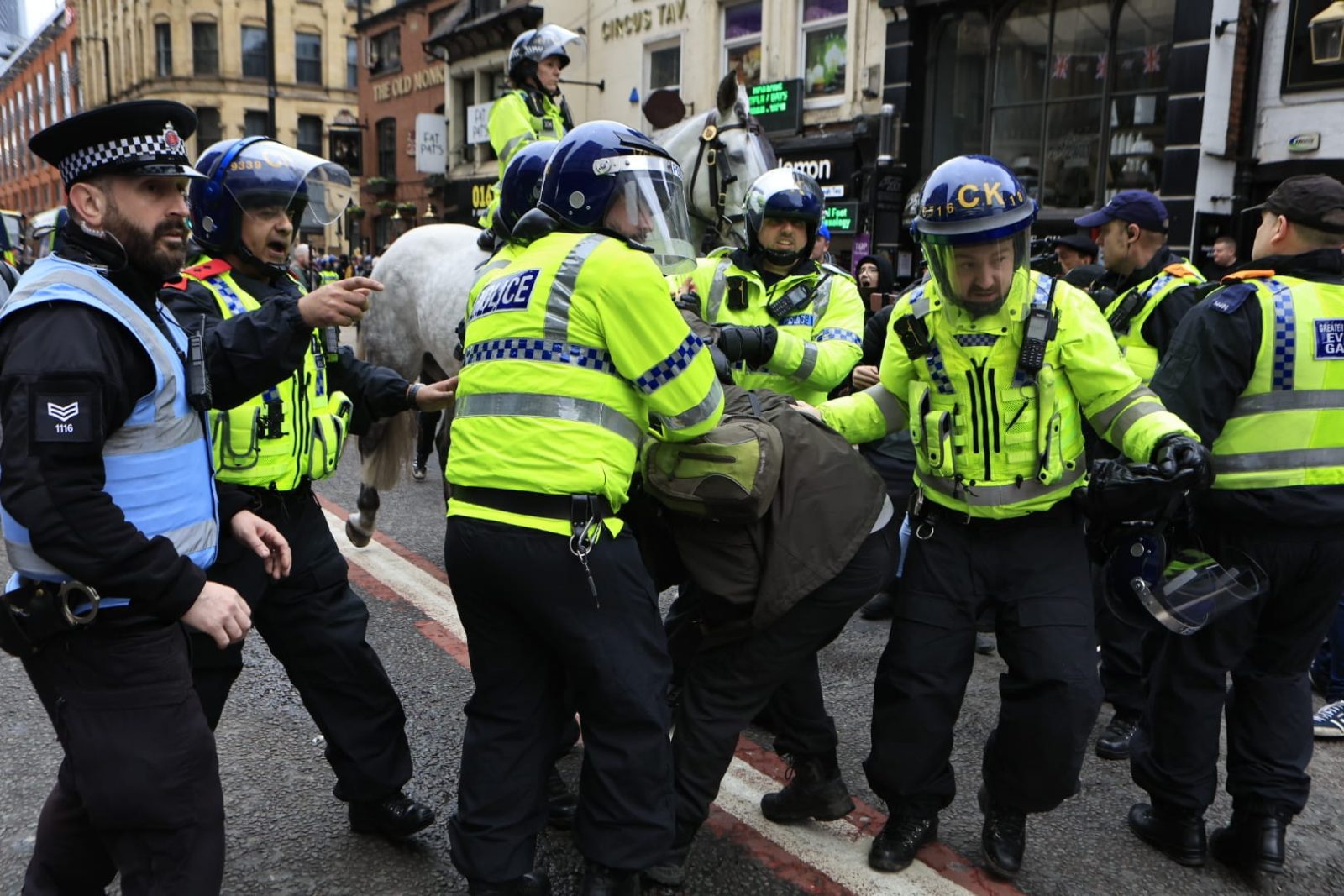
11 men have been arrested following a ‘busy’ day of protests and marches in Manchester city centre over the weekend.
Greater Manchester Police (GMP) said several demonstrations – the most noteworthy being that of the widely-reported Britain First march – took place ‘peacefully’ across central Manchester at the weekend, particularly on Saturday (21 February), with officers working closely with organisers to ensure people could protest ‘safely’.
Police were also on-hand to ensure that wider disruption to the general public around the city centre was ‘kept to a minimum’ as best as possible.
A ‘significant’ policing operation was said to be in place throughout Saturday – with additional resources deployed and pre-prepared plans activated by GMP, alongside partner agencies, to help the day run smoothly.
While the demonstrations on the day were described by authorities as ‘peaceful’, 11 people were arrested on suspicion on a range of offences.
ADVERTISEMENT
These included two men on suspicion of prevention of a breach of the peace, four men on suspicion of public order offences, and one man on suspicion of assault, just to name a few.
Two of the 11 were de-arrested, while the nine others were taken to police custody, and a section 34 dispersal order was subsequently put in place until 8pm that evening (21 February), allowing police to direct people to leave the area.
ADVERTISEMENT
11 people have been arrested following a ‘busy’ day of protests in Manchester / Credit: GMP
Speaking following the demonstrations and arrests made over the weekend, Assistant Chief Constable Rick Jackson, who was the gold commander for policing operation, commented: “Manchester was expected to be extremely busy today, with multiple planned protests in the city centre as well as several football matches.
“We put extra officers on duty to support people’s right to protest peacefully, while reducing the impact on the wider public.
“Thanks to the efforts of our officers on the ground and the planning done with our partners, hundreds of people from a range of groups were able to come together safely, with no significant issues reported.
“Greater Manchester is a place where people can confidently and lawfully express their views, while ensuring that residents, workers, and visitors can go about their day feeling safe.”
Featured Image – GMP
News
Seven in 10 NHS workers think the health service is ‘poorly prepared’ for another pandemic
Emily Sergeant
A new survey has revealed that seven in 10 NHS workers believe the health service is ‘poorly prepared’ for another pandemic if one should arise.
After the recent meningitis B outbreak in Kent last month raised the conversation of mass contagion once again, of course following the COVID-19 pandemic, a new YouGov survey of more than 1,000 NHS workers has now uncovered how well prepared staff in the health service think it is for another global pandemic.
The results show that 69% of staff surveyed think the health service is ‘poorly prepared’ for another pandemic, and to make matters worse, 26% of those even say it’s ‘very poorly’ prepared.
Only one in five (22%) think the NHS is could properly handle another pandemic, but statistically, YouGov claims none of those surveyed said it’s ‘very well’ prepared.
Seven in 10 NHS workers think the health service is ‘poorly prepared’ for another pandemic / Credit: Pxhere | Rawpixel
When workers were asked how the NHS’s level of preparedness now compares to prior to the COVID-19 pandemic, 41% did concede that they think it is better prepared now than 2020, however 37% admitted they think it’s no better prepared.
16% actively think it’s less well-prepared now than it was prior to 2020.
This marked a new era of ‘transparency’ and ‘accountability’ in the NHS, with the league tables delivering on the Government’s promise to drive up standards, tackle variation in care, and ensure people get the high-quality service they rightly expect.
Every trust in England – from urgent and emergency care, through to elective operations and mental health services – will now be ranked quarterly against ‘clear and consistent’ standards.
Featured Image – Stephen Andrews (via Unsplash)
News
Seven people arrested in Salford over plans to conduct coordinated mass shoplifting campaign
Emily Sergeant
Seven people have been arrested in Salford over plans to be part of a coordinated mass shoplifting campaign of ‘high end’ retailers and supermarkets across the country.
According to Greater Manchester Police (GMP), it is believed the group had been training for ‘non‑violent direct action’ in Salford as part of a coordinated mass shoplifting campaign, where they were intending to steal goods from high‑value stores and major supermarkets across the country, and then redistribute them to places such as food banks.
Working in collaboration with the Metropolitan Police Service, officers arrested one male and six females in Salford yesterday afternoon (Sunday 19 April) on suspicion of conspiracy to steal.
They all remain in police custody for questioning.
It has been reported in multiple sources, such as the BBC and the MEN, that the individuals arrested are believed to be part of the Take Back Power Action Group.
Take Back Power Action Group describes itself on its website as a ‘nonviolent civil resistance group’ that is aiming to ‘put the 99% in charge’ through citizen’s assemblies.
“We are ordinary people from all walks of life who believe that in order to fix Britain, taxing the rich is an essential first step, and we want ordinary people to decide how,” a statement on the group’s website declares.
Speaking following the arrests over the weekend, Assistant Chief Constable Steph Parker said: “This joint operation with the Metropolitan Police has resulted in the arrests of seven individuals who we believe were planning to take part in coordinated national activity targeting high‑value retail stores.
“We are taking robust action to disrupt this type of organised criminality, and it will not be tolerated in Greater Manchester.