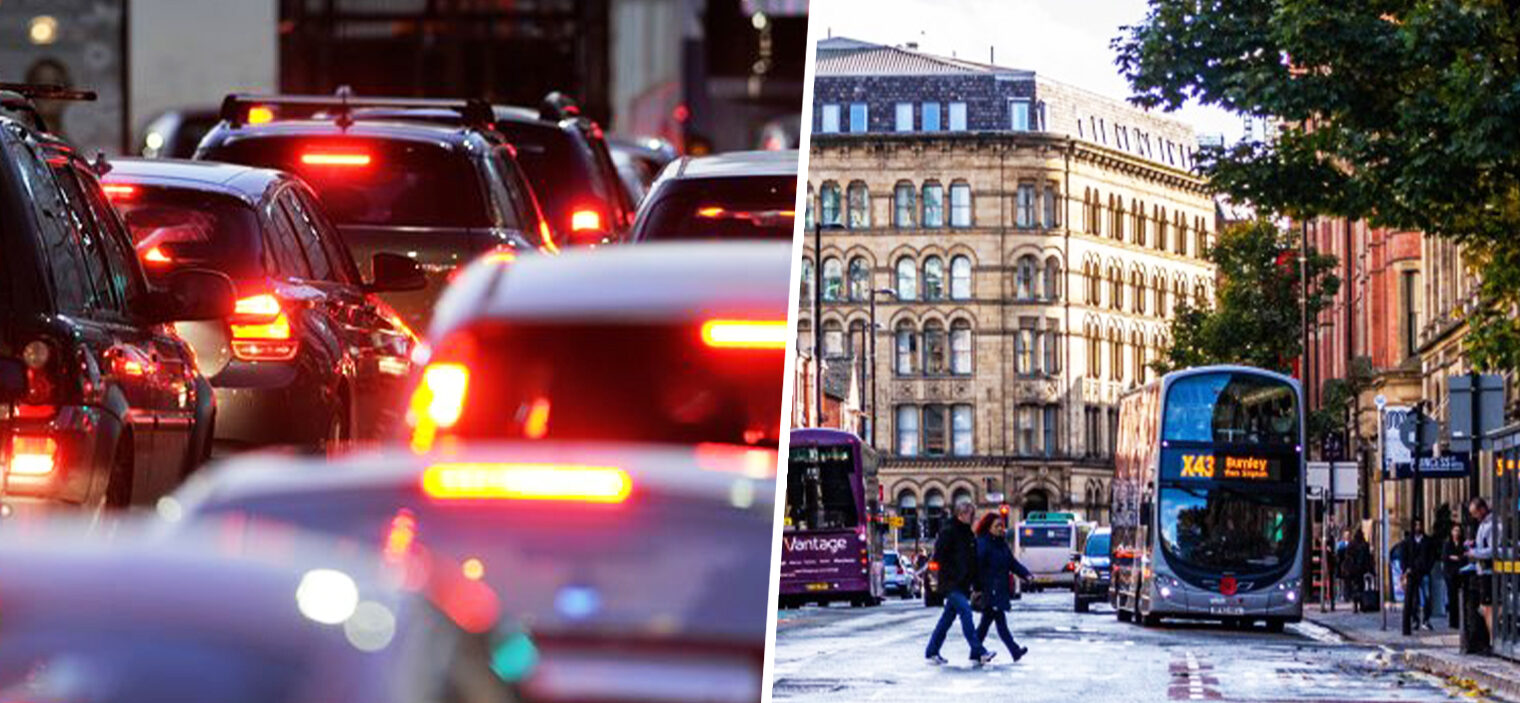
It’s been revealed that air pollution throughout Greater Manchester has crept back up to near pre-pandemic levels after a sharp drop during the first lockdown.
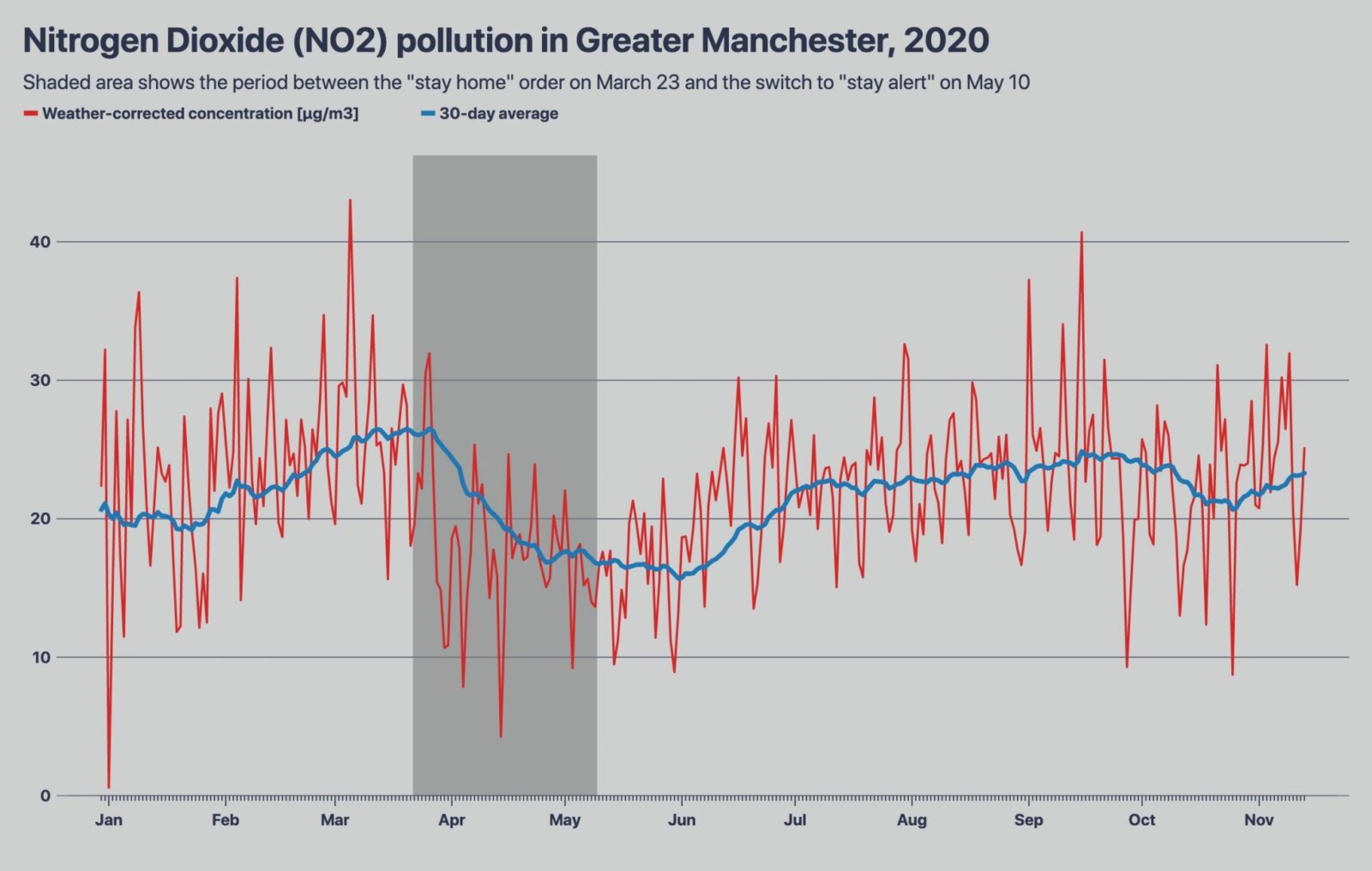
Data from the think tank Centre for Cities stated that there was a 40% reduction in nitrogen dioxide (NO2) levels across Greater Manchester following the first national lockdown and ongoing coronavirus (COVID-19) restrictions since, but this had returned to 93% of pre-pandemic levels by September.
The main source of NO2 pollution is the burning of fossil fuels, particularly fuel in vehicles.
These findings follow the end of an eight-week public consultation for a Clean Air Zone (CAZ) in the region, although plans for its implementation were previously delayed for a year because of the pandemic.
The study also looked at particulate matter with a diameter of 2.5μm or less (PM2.5) – their size means they can get deep into the lungs and bloodstream – finding that PM2.5 levels fell by 17% in the region during the first lockdown, but remained above the World Health Organisation (WHO) guidelines of 10µg/m3.
Speaking on the research findings, Andrew Carter – Chief Executive at Centre for Cities – said: “Toxic air has contributed to the deaths of thousands of COVID-19 victims this year and, even after the pandemic ends, will remain a big threat to health,
ADVERTISEMENT
“Particularly for those living in urban areas.”
DEFRA / Centre for Research on Energy and Clean Air
Dom Goggins – a member of the Manchester Climate Change Board who runs the Parliamentary Group for Renewable and Sustainable Energy – has called for WHO standards to be written into the Environment Bill that is going through Parliament, saying: “It comes back to legislation and resources at a national level to give local leaders the powers and the resources, the capacity, to do what needs to be done.
“Local leaders can’t do this with their hands tied behind their back and at the moment it feels like that is what’s happening.”
ADVERTISEMENT
The government has directed Greater Manchester to introduce a Category C CAZ, now expected to be brought in by spring 2022.
It will be England’s biggest such zone and would require vans, buses, coaches, taxis, private hire vehicles, minibuses and heavy goods vehicles that do not meet emission standards to pay a daily charge to travel.
Private cars, motorbikes and mopeds are not included.
It will apply to all roads within Greater Manchester – except for motorways and trunk roads – and will operate 24/7 using Automatic Number Plate Recognition technology.
In January, we revealed that more than 1 in 19 deaths in the UK’s largest cities & towns are linked to air pollution 🚗🌫️#CitiesOutlook2020 called for urgent action from national & local govt to clean up the air we breathe.https://t.co/SfkxrMhoqK
Mr Goggins – who has written several reports on air pollution in Greater Manchester, including Atmosphere (2018) and Unfair Air (2020) – added: “It’s essential if we’re going to deal with this problem that we’ve got to get fewer cars on the road, and we need to shift from high polluting vehicles to low polluting vehicles. But people who need a vehicle to earn a living can’t be penalised and the transitional funding needs to be made available by national government to the combined and local authorities in Greater Manchester to support that transition.”
ADVERTISEMENT
The public consultation on the Clean Air Zone (CAZ) closed on 3rd December and news on the final plan to be considered by the ten Greater Manchester local authorities is expected early next year.
You can find more information via the Clean Air GM website here.
News
Hundreds of staff at four Greater Manchester hospitals to strike AGAIN next week
Emily Sergeant
Another round of strikes has been called at a handful of major Greater Manchester hospitals.
Amid ongoing disputes following the first set of strikes at the end of last month, it has now been announced that more than 350 Northern Care Alliance Foundation Trust (NCA) employees – including nurses, clinical support workers and housekeepers – who are members of the union UNISON will once again walk out for three days next week.
According to the union, the dispute centres on the NCA’s use of an outside agency called NHS Professionals (NHSP) to manage overtime.
When covering staff shortages, workers are entitled to time-and-a-half pay – however in some cases, staff earn less than they would on a normal shift, and some have even been missing out on more than £80 per shift, the union added.
Operating theatre staff were previously on picket lines in June, and although an option to resolve the row was initially tabled by NCA bosses, this has now fallen through.
Hundreds of staff at four of Greater Manchester’s hospitals are set to strike next week / Credit: Stephen Andrews (via Unsplash)
This means that staff at Salford Royal Hospital, Royal Oldham Hospital, Rochdale Infirmary, and Fairfield Hospital in Bury are walking out next week on Monday 14, Tuesday 15, and Thursday 17 September.
The union’s North West regional organiser, Kevin Dolan, said the trust had given ‘no indication’ that it’s willing to re-enter negotiations, adding that operating theatre services were ‘chronically under-staffed’ and staff were choosing to work extra shifts to cover shortages.
Ahead of the August strikes, the trust declared a critical incident to help it secure extra support and keep urgent surgery running, while also announcing that some procedures would have to be postponed.
Understandably, some disruption is expected at each of the hospitals on strike days.
But Gertie Nic Philib, who is the chief people and strategy officer at the Northern Care Alliance, said that the trust will do ‘everything we can to minimise the impact on patients’ and ‘maintain high standards of care and quality at all times.’
“We also have contingency plans in place for emergency situations,” they concluded.
Featured Image – Pxhere
News
Stockport man jailed for life after kidnapping and sexually assaulting teenage girl
Emily Sergeant
A Stockport man has been sentenced to life in prison after kidnapping and sexually assaulting a teenage girl on her way home from the library.
Paul Sharpe has been sentenced to life imprisonment with an eight-year minimum term in prison after being convicted of a number of offences when subjected a teenage girl to what police called a ‘terrifying ordeal’ that lasted several hours back in May 2026.
Greater Manchester Police (GMP) confirmed that the victim had been studying at Sale Library before beginning her journey home with friends at around 5:50pm and contacting her parents at 6:10pm to let them know she was on her way.
Twenty minutes later, she spoke to her boyfriend on the phone and said she was approximately five minutes away from home, but that her phone battery was about to die.
This was the last contact received from the victim that evening.
While walking along Bradgate Road in Altrincham, the victim noticed a grey Ford parked nearby and a man wearing a high-visibility jacket pressing doorbells in the area.
As she walked past, Sharpe approached her from behind, placed her in a headlock and threatened to stab her if she did not get into his vehicle.
Concerned that their daughter had not returned home, the victim’s family contacted police at 9:22pm to report her missing, and officers immediately launched an investigation to locate her.
Over the next several hours, the victim was subjected to and placed in a number of terrifying situations.
Sharpe drove the victim to several locations across Greater Manchester and Cheshire, before police located and arrested him at around 3:40am on 19 May 2026.
Following his arrested, 56-year-old Sharpe was convicted of kidnap, committing an offence with intent to commit a sexual offence, sexual assault, engaging in sexual activity in the presence of a child, threats with a bladed article, and administering a noxious substance with intent to injure, annoy or aggrieve.
“This was a terrifying ordeal for a young girl who was simply making her way home,” explained Detective Inspector Karl Perry, from GMP’s Criminal Investigation Department.
“Sharpe targeted a vulnerable victim, subjected her to hours of fear and intimidation, and went on to sexually assault her.
“The victim has shown immense courage throughout the investigation and court proceedings. Through her bravery and actions, she no doubt made it harder for Sharpe to carry out whatever acts he had planned.”

 The Manc -
23rd December 2020
The Manc -
23rd December 2020