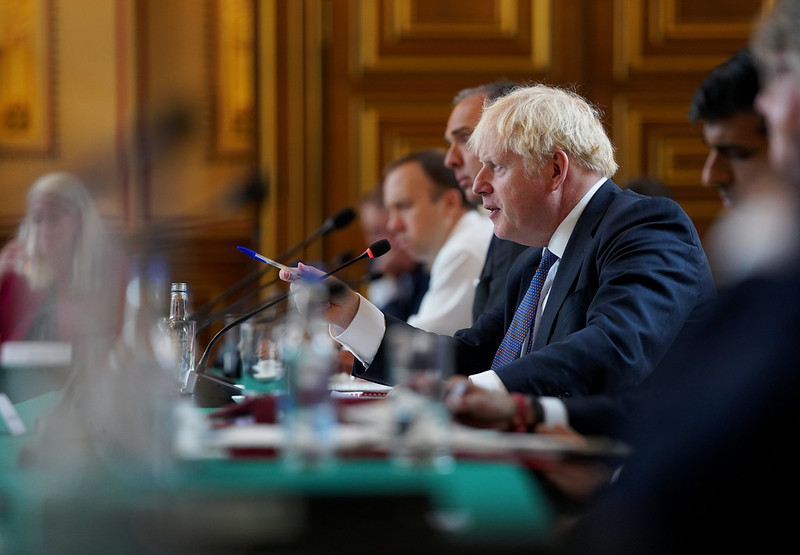
In an address to MPs live in the House of Commons, Mr Johnson has announced a new set of targeted restrictions – which have been the topic of widespread speculation over the past week or so and particularly today – for cities and towns in England in an attempt to control the spread of coronavirus (COVID-19).
Each tier under the newly-announced system has its own set of rules determined by an alert level: ‘medium’ (Tier 1) ‘high’ (Tier 2), or ‘very high’ (Tier 3).
Mr Johnson said that he does not want to go into a second full national lockdown – including closing schools and businesses and telling people to stay at home – as this would not be “the right course”. He did however say that letting the virus “rip” would lead to an “intolerable death toll” and the NHS would be under such a strain that medics wouldn’t be able to devote themselves to treating other ailments.
“We must act to save lives, and the evidence shows in changing our behaviour… our actions are saving lives.” he said.
Speaking to BBC News ahead of the announcement, Mayor of Greater Manchester Andy Burnham said officials in the area were “glad that government has listened”.
ADVERTISEMENT
“We had no evidence that hospitality was the primary course of spread in our city region,” he said.
“However, it’s important to say that any restrictions will choke off trade to our pubs, restaurants, even our shops. So, any restrictions must come with a full economic support package otherwise we are going to see a risk of redundancies and business failure running up to Christmas.”
He continued by stating that he feels that Tier 2 is “still a major restriction” for Greater Manchester.
ADVERTISEMENT
Mr Johnson confirmed that the three tier system and the whole package of measures will also be voted on in parliament before coming into force.
Here’s how each of the three tiers work:
Tier 1
Areas that fall into Tier 1 – which Mr Johnson said “will cover most of the country” – will see residents living in these areas required to adhere to national restrictions.
This includes the “rule of six”, the 10pm curfew, and social distancing measures.
Tier 2
Tier 2 will cover areas where interventions are already in place – including in Greater Manchester – and will see all mixing between different households or support bubbles indoors stopped.
ADVERTISEMENT
The “rule of six” will apply outdoors, as well as in private gardens.
It has been confirmed that Nottinghamshire, Cheshire East and West, and High Peak will also move to the high alert level as part of Tier 2.
Tier 3
This is the highest alert level and will apply where transmission is rising rapidly and the NHS could be under “unbearable pressure”.
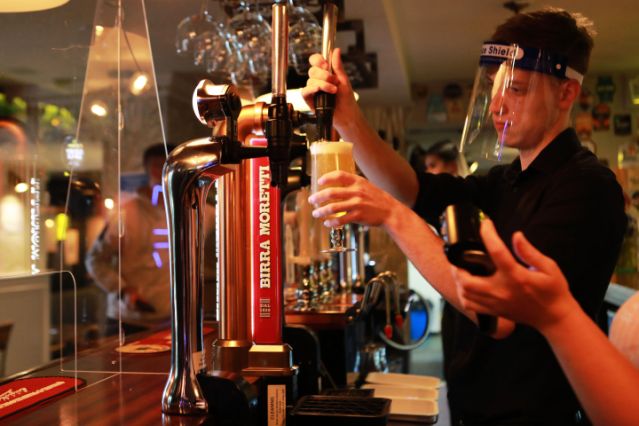
Tier 3 will see people banned from socialising with other households, both indoors and in private gardens, while bars and pubs will be closed, unless they can operate as restaurants. Residents will also be advised against travelling in and out of these areas, while it will be up local politicians as to whether other leisure venues such as gyms and casinos should also close.
However, non-essential shops, schools and universities will remain open.
ADVERTISEMENT
It has been confirmed that the Liverpool City Region is the first to be placed in Tier 3 and this comes after numbers have risen sharply in recent weeks, with Knowsley recording 944 cases per 100,000 people in the two weeks to 4th October (the highest in the country).
The restrictions for the Liverpool City Region will take effect from Wednesday.
Boris Johnson has announced his plan to "simplify and standardise" #COVID19 rules with a new three-tier alert system.
The First Tier will "cover most of the country" and includes most national measures, such as the rule of six and 10pm curfew.
A postcode checker will be launched on the government’s website to advise people what guidance applies to their area, and every local authority will be put in a Tier by the end of Monday.
In his final message to the country, Mr Johnson said: “The weeks and months ahead will continue to be difficult and will test the mettle of this country.”
But he adds: “I have no doubt at all that together we will succeed.”
ADVERTISEMENT
___
For the latest information, guidance and support during the coronavirus (COVID-19) pandemic in the UK, please do refer to official sources at gov.uk/coronavirus.
#HandsFaceSpace
News
Elbow get behind campaign to save Jodrell Bank from closure
Danny Jones
Manc band Elbow are among the latest to get behind the campaign to save Jodrell Bank Observatory from closing permanently.
The Greater Manchester natives famously played a sold-out gig at the important scientific and cultural landmark for a very special live album recording well over a decade ago, and know all too well the site’s national and, indeed, global heritage.
Choosing the Observatory and the rare chance to perform a show in the shadow of the world-renowned James Lovell Telescope, it probably remains one of their most significant standalone UK date ever.
With that in mind, the local lads have been left just as worried by the news of its impending closure as everyone else, and have therefore issued a fresh appeal to help keep it open.
Posting a timely statement on social media, the group wrote: “Jodrell Bank has long been close to elbow’s heart. In 2012, the band played beneath the Lovell Telescope for one of the most memorable shows in our history.
“The recent news that funding for the e-MERLIN radio telescope network is set to end in 2028 puts the future of the scientific work at Jodrell Bank under serious threat. It is a remarkable place, with an extraordinary history, and one that continues to play an important role in science, culture and education.”
In addition to reliving clips and images from the historic live set all the years later, they also pointed people towards their ‘elbow – Live at Jodrell Bank‘ album documentary, which has now been made available online for the very first time as part of wider efforts to raise awareness around the cause.
Directing people to key online resources shared by the institution and astrophysics centre itself following their unfortunate update late last month, the push to not only find the funding but sustain support for the facility continues to ramp up throughout the world of science, arts and industry.
For anyone who somehow missed the news – 2028 being the current deadline handed down as per budget cuts across the sector – concerned parties here in the North West and all over the country have since started petitioning to save Jodrell Bank Observatory from shutting down for good.
In addition to being described as a “huge blow” to the field by the Royal Astronomical Society (RAS), some have even gone so far as to describe the decision as a form of “vandalism” when it comes to research and British culture as a whole.
Having also served as the host venue for the annual bluedot Festival since 2016, the multi-genre science and arts celebration could soon be forced to find a new home.
The battle is far from over yet, and the community has time to rescue Jodrell Bank Observatory from its fate, but it will take lots of money and more notable public figures to make it happen.
Once again, you can do your bit by signing the petition mentioned above right HERE.
Featured Images — Emma Farrer (via Wikimedia Commons)/The Manc Group
News
All Greater Manchester boroughs to have 24-7 night buses from next month as new services launch
Emily Sergeant
Extra night buses, new routes, and more frequent bus services are being rolled out across the Bee Network at the end of this month.
You may remember that back in March, it was announced that every borough of Greater Manchester was set to get a night bus service in what is hoped to be a ‘boost’ to the night-time economy, and now plans to introduce these from September onwards have been confirmed by Transport for Greater Manchester (TfGM), along with a series of other measures.
Oldham, Stockport, Tameside, and Trafford will all get a 24-hour bus service by next month, meaning every part of the region will have a night bus operating Thursday through to Sunday.
It’s expected that once the new services have launched, it will help around 625,400 people working in the night-time economy across Greater Manchester, as well as those out enjoying the region’s nightlife, TfGM has said.
Some of the other changes set to be introduced from next month include a selection of brand-new bus services, and more frequent buses during the day and at the weekends.
All Greater Manchester boroughs will have 24-7 night buses from next month / Credit: TfGM
There will also be better connections overall to key employment and leisure destinations like Manchester Airport, Trafford Centre, MediaCity, Middlebrook Retail Park in Bolton, Kingsway Business Park, and Logistics North.
“The Bee Network belongs to the people of Greater Manchester and it needs to work for every community,” explained Mayor Bev Craig.
“As we build it, we’re listening and responding to what residents want with the biggest set of improvements we’ve ever made in one go.
🚌 More improvements are on the way across the #BeeNetwork.
36 service changes will benefit around 740,000 people across Greater Manchester, helping more communities access reliable, convenient public transport.
“We’re bringing night buses to every borough, launching new routes and ensuring buses run more often in the mornings, evenings and weekends. In doing so, we’re making it easier than ever for people to get around the city region by bus, but we’re also supporting our businesses, whose staff and customers need a reliable and safe way to reach them.
“Almost three quarters of a million people live within walking distance of a bus route we’re improving over the next few months, and we’ll continue improving connections for even more communities based on the feedback we get.”