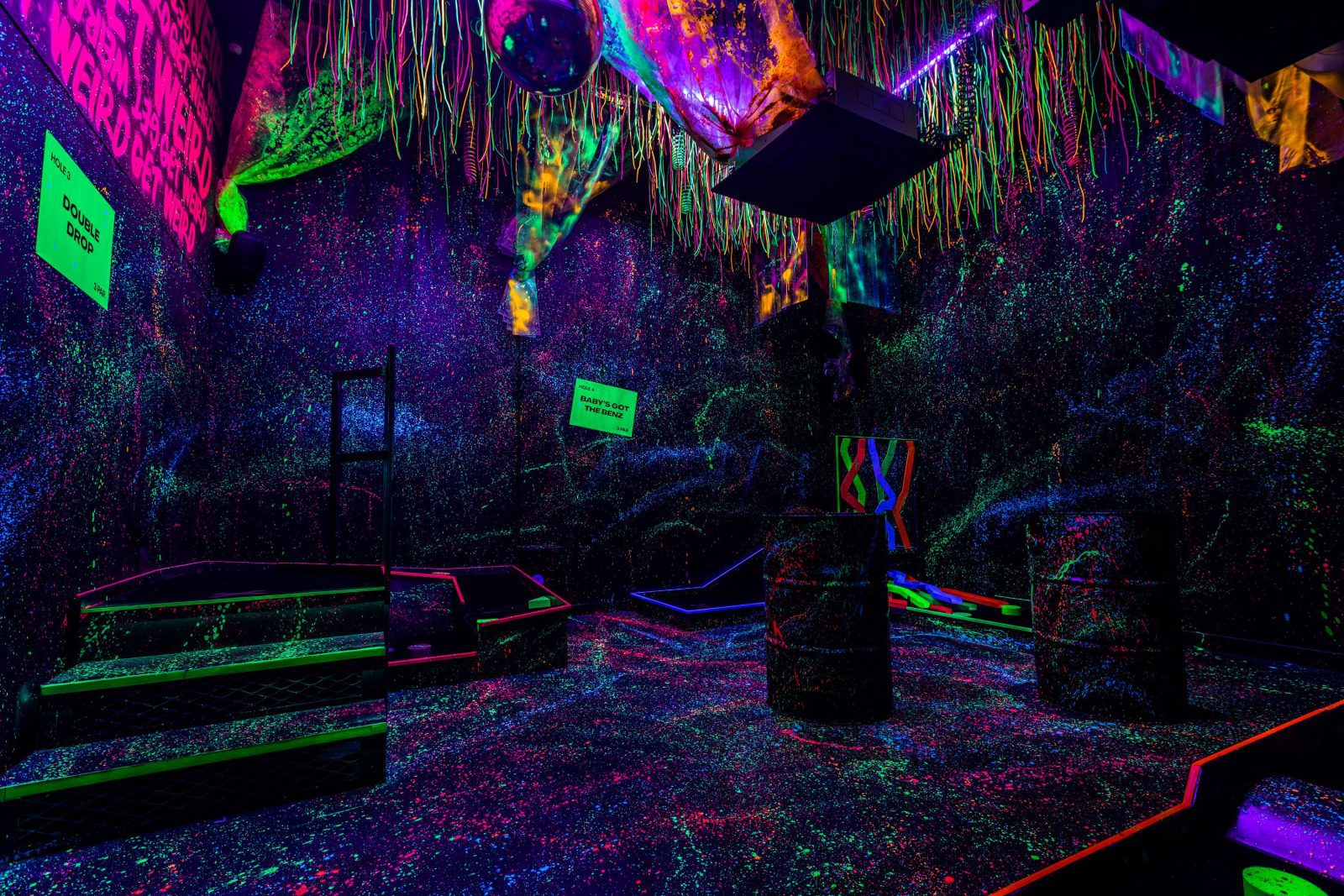
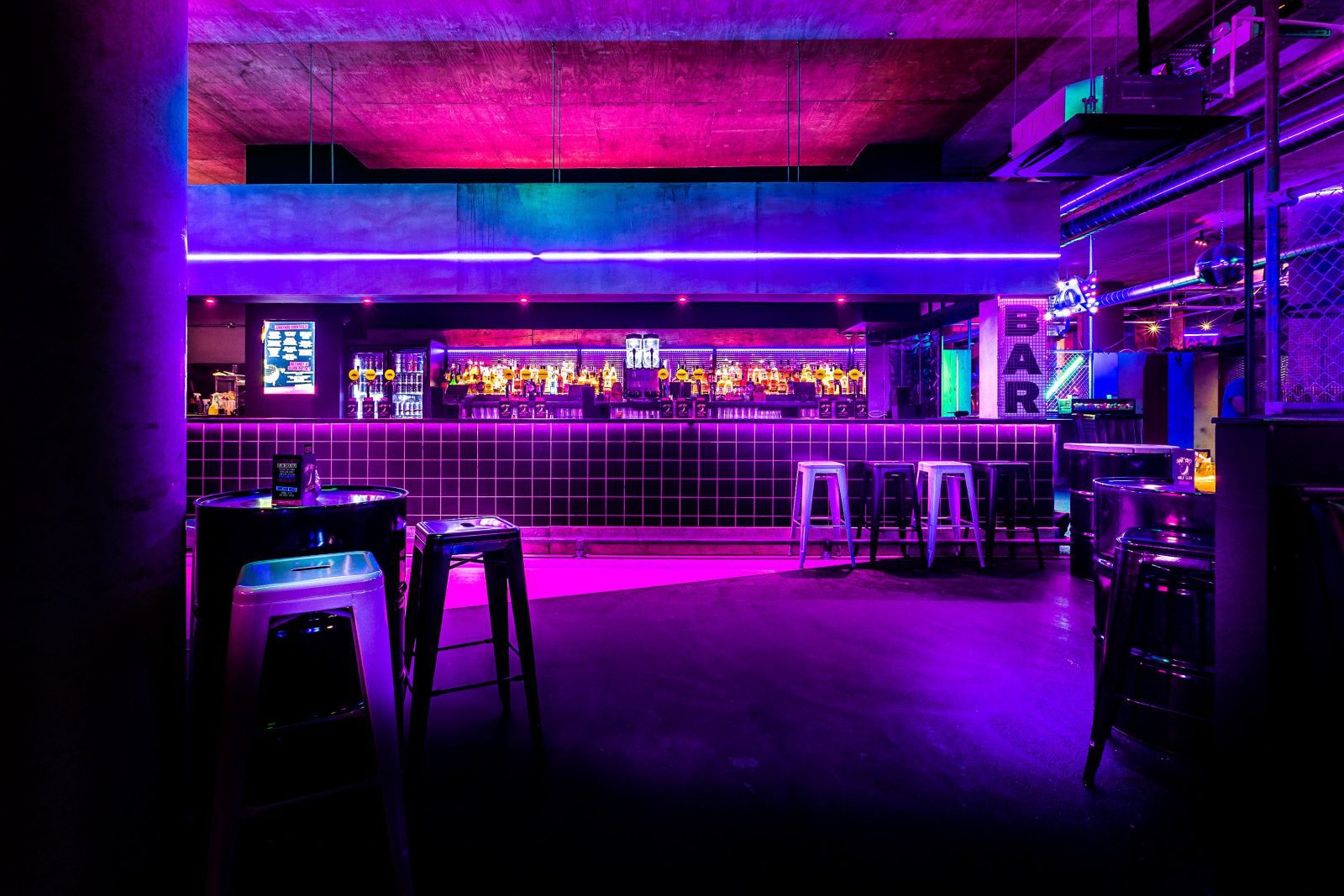
Junkyard Golf Club in Manchester has unveiled a brand new look, giving its First Street venue an industrial-inspired makeover.
Doing away with the loud neon flecks and old vinyl that the brand has become known for, now, in its place, you’ll find a new style of interiors using stencilled paint – designed to set a more ‘grown up’ tone as Junkyard enters a new phase of its evolution.
First founded here in Manchester back in 2015, over the past seven years Junkyard Golf Club has expanded to six UK sites and is currently in the process of closing on a seventh – a second London location for the group.
It’s also tipped to be eyeing up expansion opportunities overseas this year.
Images of new-look courses show a sort of concrete urban jungle, with masses of corrugated iron and exposed industrial elements offset by sprawling foliage that drapes from the ceiling.
ADVERTISEMENT
Bright neon lights still litter the course, whilst the bar area is cleaner – the bleachers, it seems, are gone, replaced with the barrels and high stools favoured in other Manchester party bar venues like Crazy Pedro’s, Liars Club and Cane and Grain.
Elsewhere, the golf courses themselves have had quite the glow-up, too, with striking new set designs. In one instance – a real life-size aeroplane installation.
ADVERTISEMENT
Image: Junkyard Golf Club
Speaking on Junkyard Golf Club’s progression as it moves into this new phase, co-founder Mat Lake said: “The courses have matured and grown just as we have as a business.
“Visually they are a lot more impressive, more immersive, and more playable, so guests of Junkyard Golf Club are given the best possible experience.
“You can expect to see a major shift in terms of set design on each course, where we have added in some bigger scale production elements (vast real aeroplane installations) as well as upgraded lighting and general theming throughout.
ADVERTISEMENT
“The vibe will appear more over the top, but much more entertaining and fun-filled to improve our customer’s experience when playing crazy golf at one of our six venues.”
Image: Junkyard Golf Club Image: Junkyard Golf Club
Over the years, Manchester has watched Junkyard Golf Club grow from a low-fi, fledgling DIY pop-up determined to give crazy golf a new lease of life, to something altogether more grown-up and polished.
Emerging alongside a new leisure sector that brought us the likes of activity-led venues Flight Club, Swingers and Whistlepunks, Junkyard’s founders may have just ‘stumbled’ across the concept initially but over the years they’ve grown it into a nationally recognised brand.
Now, with a new look, a new logo and a new-look drinks menu, it appears the brand is gearing up to enter another new phase, all over again.
ADVERTISEMENT
On target to provide over 1.8 million games of crazy golf to the public in 2022, who knows, soon Junkyard Golf Club could become an international export.
Feature image – Junkyard Golf Club
News
Victim named and murder investigation launched after young woman is killed in Newton Heath stabbing
Emily Sergeant
The victim of a street stabbing in Newton Heath this week has been named for the first time as a murder investigation continues.
It comes after officers from Greater Manchester Police (GMP) responded to reports of a disturbance at around 2am yesterday (Thursday 15 October) on Dorking Avenue, in the Newton Heath area of Manchester, and when they arrived on the scene, they found a woman in her 20s with serious injuries that were ‘consistent with a stabbing’.
Despite best efforts of all emergency services involved, the young woman was sadly pronounced dead at the scene.
As the murder investigation progresses, the woman has now been publicly named and a photo of her has been released for the first time.
She has been named as 26-year-old Alisha Samuels.
At this time, one man, aged 25, has been arrested on suspicion of murder, and a man and woman, aged 61 and 38, have been arrested on suspicion of assisting an offender, and they all remain in custody – with officers continuing their enquiries to establish the full circumstances of this incident.
Alisha’s family have asked for privacy whilst they deal with the devastating loss of their loved one, GMP has stated.
“We are continuing to urge people who may have information in relation to this incident to please come forward to support our investigation and bring justice for Alisha,” the police force said in a public appeal.
Anyone who may have witnessed the incident, or has mobile phone, CCTV, or doorbell footage, is urged to call GMP on 0161 856 5464, or contact them via the Major Incident Public Portal here.
Alternatively, you can contact Crimestoppers on 0800 555 111
Featured Image – GMP (Family Handout)
News
Former supply teacher jailed for multiple upskirting and AI sex offences across Greater Manchester
Emily Sergeant
A former supply teacher has been jailed for multiple upskirting and AI sex offences in schools across Greater Manchester.
Abusali Rahman – a British national of Bangladeshi ethnicity from Salford – appeared in Bolton Crown Court this week for his sentencing after first being charged with, and then pleading guilty to, several offences.
The offences are including, but not limited to, 12 counts of taking an indecent photograph/pseudo-photograph of a child (images obtained by upskirting), three counts of making indecent photograph / pseudo-photograph of a child (making AI-generated images), and one count of attempting to meet girl under 16 following sexual grooming.
The offences are alleged to have taken place between December 2023 and June 2025, according to Greater Manchester Police (GMP).
Twelve girls have been identified in relation to the upskirting offences – aged between 13 and 16 at the time of the alleged offending – at seven high schools in three Greater Manchester boroughs (Bury, Bolton, and Salford).
GMP says it has remained in close contact with the schools, local authorities, and other partners throughout the investigation to ensure all appropriate support is in place for those who need it.
Additionally, the court also heard how Rahman amassed a collection of images of young girls, using AI and other methods to sexualise them.
The images numbered more than 300 in total, ranging from Category A to Category C classifications, and Rahman would post these on social media, often alongside humiliating and disgusting captions.
Rahman was sentenced to six years in prison, and will also be subject to a 20-year Sexual Harm Protection Order.
A former supply teacher has been jailed for child sex offences in schools across Greater Manchester / Credit: GMP
Detective Constable Lisa McGaffin, from GMP’s Bolton Child Protection Team, described Rahman’s crimes as ‘absolutely abhorrent’.
“My thoughts throughout this process have always been with the young girls who have been subject to such indignity,” DC McGaffin said following the sentencing this week. “Their welfare and support will always be a priority for us.
“While working as a teacher – someone who young children should trust and be safe with – Rahman repeatedly took secret photos for his own sick gratification, before posting images online which showed his total disregard for the girls’ respect and dignity.

 Georgina Pellant -
7th April 2022
Georgina Pellant -
7th April 2022