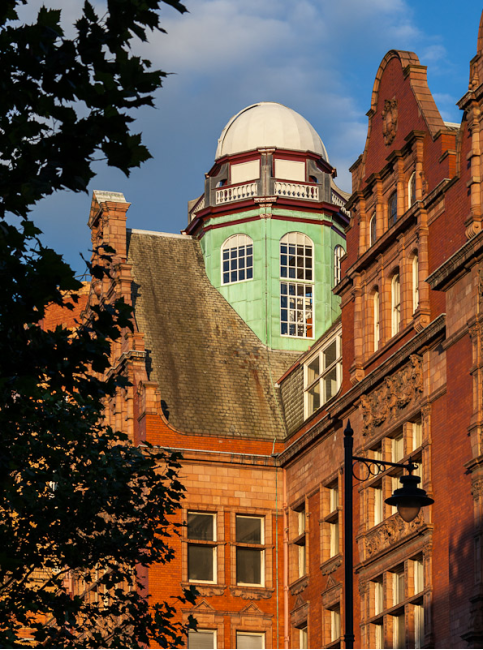
Often referred to as ‘Sackville Street’s best-kept secret’, the Godlee observatory in Manchester city centre has been going strong for over 100 years – despite the fact that the roof is constructed from papier-mache.
Located in a tower on the roof of the University of Manchester’s Sackville Building (formerly the Municipal School of Technology), its origins date all the way back to 1892.
An impressive architectural feat, it’s stood high in the sky for over a century and even survived WWII, which saw a large proportion of old Manchester decimated by air raids.
Yet, despite the observatory having been at the heart of the city’s astronomical research for more than a century, most people don’t know this tiny window to the stars even exists.
But it does – and even better, it actually belongs to all of us.
ADVERTISEMENT
Gifted to the city by an eccentric chap called Francis Godlee, it was donated to the people of Manchester when construction on the building and observatory was first completed in 1902.
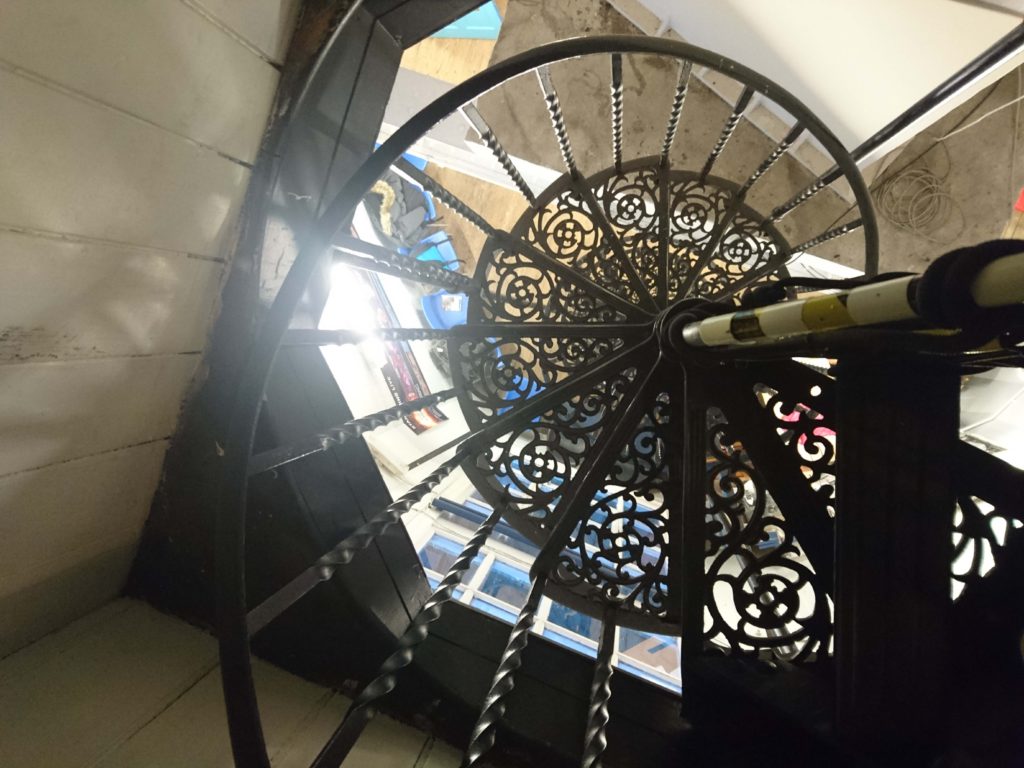
Reached by way of a winding, ornate wrought iron staircase that dates all the way back to Edwardian times, and then by clambering through a trap door, it’s possible for anyone to visit and really does feel like a hidden secret – tucked away at the top of the impressive Spalding and Cross building.
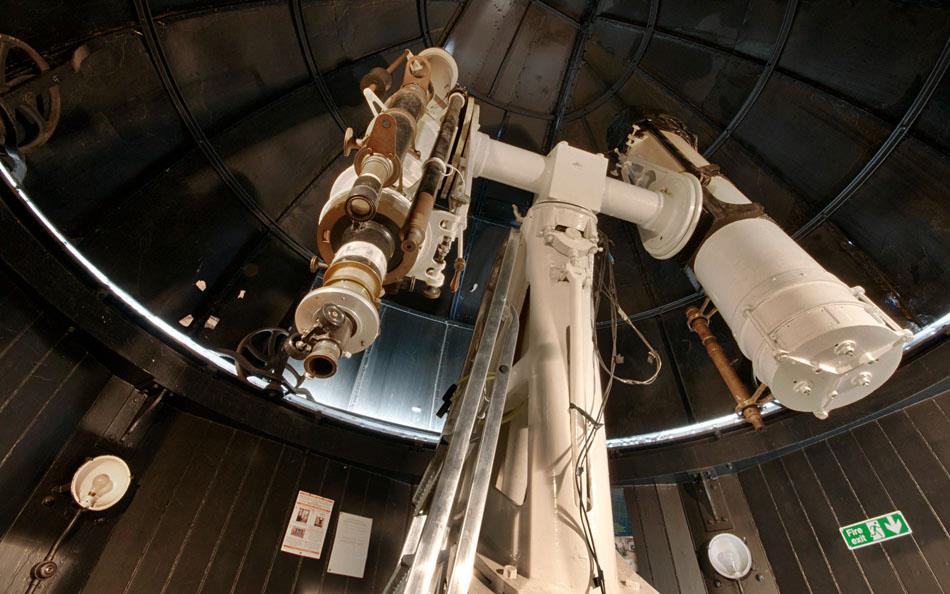
The Godlee Observatory is home to two original telescopes made by Grubb of Dublin: a Newtonian telescope and a.refracting telescope, both of which date back to 1902. Apparently, if you know what you’re looking for, you can see all nine planets in the solar system from here – including Pluto.
As for that papier mache roof? It sounds impractical given the amount of rain we get here in Manchester, but it actually has a very sensible intention behind it.
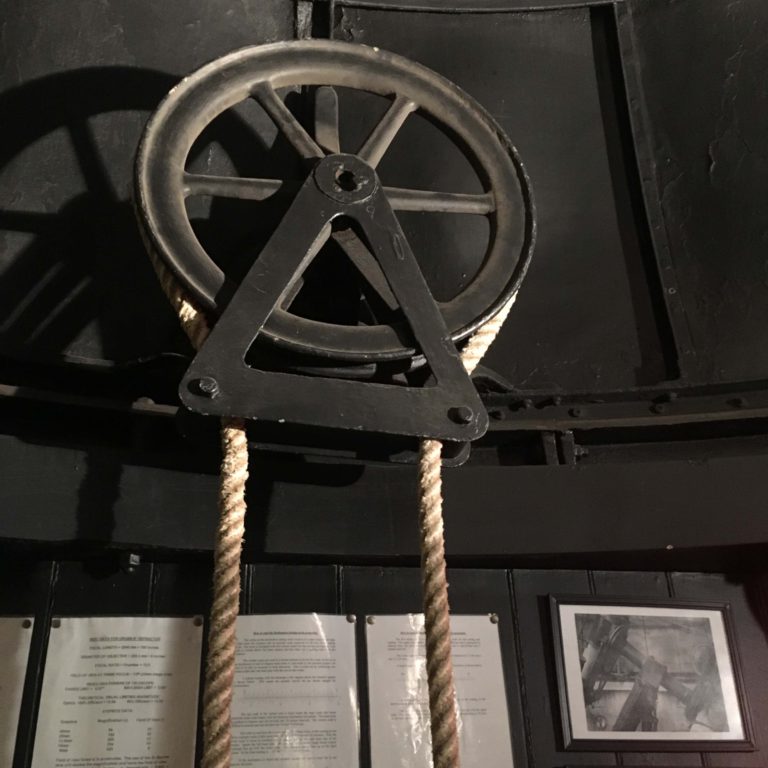
The lightness of the material allows the dome’s panels to be rotated with ease using a wheel, opening up a space in the roof that’s perfect for stargazing. It’s an engineer’s dream.
ADVERTISEMENT
And it’s not just the observatory that’s of interest. Its generous donor and namesake was, by all accounts, quite a character in his own right too.
Known for his massive clock collection, the businessman and philanthropist entertained a wide range of interests that ranged from breeding horses to yachting.
Fascinated with mechanisms and machines, he was so quick to get a telephone hwas awarded the magnificent number of ‘4’, and even had his own x-ray machine at home which he would apparently use to photograph visitor’s hands when they came to tea.
The wheel that is used to open the roof and find the perfect spot in the heavens / Image: The University of Manchester
For years, the Godlee observatory has acted as the base for the Manchester Astronomical Society – which is said to be the oldest of its kind in the whole of England.
The society still meets here most Thursday evenings, and members of the public are able to attend on request – which we’d definitely recommend.
ADVERTISEMENT
Today, Manchester’s astrologists prefer to use the Lovell Telescopes at Jodrell Bank when they scan the night sky – but that doesn’t mean that Godlee doesn’t have an important place in the history of astrology in the city.
Private guided tours of the facility can also be arranged.
UK Government announces £100 fines for ‘antisocial behaviour’ on public transport
Emily Sergeant
The Government has today announced plans to tackle antisocial behaviour on public transport.
In a bid to crackdown on loud music, littering, vaping, and other threatening behaviour on buses and trains, guidance was issued by the Government today for local authorities to prosecute and even issue fines of up to £100.
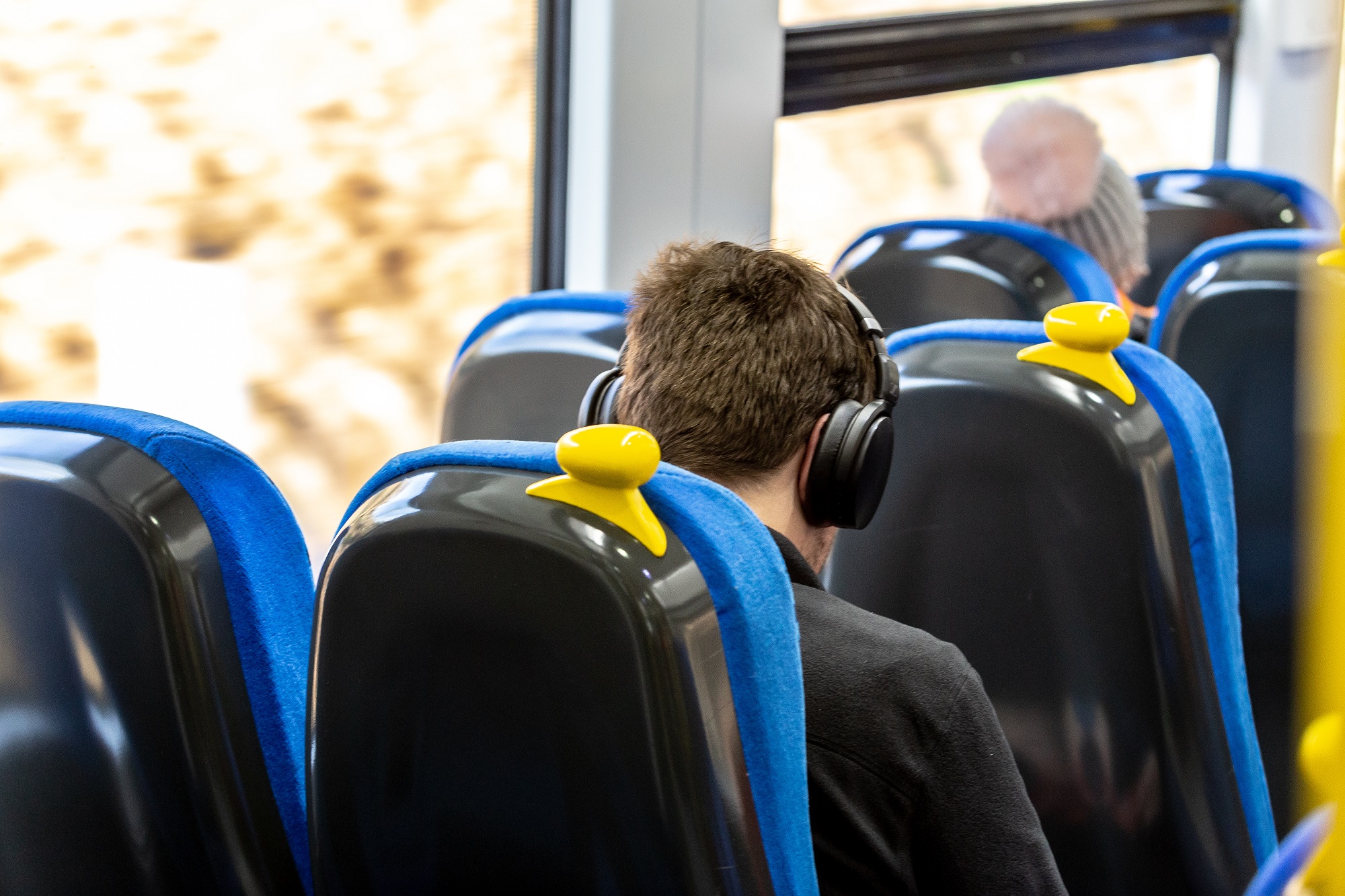
For many, playing audio out loud on public transport – also known as ‘loudcasting’ – has become one of modern life’s most irritating parts of the daily commute, but now, a new national campaign is aiming to encourage rail passengers, in particular, to ‘share the carriage, not the noise’ to improve the journey experience for all.
This will include reminders of the rules in place on the rail network and, if a passenger refuses to stop when asked by authorised rail staff, they can be removed from the train at the next station or face fines up to £1,000.
On buses, however, the powers for authorities were already made possible by the Bus Services Act 2025, meaning all local transport authorities in England are able to set and enforce their own rules.
Authorised officers – including transport safety officers and the police – will be responsible for enforcement, rather than bus drivers themselves, and they will be tasked with a three-step approach to deal with incidents. They will need to:
Engage with the person
Explain the rules and their impact on other passengers
Take enforcement action if they refuse to comply
“We’ve all been on the train when someone starts blasting music or videos from their phone,” commented Prime Minister Andy Burnham.
“It gets on your nerves and can quickly spoil the journey, so we’re launching a nationwide campaign reminding passengers to use headphones on trains. On top of that, we’re giving local leaders new powers to tackle loud music, vaping and littering on buses.
“It’s a simple thing, but one that will make journeys that little bit better for all of us.”
Ben Plowden, Chief Executive at the Campaign for Better Transport, added: “Antisocial behaviour is not just irritating, it can be a real deterrent to people using public transport – especially people with different accessibility requirements.
“If these new powers are properly and visibly enforced, they should help everyone feel safe and comfortable on public transport and enjoy the ride.”
Featured Image – Northern
News
Police provide update after stabbing of 14-year-old boy at Manchester Arndale carpark
Emily Sergeant
Police have provided an update following the stabbing of a young boy in Manchester city centre over the weekend.
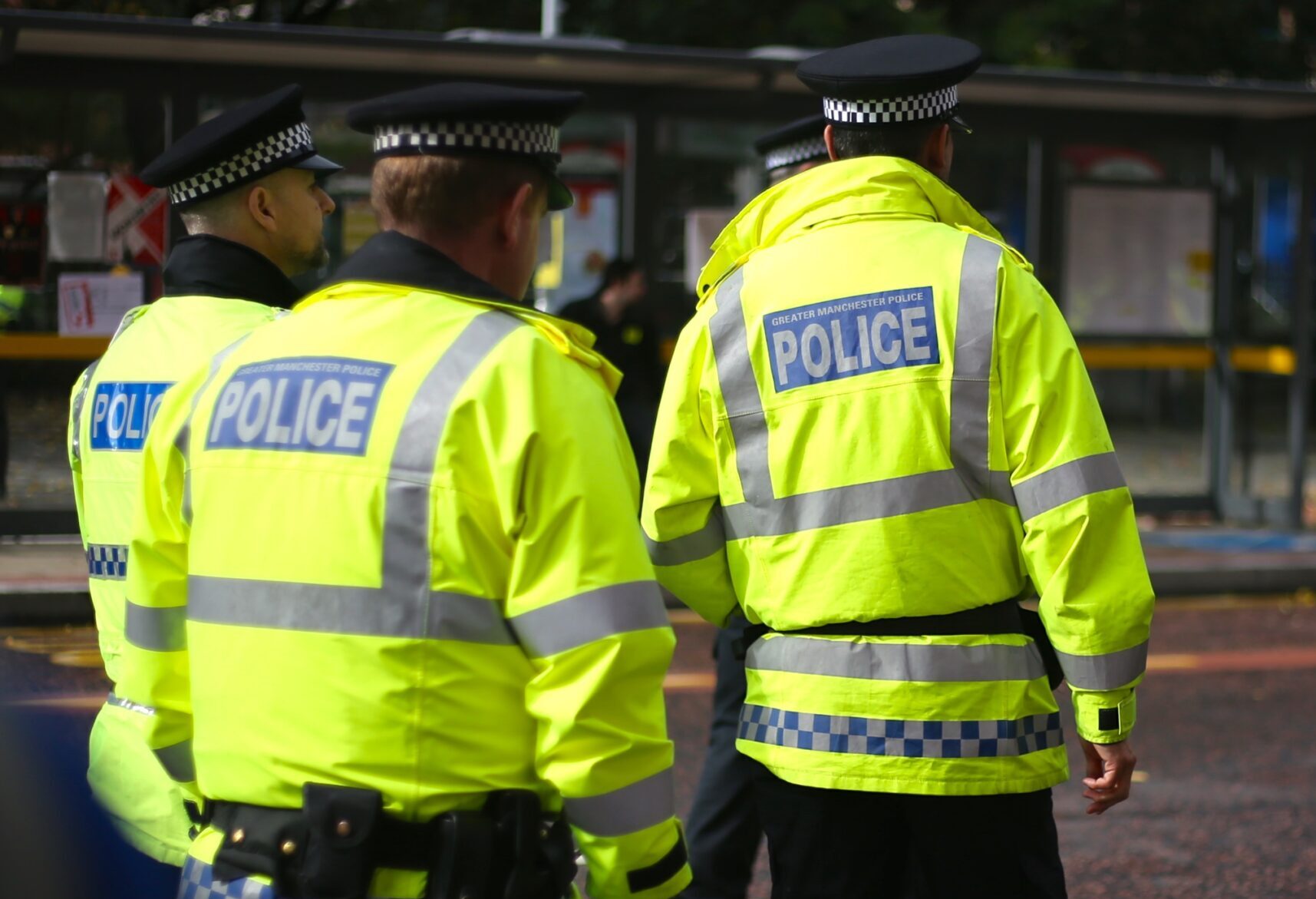
At around 3:15pm this past Saturday afternoon (17 October 2026), officers from Greater Manchester Police (GMP) were called out to reports of a stabbing on the ninth floor of the Arndale carpark in Manchester city centre.
Emergency services attended the scene, and a 14-year-old boy was taken to hospital with injuries consistent with a stab wound.
Thankfully, the victim’s injuries are not believed to be life-threatening or life changing, but an investigation and enquiries are ongoing.
Detective Inspector Sam Jones, of GMP’s City of Manchester District CID, said this will ‘understandably’ cause concern, but has assured the public that police believe this to be an ‘isolated incident.
“Detectives at the scene are working extremely hard to process the scene with Crime Scene Investigators,” explained DI Jones in an update statement issued.
“The car park is expected to be closed for several hours, so we ask for your understanding and patience whilst we gather evidence to bring these offenders to justice.
“Detectives and Officers will be in the area today to speak with local businesses and members of the public to provide reassurance. This is believed to be an isolated incident with no risk to the wider public.
“Greater Manchester Police are committed to diligently investigating all knife crime and bringing offenders to justice, and we are asking for anyone with information about this incident to come forward to assist with our enquiries.”
Anyone with information is asked to contact police on 101, quoting log 2050 of 17/10/2026, or via the LiveChat function. Alternatively, contact Crimestoppers anonymously on 0800 555 111.

 Georgina Pellant -
13th September 2021
Georgina Pellant -
13th September 2021