Coming just over seven weeks after the reintroducing of national restrictions in England for a third time amid the coronavirus (COVID-19) pandemic, the government’s roadmap will see the economy open over a number of weeks, lifting measures for separate sectors at four different stages.
Mr Johnson claimed that this exit strategy was designed in such a way as to be “irreversible”.
According to the ‘COVID-19 RESPONSE – SPRING 2021‘ roadmap document published on the gov.uk website today, decisions on easing restrictions will be led by data rather than dates, as it takes around four weeks for the data to show the impact of easing restrictions.
ADVERTISEMENT
The government will then provide a further week’s notice to the public and businesses ahead of any further changes, so for that reason, there will be at least five weeks between the steps in the roadmap.
The indicative dates in the roadmap are all contingent on the data and subject to change.
ADVERTISEMENT
Before taking each step, the government will review the latest data on the impact of the previous step against four tests, which are:
The vaccine deployment programme continues successfully.
Evidence shows vaccines are sufficiently effective in reducing hospitalisations and deaths in those vaccinated.
Infection rates do not risk a surge in hospitalisations which would put unsustainable pressure on the NHS.
The assessment of the risks is not fundamentally changed by new Variants of Concern.
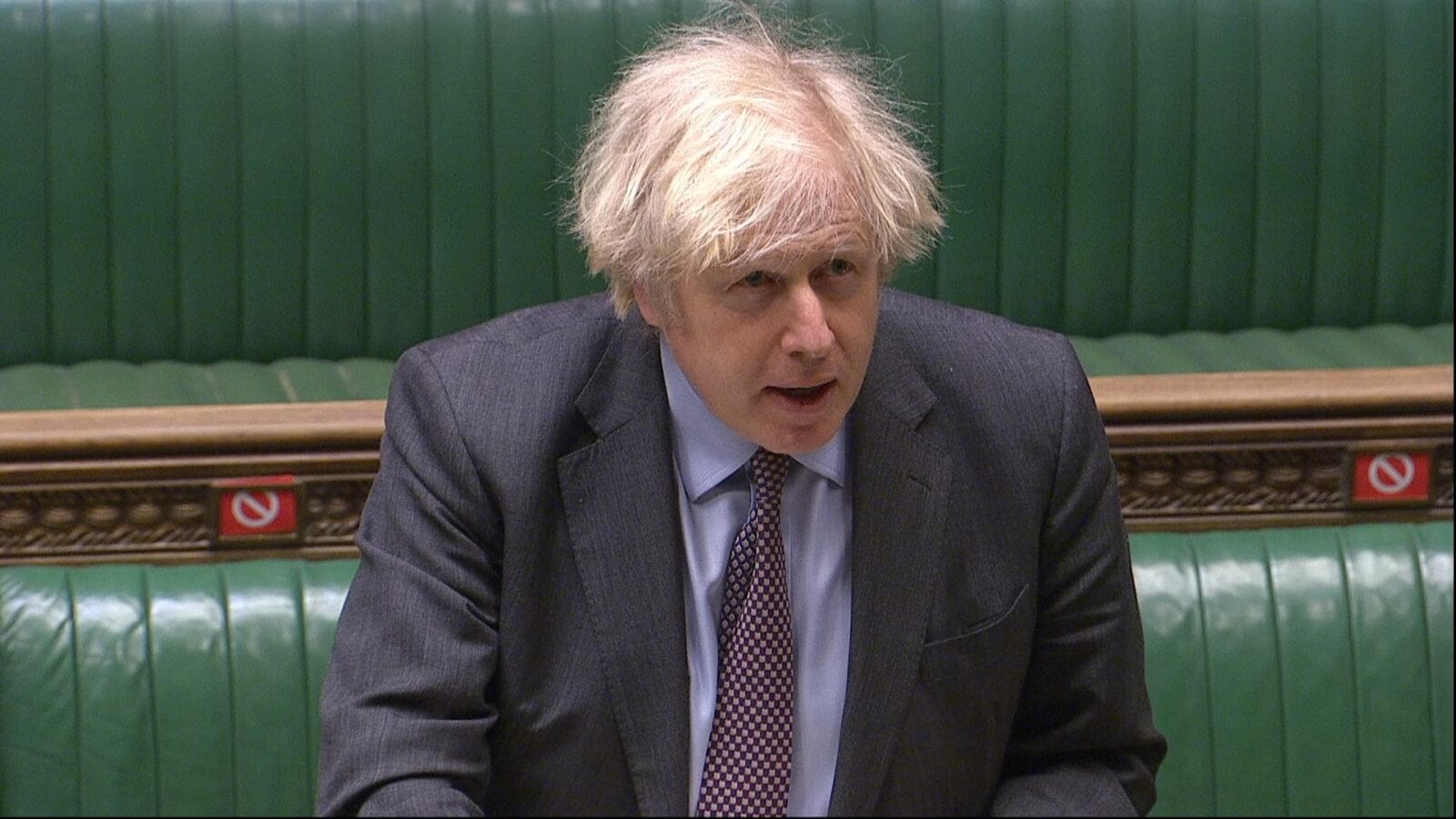
Boris Johnson outlines the four tests that the incremental easing of restrictions will have to meet, adding that there will be at least five weeks between each step.
Announcing the ‘Four Tests’ method for the incremental easing of restrictions in his address this afternoon, Mr Johnson said: “I know there will be many who will be worried that we are being too ambitious and that it is arrogant to impose any kind of plan upon a virus and I agree that we must always be humble in the face of nature and that we must be cautious,”
“But I really also believe that the vaccination programme has dramatically changed the odds in our favour, and it is on that basis that we can now proceed.”
ADVERTISEMENT
Mr Johnson first confirmed ‘ Step One’ – already widely speculated ahead of his announcement – which sees children of all ages return to school full-time from 8th March, alongside some higher education settings, as well as being able to meet one other person outside for recreational purposes and care home residents allowed one regular named visitor, both on the same date.
The 29th March sees outdoor gatherings of up to six people or two households allowed – including meeting in private gardens – and outdoor sports facilities, such as tennis and basketball courts and outdoor swimming pools, allowed to reopen, with organised outdoor sports also resuming.
But what does ‘Step Two’, ‘Step Three’ and ‘Step Four’ have in store for Mancunians?
And what do these all-important steps mean for the struggling hospitality businesses and night time economy in our city centre and throughout the region of Greater Manchester?
https://www.instagram.com/p/CLmlngkj2JF/
What’s in lockdown roadmap Step Two?
This will happen no earlier than 12 April.
ADVERTISEMENT
Non-essential retail, hairdressers, nail salons, libraries and museums open.
Outdoor hospitality in pubs and restaurants allowed with households or ‘rule of six’.
Most outdoor settings reopen such as zoos and theme parks.
Gyms and indoor swimming pools open.
Self catering holiday accommodation and camp sites reopen.
Funerals continue with up to 30 people.
Weddings with up to 15 people.
From 12 April, non-essential shops, hairdressers, beauty salons, gyms, libraries, zoos, museums, pubs, restaurants and bars can reopen.
In inside settings you'll only be allowed to be with members of your own household.
Outdoors most social contact rules lifted, up to limit of 30 people.
Mixing indoors allowed for two households, but ‘rule of six’ for indoor hospitality and elsewhere.
Cinemas, soft play centres, rest of accommodation sector, hotels, indoor exercise classes return
Performances and sporting events resume – larger performances with venues 1,000+ or half full will be allowed indoors and outdoors 4,000 capacity or half full (whichever lowest).
In very largest outdoor seated venues such as football stadiums up to 10,000 people allowed to attend (or 1/4 full whichever is lowest).
Up to 30 people can attend weddings, receptions, funerals, wakes.
From May 17, gatherings of up to 30 people outdoors will be allowed and the rule-of-six will apply indoors. Pubs and restaurants will be allowed to serve people indoors.
Large events will also be allowed with up to 1,000 people indoors.
The Prime Minister said he hopes the lockdown in England will be lifted around 21st June, but he stressed that the decision to lift restrictions will be driven by data and not dates.
So Step Four, from no earlier than 21st June.
All legal limits on social contact removed, with ambition to reopen final closed sectors of the economy such as nightclubs.
Hope to lift restrictions on large events and performances.
Hope to remove all limits on weddings and other “life events”.
Boris Johnson says that from no earlier than 21 June all legal limits "on social contact and on weddings and other life events" will be removed, adding "we will reopen everything up to, and including, nightclubs"
Mr Johnson closed out his address to MPs in the House of Commons, stating that he hoped the nation was on a “one way road to freedom” after a “wretched year”.
He declared: “The end really is in sight.”
ADVERTISEMENT
The Prime Minister’s unveiling of his vision to remove “all legal limits on social contact” by 21st June comes after he said last week that the use of lateral flow tests could be the “route forward” to reopening those businesses that have been “the toughest nuts to crack”.
He said: “For the purposes of this country and doing things within the domestic UK economy, we will look at everything. But what we are thinking of at the moment is more of a route that relies on mass vaccination [as] we intend to vaccinate all of the adults in the country by the autumn, plus lateral flow testing, rapid testing for those bits that have been the toughest nuts to crack.
“Such as nightclubs or theatres – those parts of the economy we couldn’t get open last year.
“I think that will be the route that we go down and that businesses will go down [and] you are already seeing lots of business using the potential of rapid, on-the-day testing as well.
“I think that, in combination with vaccination, will probably be the route forward.”
ADVERTISEMENT
___
For the latest information, guidance and support during the coronavirus (COVID-19) pandemic in the UK, please do refer to official sources at gov.uk/coronavirus.
#StayHome
News
30 years ago, the IRA detonated a 1,500kg lorry bomb on Corporation Street in the heart of Manchester – here’s the story
Georgina Pellant
Today marks three whole decades since an explosion from the inside of a lorry parked on Corporation Street shattered windows and destroyed buildings across the city centre.
Causing an evisceration that stretched for miles, when the 1,500 kilogram IRA bomb went off in 1996, it was the biggest detonation in Great Britain since the Second World War.
Following the explosion, the city fell silent – leaving rack, rubble and ruin in its wake. Famously, one red post box was left standing – today fitted with a memorial plaque in remembrance of the tragedy.
It seems scary to think that back then, most people could only stand there, watch on and worry.
The bomb caused an estimated £700 million worth of damage to Manchester’s infrastructure and economy, and over a quarter of a century later, locals still tell the stories of where they were when it went off – and of the devastation it left behind.
Notably, one resident of the Cromford Court maisonettes on top of the Arndale – a 77-year-old RAF veteran suffering from the flu – didn’t even bother to get up when the telephone warning to evacuate hit, considering himself to have survived much worse feats during his time in military service.
Having been a rear gunner in a Lancaster in the war, he reportedly told police and authorities “he was buggered if he was going to let a small bomb affect him.”
In subsequent years, Danny O’Neill has become a part of an urban legend surrounding the bomb as his staggering story has been told time and time again.
Around 90 minutes prior to the detonation, the Provisional Irish Republican Army had telephoned in warnings – meaning that around 75,000 people were able to be evacuated from the area before the bomb went off from the back of a van.
However, the bomb squad were unable to defuse it in time, leading to over 200 injuries from people still left in the area.
Thankfully, despite those injuries, there were no fatalities, and many of those reported traumas came from the shattering of thousands of windows and other damage to buildings in which unsuspecting people were getting on with their days.
Several buildings near the explosion were damaged beyond repair and had to be demolished, while many more were closed for months for structural repairs, and this prompted the biggest regeneration of Manchester city centre ever – something that is still continuing to this day, arguably at a more rapid rate than ever.
The city lay dormant for days after the explosion, as people came to terms with what had happened and kept their distance. Many moved out of the centre for a period of time, while many more simply decided not to visit for fear of another incident.
It was a desolate place, eerily quiet, and in need of some serious TLC.
According to Home Office statistics, an estimated 400 businesses within half a mile (0.8 km) of the 1996 blast were affected, 40% of which did not recover.
Credit: Manchester Libraries
Market Street – near the explosion and at that time the second-busiest shopping street in the UK – was considered by some a “fearful” place, and one that was to be “avoided like the plague”.
The prospect of pulling Manchester’s bustling city centre out of its darkest depression was not casually approached by those in charge.
It was acknowledged as a mammoth task from the get-go, but Greater Manchester has never let anything get in its way. Despite how steep the hill is that we’re standing at the base of, we always manage to reach the peak, ready to go again.
Manchester City Council green-light new venue at Medlock Square, with Mamma Mia! The Party to open the immersive space
Danny Jones
The smash-hit ‘Mamma Mia: The Party’ is set to land in Manchester next year as the maiden event of another brand-new space set to open as part of the upcoming Medlock Square development.
Etihad Campus has seen a lot of moving pieces over the past few years, be it the building of Co-op Live, the ongoing expansion of Man City’s home ground, the soon-to-launch hotel attached to the stadium and now Medlock.
But those in control of the land are content with stopping there; this looks to be just the start of a whole new evolution for the East Manchester area, with an as yet untitled new immersive arts, experience and events venue also set to join the new slate of projects.
You see another glimpse of the purpose-built mini arena, of sorts, down below.
With plans having now been approved by the City Council, the ‘immersive’ space will be situated between the Etihad, Co-op Live and Medlock Square itself, holding up to 600 guests per performance.
Currently set to open in late 2027, following the rest of the square’s launch window being fully rolled out, we still don’t know the name of this next addition, but the structure itself will dovetail with the surrounding buildings and areas as part of seasonal activations, live shows and sports screenings, as well as pop-ups, brand collaborations and more.
Looping back, the interactive, multimedia extravaganza that is ‘Mamma Mia! The Party’ will finally be making its Manc debut as part of the 10th anniversary of the all-singing, all-dancing and even all-dining in-demand production.
As per an official press release from the Medlock Square media team, the show will combine “live music, theatre, food and storytelling” and “offer visitors an unforgettable night out.”
The original UK production at The O2 in London has now surpassed more than 1,500 performances, with a total of 700k guests attending these shows in 110 countries across the globe. Safe to say it’s rather popular.
As for Medlock Square and the surrounding Etihad Campus, Manchester City supporters have also been given another look at the soon-to-open, immersive hotel tie-in experience.
With a skywalk, rooftop bar, a new MCFC shop and various other bits set to spill out onto Medlock Square, it all feels like a period of wholesale changes over in the blue half of the city – especially with the football club bidding farewell to their manager Pep Guardiola after more than a decade.
Following the new and improved North Stand being named after him in the first of many tributes, the City Football Group (CFG) are also set to commission a statue in his honour over the coming months.
Meanwhile, Medlock Square is also due to open later this year, although an official completion date has not been confirmed.
You can stay up to date with all the latest on Mamma Mia! The Part’s Manchester shows right HERE.
Not forgetting a brand-new women’s football facility, too, there is so much stuff going on over at the Etihad that it can be hard to keep track, but here’s the latest look at some of the rooms set to feature in the hotel of the same name.