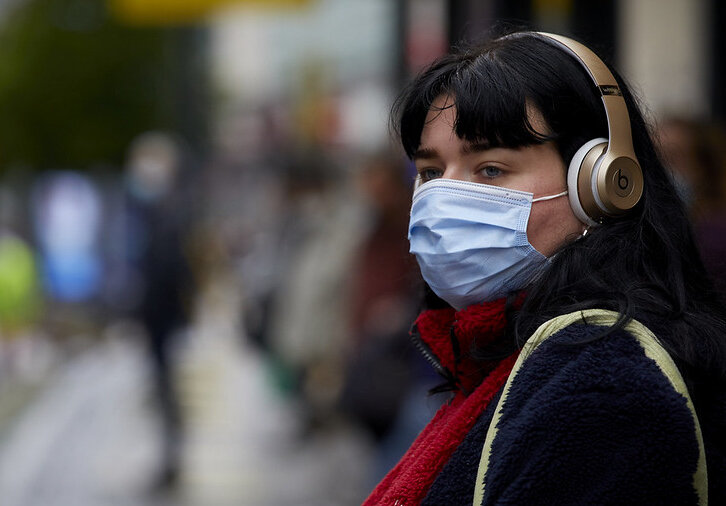
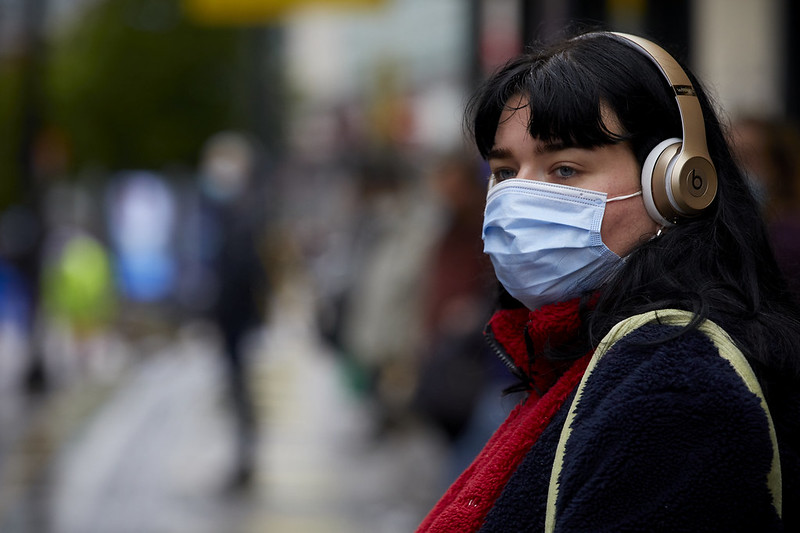
The government is set to announce today that the wearing of a mask/face covering in all shops in England is to become mandatory from 24th July.
Under these new regulations, it is stated that fines of up to £100 will be enforced by police officers for those whole fail to comply.
This fine will be reduced to £50 if paid within 14 days.
A spokesperson for No.10 confirmed yesterday evening that: “There is growing evidence that wearing a face covering in an enclosed space helps protect individuals and those around them from coronavirus. The prime minister has been clear that people should be wearing face coverings in shops and we will make this mandatory from 24 July.”
Since mid-May, the public have been advised to wear coverings in enclosed public spaces, where they may encounter people they would not usually meet.
ADVERTISEMENT
With this new guidance expected to be detailed in full and officially released by the UK government today, where exactly are face masks and coverings already mandatory in England, and where will they be as of 24th July 2020?
We’re not back to normal yet.
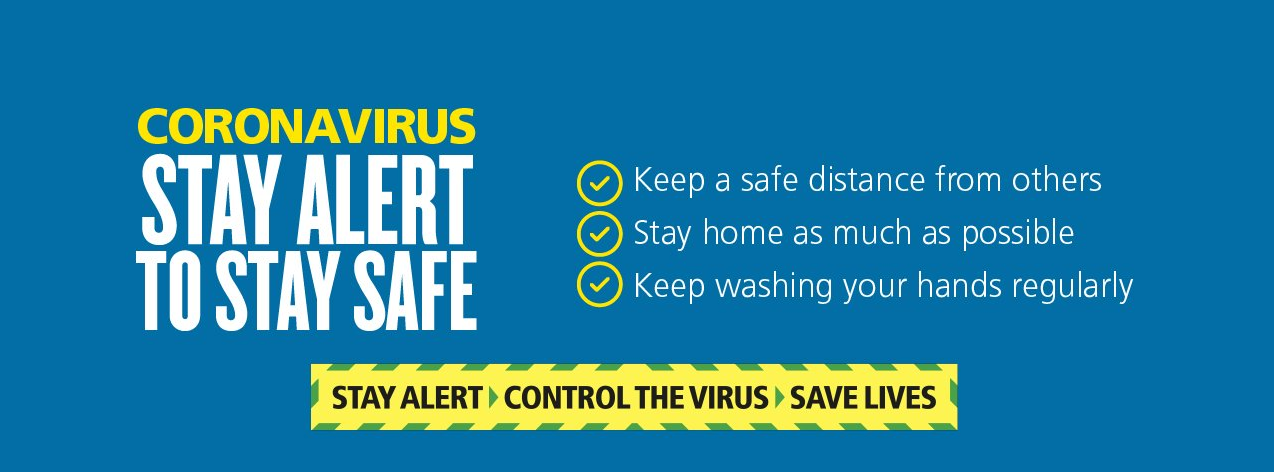
It is vital that you continue to keep a safe distance from others.
In situations where you can't keep 2 metres apart, stay at least 1 metre apart while taking other extra precautions.
— Department of Health and Social Care (@DHSCgovuk) July 13, 2020
It was declared that from 15th June 2020 it would become mandatory for anyone travelling by bus, train, ferry or plane in England to wear a face covering.
ADVERTISEMENT
A number of passengers are exempt from the regulations including:
Children under 11.
People with disabilities.
Those with breathing difficulties.
Anyone travelling with someone who relies on lip reading.
These regulations also state if it is “reasonably necessary” for you to eat or drink, then you are permitted to remove the face covering in order to do so.
The modes of public transport that are excluded from the above regulations cruise ships, school transport, taxis and private hire vehicles, however, ride-sharing company Uber did make face coverings compulsory for all drivers and passengers from 15th June too.
ADVERTISEMENT
Passengers can be refused travel if they don’t follow the face covering rules and can be fined as a last resort.
Environment Secretary George Eustice has appeared on a number of media outlets live this morning to discuss the new face covering regulations that are set to become mandatory and has indicated that the wearing of masks will however not be compulsory in restaurants, eateries, bars and pubs, although confirmation of this in full is expected along with the published guidance today.
When questioned, Mr Eustice also went on to defend the Government’s delay on bringing the new measures in, stating that it was based on “changing evidence”.
Please refer to official sources via the gov.uk/coronavirus website here for more information on the above upon release.
You can also visit the @PHE_uk interactive dashboard which included local authority data for England: ➡️ https://t.co/8OHvHj6yyM
— Department of Health and Social Care (@DHSCgovuk) July 13, 2020
#StaySafeSaveLives
News
Altrincham named one of the UK’s best places to live in 2026 in The Sunday Times’ annual ranking
Emily Sergeant
A popular Greater Manchester town has been named among the UK’s best places to live by the Sunday Times in its annual ranking.
That’s right… it’s that time of year, once again.
The Sunday Times is known for pulling together a list of what it considers to be the most sought-after places to live in the UK every year, and 2026’s ranking has officially been published today – with dozens of locations across the country making up the comprehensive guide, and six of those coveted locations being right here in the North West.
The Sunday Times’s expert judges have visited all locations on the list, and assessed factors such as schools, transport, culture, broadband speeds, access to green spaces, the health of the high streets, and much more to devise the always-talked-about annual ranking.
Macclesfield in Cheshire, Eden Valley in Cumbria, Lancaster in Lancashire, and Aigburth in Liverpool are just some of the North West areas named by the publication in the 2026 list.
Altrincham has been named one of the best places to live in the UK / Credit: The Manc Group
A spotlight has also been shone on two Greater Manchester towns, and one of two has even been given the regional North West title… but which are they?
Where has taken the top spot as the best place to live in the North West for 2026, and is therefore one of the best places to live in the whole of the country? Well, that honour has been given to none other than Greater Manchester’s very-own Altrincham.
The publication described the Trafford town as ‘classy, cool and effortlessly comfortable’.
“Altrincham is a top-notch town brimming with independent businesses and big brands, and now it’s flying even higher,” The Sunday Times said.
The fact that co-working has now arrived on the high street thanks to the conversion of the old Rackhams department store, and that the town’s cultural and creative ‘cachet’ is also on the rise, have been highlighted as reasons as to why Altrincham has been chosen as the North West’s winner, as well its newly-flourishing fitness scene.
Of course, the town has also been praised for its transport links into Manchester city centre and across the region, as well as it being a great place for families thanks to the excellent local schools on offer.
Didsbury was the other Greater Manchester town chosen to represent the best of the North West – with the Manchester suburb described as being ‘stylish, solid, safe, and, yes, a little bit smug in parts… but that’s okay’.
You can read the full Altrincham feature here, and see where else The Sunday Times included in its list for 2026 here.
Featured Image – Geograph
News
11 arrested and £70k cash seized during early-morning police drug raids across Greater Manchester
Emily Sergeant
11 people have been arrested, as well as a large amount of cash and drugs seized, during early-morning raids across Greater Manchester.
The raids took place during the early hours of the morning yesterday (Thursday 19 March 2026), where Greater Manchester Police (GMP) successfully executed eight warrants simultaneously across Tameside, Oldham, and Rochdale to tackle a ‘suspected criminal network’ involved in the distribution of class A drugs and firearms.
Officers from Tameside Programme Challenger team, the District Intelligence Unit (DIU), and GMP’s Tactical Aid Unit (TAU) were deployed to each of the addresses.
Following weeks of intelligence gathering and preparation, a total of 11 people – each aged between 24 and 77 – were arrested on suspicion of drug-related offences during the raids.
Eight men and three women were arrested on suspicion of a range of offences, including conspiracy to supply class A and B drugs, being part of an organised crime group, possession with intent to supply, money laundering, and possession of an offensive weapon.
They all remain in police custody for questioning at this time, GMP confirmed.
During searches of the addresses, various class A, B and C drugs – including crack cocaine, heroin, cannabis, and nitrous oxide – were seized, while further recoveries of £70,000 in cash, a zombie knife, a BB gun, and four vehicles were also made at the same time.
Speaking following the success of the raids yesterday, Chief Superintendent Shan Nasim, District Commander for Tameside, said: “[This] operation has been a powerful example of our continued, determined effort to dismantle organised crime in our district and Greater Manchester.
“We have 11 people in custody being questioned by our investigation teams in relation to an organised crime group (OCG) that have been causing widespread harm across our communities.
“This action caused significant disruption of an organised crime group (OCG) and has prevented drugs and weapons from reaching the streets, as well as the associated harms that come hand in hand with organised crime.
“Organised criminals exploit vulnerable people and blight our communities; we will take robust action to catch offenders, keep our communities safe, and protect vulnerable people across Greater Manchester.”