After a year of postponement due to the pandemic, European football’s flagship tournament gets underway this evening, and will play right through to 11 July.
24 countries will be battling it out for the trophy, including three UK home nations – England, Scotland, and Wales.
Turkey will face Italy at the Stadio Olimpico in Rome for the first match of the highly-anticipated tournament tonight, with Gareth Southgate’s England squad up against World Cup 2018 finalists Croatia in their first match at Wembley Stadium on Sunday 13 June.
Unlike previous tournaments, Euro 2020 will be the first European Championship to be played across the entire breadth of the continent, using 11 different venues.
ADVERTISEMENT
England has been placed in Group D, alongside Scotland, Croatia, at the Czech Republic.
Every tournament’s group stage tends to have a so-called ‘group of death’, with Euro 2020’s coming in the form of Group F – which features the 2014 World Cup winners Germany, the reigning world champions France, and the reigning European champions Portugal, with Hungary being the somewhat unlucky nation rounding out the group and therefore needing to produce a moment of magic to come out the other side.
ADVERTISEMENT
But how will England fare in this year’s tournament? How far are they expected to go? Do they stand a strong chance of making it to the final? Which countries will stand in their way?
Here’s everything you need to know about Euro 2020.
24 countries will be battling it out for the trophy / Credit: Flickr
When is Euro 2020?
The tournament officially kicks off on Friday 11 June in Rome, and ends with the final at Wembley Stadium in London on Sunday 11 July.
ADVERTISEMENT
What are the groups?
Group A: Italy, Turkey, Switzerland, and Wales.
Group B: Belgium, Denmark, Finland, and Russia.
Group C: Austria, Netherlands, North Macedonia, and Ukraine.
Group D: Croatia, Czech Republic, England, and Scotland.
Group E: Poland, Slovakia, Spain, and Sweden.
ADVERTISEMENT
Group F: France, Germany, Hungary, and Portugal.
Where are the venues?
Amsterdam (Johan Cruijff Arena)
Baku (Olympic Stadium)
Bucharest (National Arena)
Budapest (Puskás Aréna)
Copenhagen (Parken Stadium)
Glasgow (Hampden Park)
London (Wembley Stadium)
Munich (Fußball Arena München)
Rome (Stadio Olimpico)
Seville (La Cartuja Stadium)
St Petersburg (St Petersburg Stadium)
What is the fixture schedule?
The Group Stage will take place between Friday 11 June – Wednesday 23 June, the Knockout Phase will then take place between Saturday 26 June – Tuesday 29 June, the Quarter Finals will happen on Friday 2 and Saturday 3 July, the Semi Finals on Tuesday 6 and Wednesday 7 July, and it’ll all culminate with the Final on Sunday 11 July.
You can check out the fixture schedule in full on the official UEFA Euro 2020 website here.
What’s England’s route to the final?
It’s easy to get carried away with ourselves when it comes to sporting tournaments such as Euro 2020, and it’s only natural for England fans to be looking ahead at the best way for the squad to make it to the final.
They’ve got to make it to the Knockout Phase first though – but how will they do that?
ADVERTISEMENT
There’s a number of ways the Group Stage could pan out for England that will determine who they face in the knockouts.
This chart that’s been doing the rounds online might make things a little clearer.
England has been placed in Group D, alongside Scotland, Croatia, at the Czech Republic / Credit: Google
Who is predicted to win?
Predictions will always be predictions, but the bookies over at Paddy Power have set the odds for six countries expected to perform well:
England 9/2
France 11/2
Belgium 6/1
Spain 13/2
Germany 15/2
Portugal 15/2
Where can I watch Euro 2020 in Manchester?
Manchester is a city that’s obsessed with football, so understandably, there’s plenty of venues going all out for the Euros this year.
We’ve been inundated with messages over the past few weeks from our loyal audience keen to find out the best places to catch a match this summer, so we’ve knuckled down and done the leg work for you.
ADVERTISEMENT
If you’re looking for recommendations, you can find 20 of the best spots to watch Euro 2020 in Manchester city centre this summer here.
Featured Image – Flickr
Sport
Manchester’s beloved Club de Padel to return home, with plans for huge new club
Daisy Jackson
Club de Padel – the first padel club to bring the sport to Manchester – have announced exciting plans for a brand-new club in the city centre.
The Manchester-born business closed down earlier this year after land owners Renaker began redeveloping the site it occupied at Deansgate Square.
But now Club de Padel will be making a grand return home, with an exciting new club featuring five covered courts, a coffee-bar, and event spaces.
They’ve secured a new home within Mayfield Park, beneath the arches of Depot Mayfield which is already home to Freight Island and the Warehouse Project.
The new club will also be close to the park’s award-winning children’s playground.
As well as operating padel clubs in Sheffield and Manchester, Club de Padel has a huge lifestyle arm to its business too, collaborating with local brand UN:IK on a clothing range, as well as working with M&S for a spring childrenswear line.
Co-owner Lucy Noone-Blake said: “We are beyond excited to have found our Manchester home at Mayfield Park.
Manchester’s beloved Club de Padel to return home, with plans for huge new club
“The regeneration of the Mayfield district, including the dynamic and creative use of the Depot, the sheer care and effort poured into the park, incredible collaborations such as the rehoming of an award-winning Chelsea Flower show garden and the development of new workspace and homes come together to create a neighbourhood that we’re delighted to be a key part of.
“We’re grateful for the Mayfield Partnership who understand our vision and commitment to bring a well priced, accessible and creative approach to city centre wellness, and for their efforts in creating this beautiful place. We’re Manchester-born and based and we just can’t wait to come home.”
Hen Nowne, Development Director at Landsec, speaking on behalf of the Mayfield Partnership, said: “Club de Padel is a brilliant addition to Mayfield Park. We want to create the kind of place people feel a real connection to and want to return to with more reasons to spend time here.
“It brings another burst of energy to Mayfield and feels like a really natural fit. We’re delighted to have Club de Padel as part of our community.”
Club de Padel Manchester will open in the summer of 2027, with a full programme of events, coaching, music and wellness.
Manchester Half Marathon 2026 – route map, start times, travel warnings, and more
Lydia Mastrolonardo
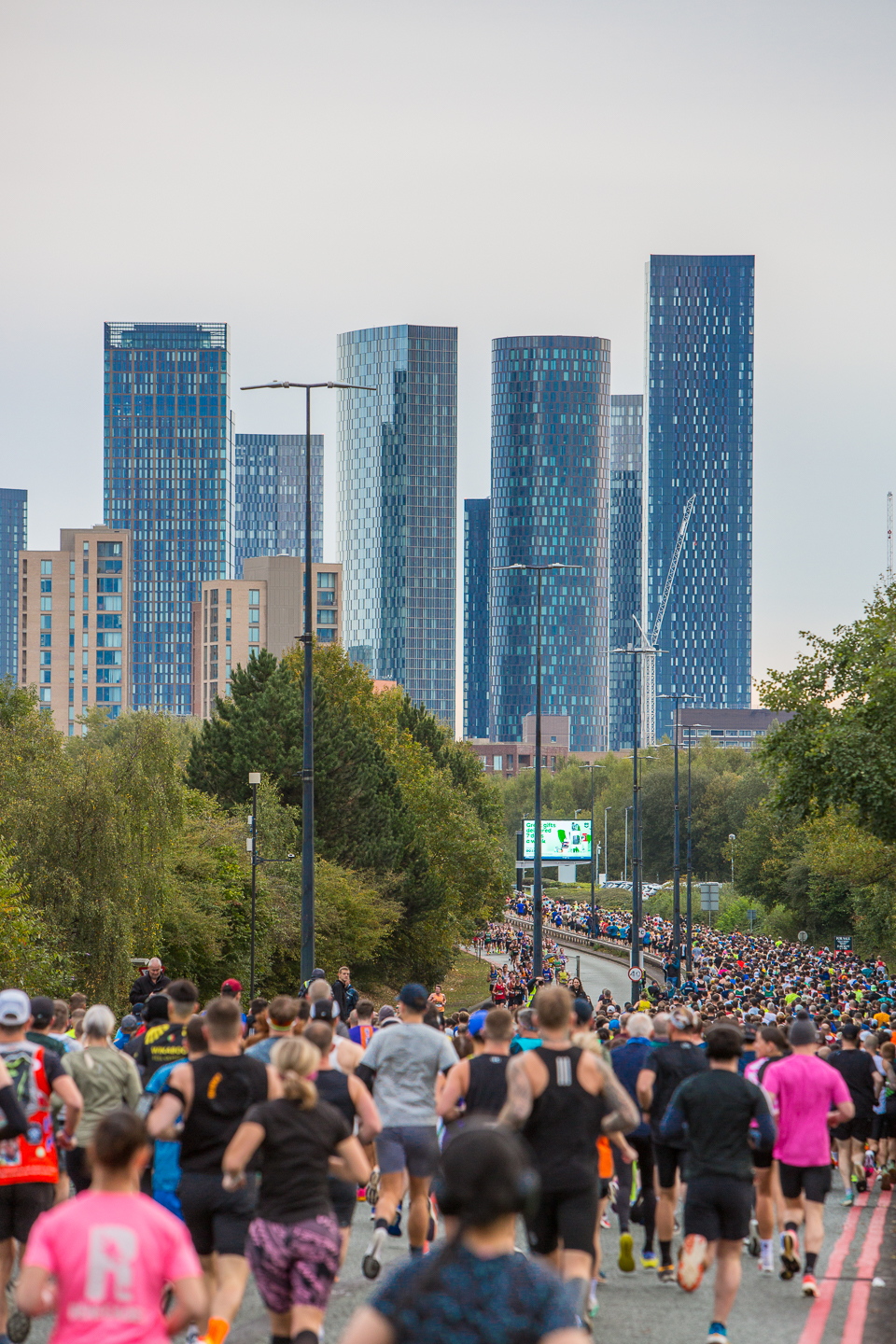
It’s that time of year again: the ASICS Manchester Half Marathon is back this weekend and with more than 32,000 people taking part, it truly is going to be bigger and better than ever.
Taking place on Sunday 4 October, Mancs and runners from all over will be taking on the 13.1-mile challenge. Make that 21.1 kilometres if you’re metric folks like us.
The event expects to raise £1.8 million for various well-deserving charities including Alzheimer’s Society, Cancer Research UK, The Christie, and Moya Cole Hospice.
It’s set to be a bad day to be an empath – the event hosts thousands of runners, all with their own personal stories coming together to raise awareness and money for charities close to their hearts.
This race never fails to draw in a city full of supportive spectators, even despite a chill being back in the air. So, remember to pack those tissues and prepare to cry for thousands of people you don’t even know.
Being the biggest half marathon event in the region, whether you’re taking part or just cheering on from the roadside, it’s handy to have all the important details in one place.
Be it the route, hotspots for spectators, or freebies, we’ve got everything you need in this helpful guide to the 2026 ASICS Manchester Half. Let’s start off simple.
ASICS Manchester Half Marathon 2026 – all you need to know
What time does the 2026 ASICS Manchester Half start?
Those running in this year’s Manchester Half can expect to hear the starting gun from as early as 8:50am.
The first wave of the day will be for the elite wheelchair participants, with the rest of the standard elite wave following them at 9:05am.
However, as we’re sure you’re all fully aware, the Manchester Half is broken up into waves based on predicted times. The rest of the participants will then set off in roughly 10-minute intervals, depending on their allocated bib colour, with the final group setting off at approximately 11:07 am.
You can find the full breakdown of waves and their start times HERE.
The starting line and route for the Manchester Half 2026
To access the start line on race day, participants should head to the Event Village, atthe Lancashire County Cricket Club Grounds.
Here you’ll find the bag drop station, toilets for those pre-race nervous wees and poos (this is a non-judgmental space, guys – trust us and go for a ‘safety’ one), as well as the many marshals who will direct you to the starting line which is located on Talbot Road, opposite Trafford Town Hall.
The course will take runners into Manchester city centre, then back through Stretford, Sale, Chorlton-cum-Hardy and finishing back on Talbot Road before the celebrations can begin. You’ll be glad to hear the route is generally flat with no major inclines – phew.
You can find the full map for the 2026 Manchester Half Marathon route down below and click HERE for additional route information.
Manchester Half Marathon water stations, toilets and nutrition
Now, you might be thinking, “What about water stations?” or, “Where are the toilets in case there’s, you know… an emergency along the way”. Don’t worry, there’s plenty of both, as well as vital points to pick up some mid-race fuel.
There will be four water stations located roughly every three miles along the course to keep participants refreshed; there will also be ESN Hydro Gels available at the second and third water stations to give participants that extra boost if needed.
As for toilets, you’ll find them at or near each water station, as well as at the Event Village before and after the race, so you’ll have plenty of chances to grab a pit stop.
Preparation is key, as they say, so you can find out more about race day nutrition HERE and find out other ways to get your body ready now we’re into the final few days before the race.
Manchester Half Marathon road closures and travel info
As for travel advice, it’s going to be a busy weekend and so please allow extra time for any journeys.
As I’m sure you can imagine, this type of event does require a fair few road closures, meaning driving is strongly discouraged, to avoid missing your start time due to traffic.
Many bus services will also be diverted due to these closures, too.
Whether you live in the city centre, you’re getting the train into Piccadilly or Victoria from further afield, or you choose to Park and Ride, our recommendation would always be to use the Bee Network trams.
The closest tram stops are Old Trafford and Trafford Bar, but they may be congested due to their close proximity to the race, so why not incorporate a gentle 15-minute walk into your pre-run warm up and get off at the quieter Imperial War Museum tram stop.
As always, we advocate for travelling as green as possible. More travel guidance is available online HERE.
Where is best for spectators to watch the Manchester Half?
Spectators are best to encourage loved ones on from along the course, rather than just at the start and the finish area where access is limited and often overcrowded.
There are multiple places along the course to cheer on our wonderful runners including the Asics Cheer Zone, The Bupa Stretch, ESN Fuel & Cheer Zone and cheer points from all of the Official Charity Partners.
The Deansgate Interchange would be our recommendation at the start of the day to soak up the atmosphere, where a big screen will show the live starts from the ‘Kick-Off Cam.’
Other prime viewing spots include Stretford, Sale and Chorlton around a mile before the finish.
To see participants cross the finish line, you can get another view away from the roadside by heading inside the Lancashire County Cricket Club. Here, The Event Village is set to be the place to be, with food and drink vendors and a large screen, to show live finish line coverage throughout the day.
ADVERTISEMENT
Official merch and the 2026 Manchester Half medal design
Now, in case you need any extra information, we thought we’d give you a glimpse of what’s up for grabs at this year’s Manchester Half Marathon – other than glory, of course.
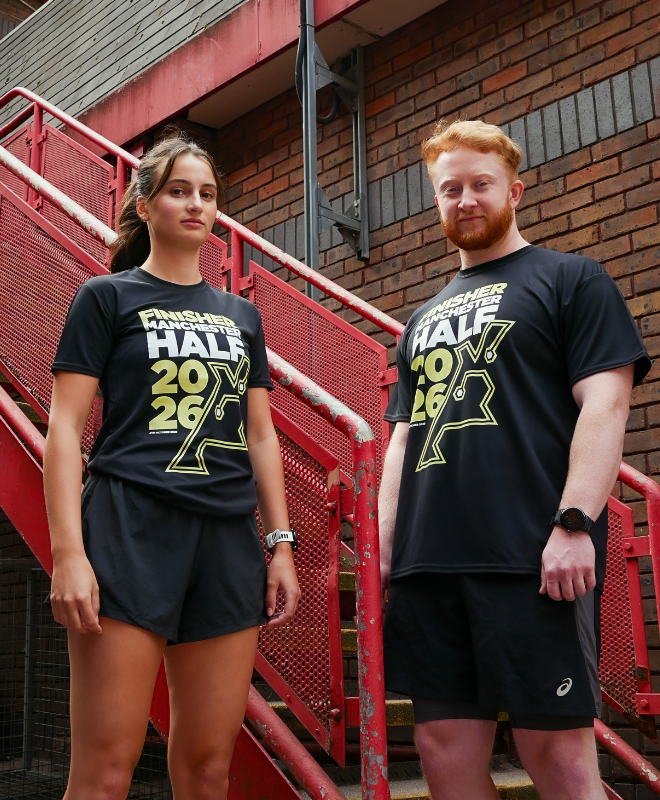
This year’s Finisher Tee is one of our favourites for a long time, showing the route in a black and gold design, making it the perfect keepsake to remember such a huge achievement.
Oh yeah, and there is the obvious prize you’re all working towards: the 2026 Asics Manchester Half Marathon medal. We really love this year’s design too and we can’t wait to see you all wearing them proudly around your necks in just a few days’ time.
What else to look out for at the 2026 Asics Manchester Half Marathon?
Beyond all that, there’s also an array of activities and new experiences to get involved in over the event weekend.
To make the most of what’s on offer, spectators can also use new interactive walking maps on the online Spectator Hub. These maps contain recommended routes for walking, stop-off points for refreshments and more transport suggestions.
ADVERTISEMENT
Oh – and the hugely popular hyper-personalised bibs are back. As part of the ‘Express Yourself’ edition there are some super exciting new design options.
What post-run treats can you make the most of?
There will also be plenty of freebies and exciting activities on offer for participants.
Now the race is over, head on down to The Event Village to begin the celebrations. Here, there will be an ESN Performance Hub, ASICS Celebration Zone, Bupa Recovery Zone and Vitamin Well Victory Vault.
First up, ESN are giving out their Goat Bars over the finish line. These recovery protein bars will help to repair your muscles, allowing you to re-energize ahead of your evening plans.
Next, head on over to the Erdinger Alkoholfrei DJ zone to quench your thirst with a natural isotonic drink packed with vitamins and minerals to replenish any lost.
ADVERTISEMENT
Finally, there will also be ice cold Vitamin Well drinks available in the Athlete’s village to quench your thirst and ensure you leave feeling revitalised, before collecting kudos from your peers.
Once you’ve collected your goodies, move on to the Asics Celebration Zone to get your picture taken, then visit the Bupa Recovery Zone to unwind with physiotherapists leading stretch sessions. The ESN Performance Hub will also allow supporters a chance to win exclusive products, while runners can pick up a limited number of ESN Fuel Pack goodie bags.
There’s lots to get your hands on so make the most of it before leaving the village – after all, you deserve it.
Lastly, we wish you the best of luck for race day and just remember, there’s nothing quite like that feeling when you cross the finish line.
Now go and smash it! We’re already unbelievably proud of you all.

 The Manc -
11th June 2021
The Manc -
11th June 2021