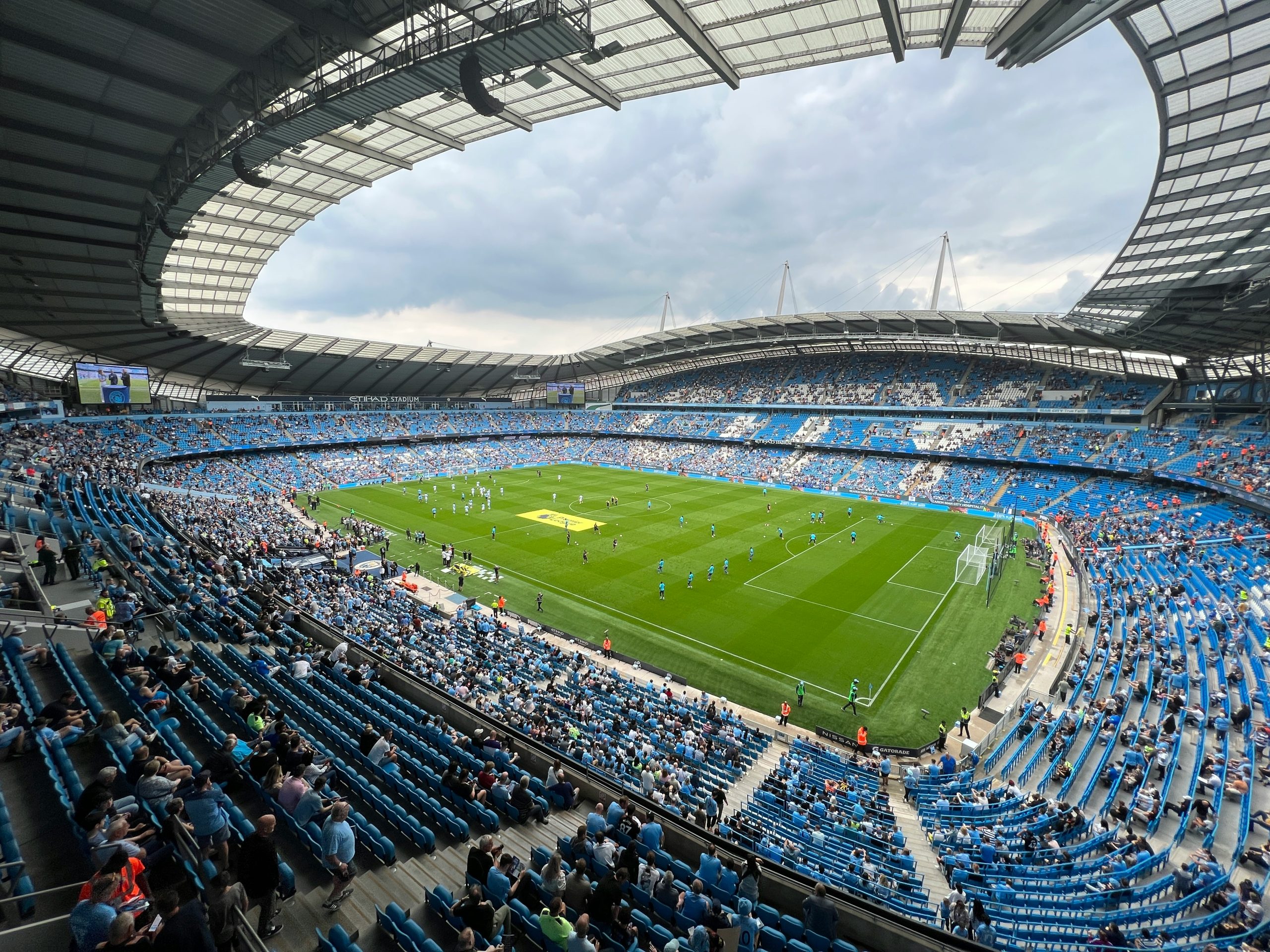
Manchester City have officially started work on the next phase of their ambitious stadium expansion plans which will see their capacity increase and the wider Etihad Campus transformed into a ‘best-in-class entertainment venue’.
Planning permission for the Etihad Stadium update was secured back in July 2023 and the club has confirmed that the first steel beams have now been installed after arriving in recent weeks.
The £300 million project will not only see the Etihad’s capacity climb from 53,400 to over 60,000 but, as previously detailed, the City Football Group‘s plans also entail the creation of a brand new club shop and museum, an integrated 400-bed hotel as well as an updated fan zone set to house around 3000.
With the initial steel framework now in place, not only has ground now been broken 12 months on from full arrival and just in time for the club’s 130th birthday, but they’re already making fast progress.
Today marks a year since we applied for planning permission and twelve months on, the Etihad Stadium expansion is starting to take shape. 🏟️
Man City and CFG issue update on £300m stadium and Etihad Campus expansion.
Man City fans can expect to see the number of seats jump up in time for the 2025/26 season, with the bulk of the stadium expansion and other renovations taking place around the North Stand – the tier facing opposite the brand-new Co-op Live Arena, which faced setbacks this week.
ADVERTISEMENT
In addition to the other main leisure attractions, once completed, the newly expanded stand will also boast a sky bar and stadium roof walk above the upper tier, giving fans and tourists the chance to enjoy unique views of the pitch and the Manchester skyline.
Drawing parallels to Tottenham Hotspur’s new stadium, which was finally completed back in 2019, this will see City once again trying to assert themselves at the forefront of modern football experiences.
ADVERTISEMENT
Moreover, with neighbouring Co-op Live arriving as a joint venture between the CFG and Oak View Groups, the Etihad Campus is perfectly poised to achieve the owners’ goal of becoming a “world-class, all-year-round entertainment venue”.
Those working on the Manchester City stadium expansion (Credit: Tom Barton via Man City)
Importantly for the East Manchester district, the stadium infrastructure project will also bring job opportunities and economic growth to the area, with the club insisting they want to build on their “long-standing investment and commitment to its local community”.
As per an official press release, it is estimated that approximately 890 full-time roles will be created during the construction phase alone and even more are expected to be delivered once Manchester City’s new hotel, museum, sky bar and dedicated fan zones are finished.
ADVERTISEMENT
Speaking at the site, Managing Director of Manchester City Operations, Danny Wilson, said: “It’s been an exciting few months with the arrival and installation of the first steels and fantastic to see the development and progress of the build in recent weeks.
“This project has been designed with our fans at its heart and demonstrates our commitment to creating one of the most memorable fan experiences in world sport. Fans will have the opportunity to extend their matchday by joining us at the new covered fan zone, visiting the museum, or staying at the hotel… The next evolution of the campus is well underway and it’s great to mark the progress being made.”
The road to the Super League Grand Final at Old Trafford has been confirmed
Daisy Jackson
The road to one of the biggest nights in rugby league has officially been mapped out, with the 2026 Betfred Super League Grand Final set to return to Manchester’s Old Trafford this October.
Following the final round of regular-season action, the four play-off ties have now been confirmed as the battle for a place at the home of Manchester United enters its final stages.
And there’s plenty for Greater Manchester sports fans to get excited about.
Wigan Warriors have secured the League Leaders’ Shield after an emphatic 50-12 victory over Catalans Dragons, with Matt Peet’s side running in nine tries to finish top of the table.
The result keeps Wigan’s hopes of an incredible treble alive, having already lifted the Betfred Challenge Cup back in May.
They’ll now have a week off while the opening play-off ties take place, as will second-placed Leeds Rhinos.
The first eliminator sees Wakefield Trinity welcome Leigh Leopards on Friday 18 September, with kick-off at 8pm.
Then, on Saturday 19 September, Warrington Wolves take on Hull KR at 5.30pm.
The winners of those games will progress to the semi-finals, while the losing sides will face the two highest-ranked teams in the competition.
The road to the Super League Grand Final at Old Trafford has been confirmed. Credit: Simon Wilkinson/SWpix.com
Leeds will host the highest-ranked eliminator loser on Friday 25 September at 8pm.
Then, 24 hours later, Wigan will welcome the lowest-ranked loser to the Brick Community Stadium for their semi-final, with that one kicking off at 5.30pm on Saturday 26 September.
For Wigan, it represents a huge opportunity to take another step towards an historic treble – and ultimately a return to Old Trafford.
The Grand Final itself takes place on Saturday 3 October, with the action getting underway at 6pm.
As ever, the biggest prize in Super League will be decided under the lights at Old Trafford, with the two remaining sides battling it out in front of what is expected to be another huge crowd in Manchester.
Both Manchester United and Manchester City named as teams with the least amount of local fans
Emily Sergeant
Both Manchester United and Manchester City have been identified as being teams with the least amount of local fans, according to a new survey.
We all know that supporting a local team can be seen as a mark of credibility among a certain kind of football fan, while on the flip side of that, not following a local team is often associated with being a ‘glory hunter’. But which Premier League clubs have the highest – and lowest – proportion of supporters living close to home?
Well, YouGov decided to use its profiles data to analyse the fanbases of all 20 Premier League clubs for the 2026-27 season to get the answer to this once and for all.
And it’s fair to say that it’s not looking the best for the Manchester teams.
The study found that, overall, Brighton & Hove Albion is the Premier League’s most local team – with 56% of fans based in the South East.
Sunderland (50%) and Nottingham Forest (49%) supporters are the next-most likely to live in the same region as their teams, followed by Aston Villa, Brentford, Ipswich, Leeds, Fulham, Hull, and Crystal Palace fans rounding out the top 10.
At the other end of the table, Manchester United has the second-lowest proportion of local supporters, with only a quarter based in the North West (23%), with one in six (17%) actually living in London instead.
And then as for Manchester City – who are widely considered to be the most successful team of the modern era – it has ranked fourth-bottom for local fans, as a quarter of the club’s supporters are based in the North West, with a fifth based in London (19%).
But although both United and City have found themselves towards the bottom end of the ranking, they are not the worst offenders.
That title, unfortunately, does belong to another North West team though – Liverpool.
Liverpool is the club with the lowest proportion of ‘local’ supporters, as just a fifth are based in the North West (21%) with the next highest concentration of fans can being found in London.

 Danny Jones -
23rd April 2024
Danny Jones -
23rd April 2024