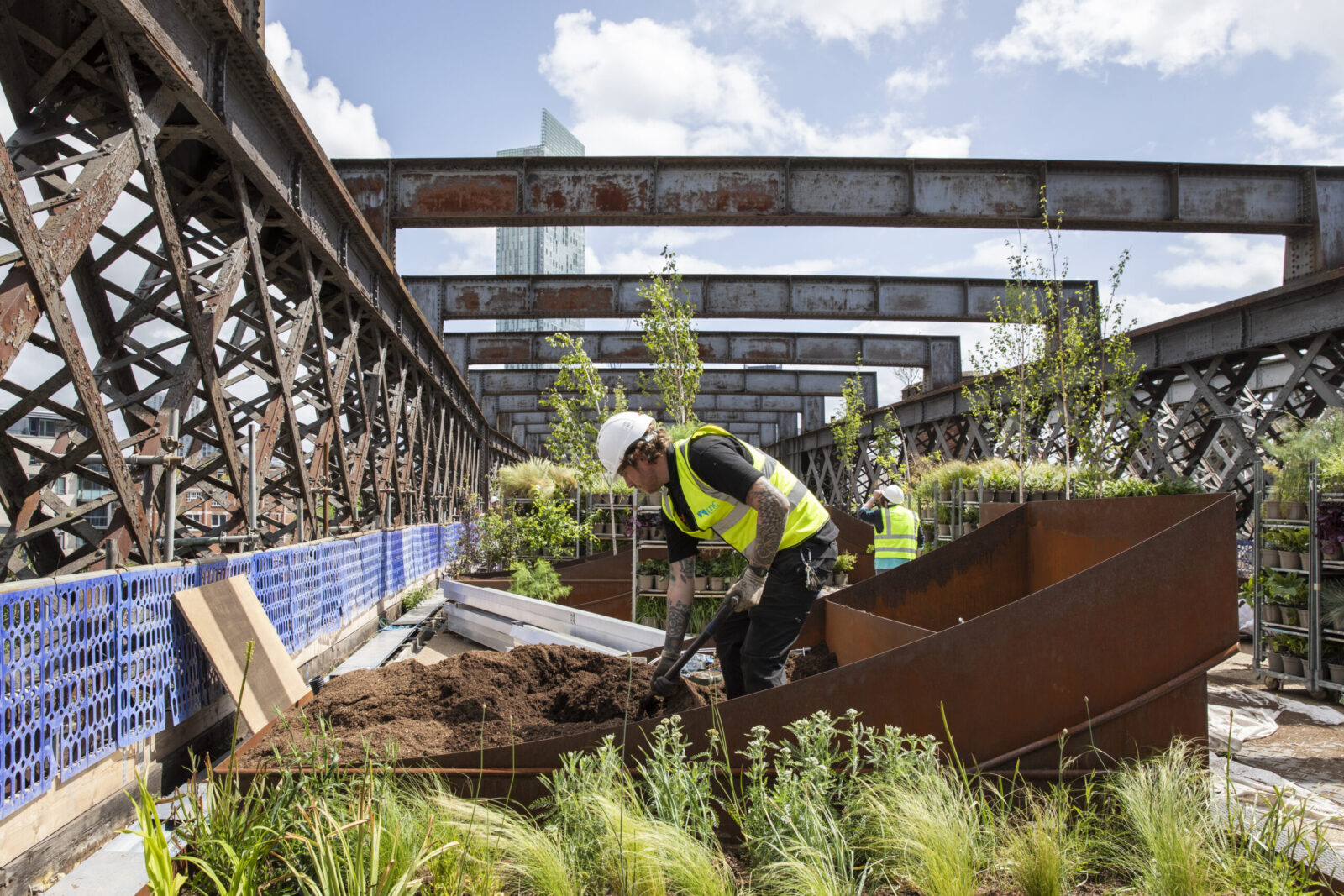
The official opening date of Manchester‘s New York-inspired ‘sky park’ at Castlefield Viaduct has now finally been confirmed.
After the National Trust announced its ambitious vision to create an urban green space in the heart of the city centre by tackling the challenge of “greening” the Grade II-listed Castlefield Viaduct and celebrate the history of this well-known landmark, it has now been revealed that visitors will be able to enjoy the park from next weekend.
Construction company MC Construction, Twelve Architects, and four local partners have been working with gardening specialists and apprentices at the National Trust to create the new park – with thousands of plants, shrubs, and trees having been planted over the past five months.
Now, less than half a year after work began to transform the giant 330-metre steel viaduct into an elevated park, the finishing touches are being made.
The temporary urban park at Castlefield Viaduct will open to the public on Saturday 30 July.
ADVERTISEMENT
Artist impression images of what Castlefield Viaduct will look like once it opens to the public in summer 2022 / Credit: Twelve Architects & MC Construction (via National Trust)
The park will be or the next 12 months, with green spaces stretching across the elevation, and during this time, visitors will have the opportunity to explore part of the structure and find out more about the viaduct’s heritage, the city’s long relationship with plants and trees, and learn urban gardening tips.
You’ll also get to experience a variety of planting displays as you walk along the viaduct while enjoying the elevated setting above the historic cobbled streets, according to the National Trust, and see the park “develop, evolve, and respond” with the changing seasons.
The plans for Castlefield Viaduct are part of the National Trust’s work to “increase access” for everyone to nature, history and beauty in, around, and near urban areas.
The Castlefield Viaduct dates back to 1892 and was built by Heenan and Froude – the same engineers who worked on Blackpool Tower – but the site closed in the late 1960s, and before the National Trust took over and began to add over 3,000 plants, shrubs, trees, and more, it had sadly been left derelict.
ADVERTISEMENT
Castlefield Viaduct before work began to transform the derelict site / Credit: National TrustPlanting underway on Castlefield Viaduct / Credit: Annapurna Mellor (via National Trust)
The industrial heritage of Castlefield has been reflected through all elements of the design of the park.
The National Trust says the design of the planters at the new park gives “a subtle nod” to the industrial architecture of the viaduct, and mirrors the curve of the railway tracks that once transported goods across the structure to the Great Northern Warehouse.
A section of the viaduct has also been left untouched to “provide a sense of how nature has reclaimed the space” since the site closed.
Speaking ahead of the park officially opening to the public next Saturday, Andy Jasper – National Head of Gardens & Parklands at the National Trust – said: “Creating a garden on an industrial heritage structure such as this is new territory for us and we have created a test bed that represents how the park in the sky might be, if the people of Manchester want it.
“With more than 3,000 individual plants planted in completely peat free growing media over the past couple of months, we’ve been literally trialling new planting techniques as we go – working with limited growing depths and thinking about how these plants will deal with the more challenging conditions of being 17 metres in the air.
ADVERTISEMENT
“I cannot wait to see what people say, and I am intrigued to see how the plant life will take in its new surroundings.”
A green oasis from industrial foundations, new life is being breathed into Castlefield viaduct: https://t.co/Eu9xBfIBuO
Once carrying heavy traffic into the heart of Manchester, it’s now set to be transformed into an elevated park that celebrates the city’s heritage. pic.twitter.com/ftjYraNaa4
Duncan Laird – Head of Urban Places at the National Trust – added: “This has been an intensely busy few months as we prepared to open the doors of the pilot project, and we are incredibly excited to finally be able to open this space for people to visit for the first time in over 50 years.
“As the trees and plants start to bed in and grow it will slowly begin to match the vision for this space, and we will be keenly listening to visitor feedback that we will use to shape the ongoing evolution of the viaduct.
“We’re at the start of the journey – not the end.”
100 people a day will be able to visit the Castlefield Viaduct from Saturday 30 July.
Entry onto the structure will be free, but a booking system will be in place to help manage numbers, and as part of the experience, visitors will be able to join guided walks – with plans to host various community events, workshops, and consultations in the pipeline.
Featured Image – Howard Bristol (via National Trust)
Trending
Two North West cities named among the ‘noisiest’ in the UK – including Manchester
Emily Sergeant
A new analysis has revealed a list of the noisiest cities in the UK, and two Greater Manchester locations are in the top five.
From blaring sirens and car horns, to house parties, barking dogs, and loud neighbours, escaping the noise of a city can feel almost impossible – even in your own home.
No matter whether you live in the hustle and bustle, or you’re out in the sleepier suburbs, noise can keep you up at night, disturb your peace, and lead to frustration. But just how loud are Greater Manchester’s cities compared to the rest of the UK? In a bid to get to the bottom of it, Alpine Hearing Protection has done some research to compile a top 10 list.
And both Salford and Manchester have found themselves not just within the top 10, but within the top five… and to make matters worse, Salford has actually claimed the number one spot.
The reason Salford has found itself at the top of the list, according to the research, is because it sits at the intersection of several major transport and urban hubs, with major motorways running through or around the city including the M60, M61, and M62.
Major rail routes also run through the city – including via Salford Crescent – which sees 16 million passengers every year, and also leads to Manchester Airport.
Top 10 noisiest cities in the UK
Salford
Portsmouth
Manchester
Southampton
London
Leeds
Stoke-on-Trent
Wakefield
Newcastle upon Tyne
Bradford
Parts of Salford are also very built-up, making pockets of the city noisy – especially in the concentrated centre where traffic, construction, nightlife and commercial activity get loud.
And of course, like any growing city, construction noises have been noted as ‘particularly bothersome’ for residents where major developments are springing up.
Manchester is third on the list of noisiest cities, due to many of the same reasons as Salford.
But the difference being that Mancunians are noted as one of the many reasons why the city is so loud – with residents making 5,301 noise complaints across Manchester between January 2024 and January 2025, and Hulme identified the loudest area with 304 complaints.
As well all know, Manchester is also home to many universities, which brings an active nightlife scene to the region, especially in the city centre, and in recent FOI data, it was revealed that the University of Manchester saw 2,049 noise complaints in the last five years.
Motorists warned of common winter driving habit that could land them with annoying fines
Emily Sergeant
With the temperatures drastically dropping now as we head into winter, motorists are being warned against a common driving habit.
On a wintry morning when the windscreens are frozen and your hands are equally as frozen too, it’s pretty common for drivers to start the engine, turn the heater right up, and remain stationary for several minutes to warm the car up before setting off on their journey… but did you know that doing this could see you, inadvertently, fall foul of the law?
That’s right – as ridiculous as it sounds, leaving your car engine running ‘unnecessarily’ while parked on a public road is illegal.
And to make matters worse, the rules on ‘engine idling’, as it’s known, apply regardless of whether the driver is using the heating, waiting for someone, or simply sitting in the vehicle.
Known as a stationary idling offence, Rule 123 of the Highway Code states that drivers must not leave a vehicle’s engine running unnecessarily while it is stationary on a public road, and according to the rule, a fixed penalty of up to £80 can be issued, right there and then.
Motorists are being warned of a common winter driving habit that could land them with annoying fines / Credit: PickPik | Wikimedia Commons
Fines will only be handed out if a motorist is stopped by a police officer who asks them to switch the engine off, and they fail to comply.
“However tempting it might be to sit in a vehicle with the engine running and the heater on to warm up, we strongly advice against it,” commented RAC senior policy officer Rod Dennis.
“As well as polluting the air and wasting fuel, drivers who leave their engines idling unnecessarily on a public road also risk an on-the-spot fine of £80. On cold mornings, the best approach is to clear any ice or snow properly and ensure windows are fully de-misted before setting off, then get on your way and let the car warm you up.”
There are some exceptions to the rule, however, as keeping the engine running is permitted in certain circumstances.
This includes when a vehicle is stationary because of traffic conditions, when the engine needs to run so a mechanical fault can be investigated, or if certain work is being carried out on the side of the road.

 Emily Sergeant -
22nd July 2022