Greater Manchester Police (GMP) has confirmed it has launched an investigation into a student who published a study dubbed a “PhD in masturbation”.
For an article recently-published in the Journal of Qualitative Research, PhD student Karl Andersson – who was attending the University of Manchester (UoM), but has since been suspended by the insitution – was conducting research into the ‘shota’ genre of Japanese comic books – which are known for centring around prepubescent or pubescent male characters depicted in a “suggestive or erotic” manner.
In his 4,000-word article – which was titled ‘I am not alone – we are all alone: Using masturbation as an ethnographic method in research on shota subculture in Japan’ – Mr Andersson said he wanted to “understand how [individuals] experience sexual pleasure when reading shota”.
To do this, he decided to undertake his own research.
He claims that he embarked on a three-month stint of masturbating to the comic books himself, and making notes on each session, the Telegraph reported.
ADVERTISEMENT
Andersson added that he had recently come out of a long-term relationship when he began his research – which he said contributed to his “willingness and eagerness”.
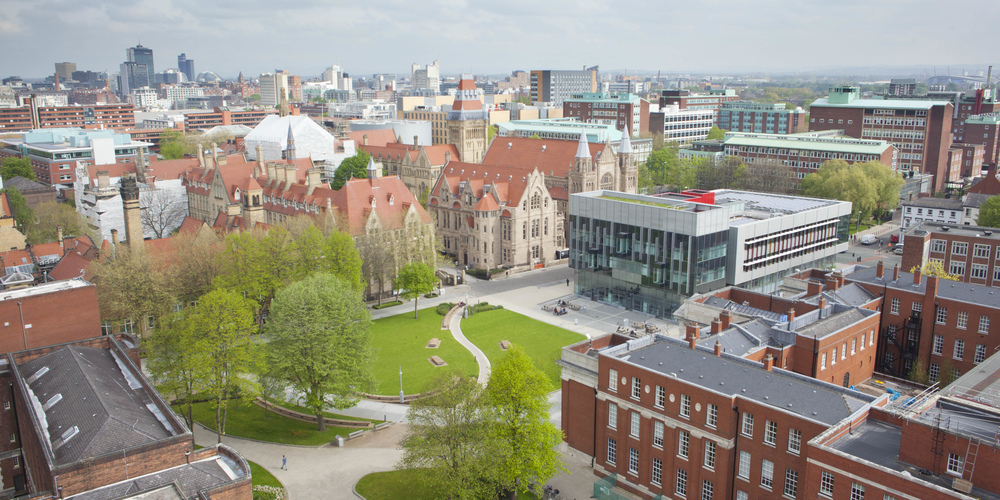
The University of Manchester (UoM) has been criticised for allowed a student to publish a “PhD in masturbation” / Credit: University of Manchester
Shortly after the article was published, Mr Andersson and the University of Manchester came under fire and were berated by both members of the public on social media and politicians – who branded the piece “a PhD on masturbation”.
ADVERTISEMENT
Following the huge uproar online, the article was removed and then retracted by the Journal of Qualitative Research, and the University of Manchester has since launched its own investigation into the matter, as well as suspending Andersson as a precautionary measure pending the outcome of the full investigation.
A spokesperson for Greater Manchester Police confirmed that it has also opened an investigation.
“We are working closely with the University of Manchester, who are assisting us with our enquiries to establish what, if any, offences have been committed,” GMP told Research Professional News.
In a statement published on 22 August, UoM said it had now completed the initial phase of the investigation, explaining: “We are examining all aspects of the student’s work and academic supervision, the origin of the article, his prior background, the associated university processes for admission to our PGR programme and research conduct, and other questions that have been raised.”
/ Credit: University of Manchester
The university said it was also helping GMP to establish if offences had been committed “in the UK or elsewhere”.
UoM confirmed from its initial phase of investigations that although Andersson was registered for a PhD at the university, the research design which he proposed for his PhD was rejected by the University Research Ethics Committee on 17 June 2022.
The university said it was not aware of the background information on the student.
ADVERTISEMENT
It said that the case has “highlighted that we must ensure our PhD student recruitment processes are sufficiently robust to appropriately scrutinise the legal, ethical and safeguarding issues of the proposed research and applicants’ prior related activities where relevant.”
Featured Image – GMP
Trending
Two North West cities named among the ‘noisiest’ in the UK – including Manchester
Emily Sergeant
A new analysis has revealed a list of the noisiest cities in the UK, and two Greater Manchester locations are in the top five.
From blaring sirens and car horns, to house parties, barking dogs, and loud neighbours, escaping the noise of a city can feel almost impossible – even in your own home.
No matter whether you live in the hustle and bustle, or you’re out in the sleepier suburbs, noise can keep you up at night, disturb your peace, and lead to frustration. But just how loud are Greater Manchester’s cities compared to the rest of the UK? In a bid to get to the bottom of it, Alpine Hearing Protection has done some research to compile a top 10 list.
And both Salford and Manchester have found themselves not just within the top 10, but within the top five… and to make matters worse, Salford has actually claimed the number one spot.
The reason Salford has found itself at the top of the list, according to the research, is because it sits at the intersection of several major transport and urban hubs, with major motorways running through or around the city including the M60, M61, and M62.
Major rail routes also run through the city – including via Salford Crescent – which sees 16 million passengers every year, and also leads to Manchester Airport.
Top 10 noisiest cities in the UK
Salford
Portsmouth
Manchester
Southampton
London
Leeds
Stoke-on-Trent
Wakefield
Newcastle upon Tyne
Bradford
Parts of Salford are also very built-up, making pockets of the city noisy – especially in the concentrated centre where traffic, construction, nightlife and commercial activity get loud.
And of course, like any growing city, construction noises have been noted as ‘particularly bothersome’ for residents where major developments are springing up.
Manchester is third on the list of noisiest cities, due to many of the same reasons as Salford.
But the difference being that Mancunians are noted as one of the many reasons why the city is so loud – with residents making 5,301 noise complaints across Manchester between January 2024 and January 2025, and Hulme identified the loudest area with 304 complaints.
As well all know, Manchester is also home to many universities, which brings an active nightlife scene to the region, especially in the city centre, and in recent FOI data, it was revealed that the University of Manchester saw 2,049 noise complaints in the last five years.
Motorists warned of common winter driving habit that could land them with annoying fines
Emily Sergeant
With the temperatures drastically dropping now as we head into winter, motorists are being warned against a common driving habit.
On a wintry morning when the windscreens are frozen and your hands are equally as frozen too, it’s pretty common for drivers to start the engine, turn the heater right up, and remain stationary for several minutes to warm the car up before setting off on their journey… but did you know that doing this could see you, inadvertently, fall foul of the law?
That’s right – as ridiculous as it sounds, leaving your car engine running ‘unnecessarily’ while parked on a public road is illegal.
And to make matters worse, the rules on ‘engine idling’, as it’s known, apply regardless of whether the driver is using the heating, waiting for someone, or simply sitting in the vehicle.
Known as a stationary idling offence, Rule 123 of the Highway Code states that drivers must not leave a vehicle’s engine running unnecessarily while it is stationary on a public road, and according to the rule, a fixed penalty of up to £80 can be issued, right there and then.
Motorists are being warned of a common winter driving habit that could land them with annoying fines / Credit: PickPik | Wikimedia Commons
Fines will only be handed out if a motorist is stopped by a police officer who asks them to switch the engine off, and they fail to comply.
“However tempting it might be to sit in a vehicle with the engine running and the heater on to warm up, we strongly advice against it,” commented RAC senior policy officer Rod Dennis.
“As well as polluting the air and wasting fuel, drivers who leave their engines idling unnecessarily on a public road also risk an on-the-spot fine of £80. On cold mornings, the best approach is to clear any ice or snow properly and ensure windows are fully de-misted before setting off, then get on your way and let the car warm you up.”
There are some exceptions to the rule, however, as keeping the engine running is permitted in certain circumstances.
This includes when a vehicle is stationary because of traffic conditions, when the engine needs to run so a mechanical fault can be investigated, or if certain work is being carried out on the side of the road.

 Emily Sergeant -
24th August 2022