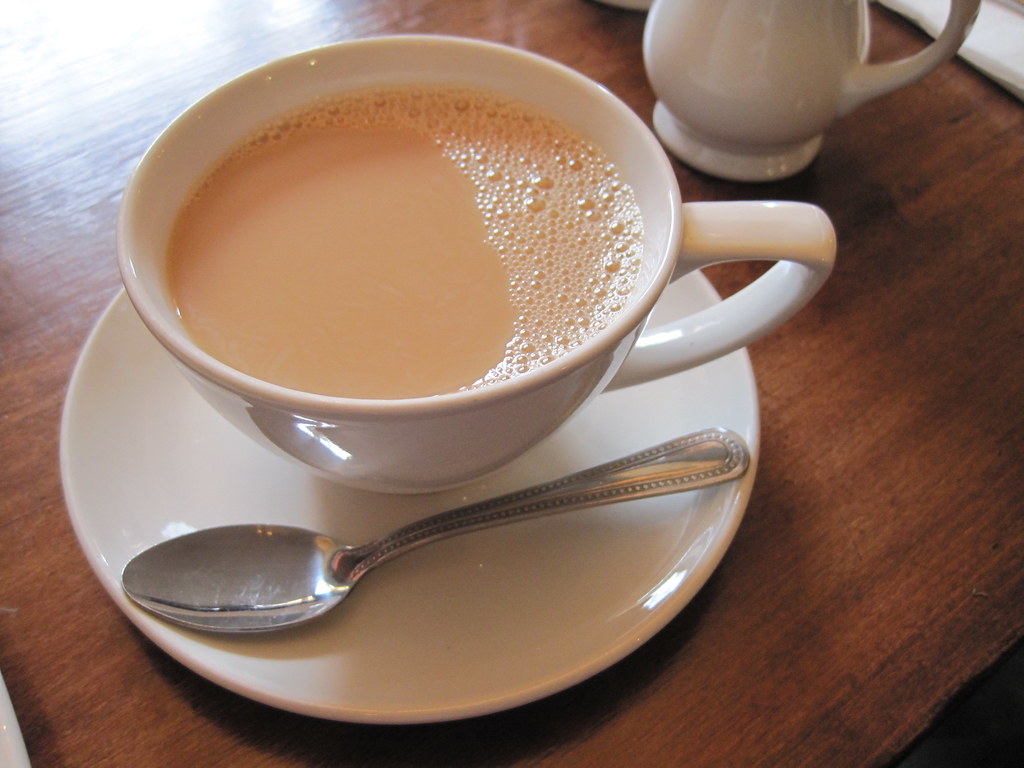
Talking to Brits about brews is very delicate business.
Why? Well, because put simply, Brits love a brew.
Statistically too, Brits have been buying tea more than ever during lockdown – with an additional £24 million spent on the stuff in a four week period – so we’re not joking about this.
Brits love a brew and Brits love a debate, so it makes perfect sense that one of the country’s most long-standing debates would involve tea and how to make the perfect cup. Last month, the Queen’s official tea finally settled the long-standing ‘water or milk first’ battle once and for all, but now a ‘professional tea taster’ wants to chip in too.
Yes, that is a real job.
ADVERTISEMENT
Arguably, us Northerners love a brew more than anywhere else in the country too, but are we going to be big enough to at least hear this ‘professional tea taster’ out?
Let’s see what they have to say at least.

ADVERTISEMENT
iStock
Meet Kevin Gascoyne.
First of all, he grew up in Yorkshire, but he’s also since travelled the world seeking out the perfect cuppa, he works as a taster for a specialist tea shop – Camellia Sinensis in Canada – and has co-hosted the World Tea Awards on several occasions.
Oh, and he drinks about four or five litres of the stuff each day too.
ADVERTISEMENT
According to Kevin, when it comes to making the perfect brew the first thing to remember is, how ever you like it is the best way and that should settle a few arguments about whether milk goes in first, second, or not at all.
Secondly, there’s a science to it.
Kevin explained to LADbible that: “Priority number one is getting pleasure from your brew. We are each the expert on what tastes good to us so if you have a preferred method, be it milk first or last, stick to your guns.
“[But] I would say it depend on the infusion technique we are using.
“Scalding water messes with the milk, it curdles into curds and whey getting lumpy. It only takes your water a short time to cool a few degrees for this to be avoided. So, with this in mind, in an ideal world my tea would always be brewed loose leaf in a teapot [because] as the leaves infuse for three minutes or so the temperature has come off the boil a few degrees so in this scenario I’d say milk first.”

ADVERTISEMENT
Unsplash
What about the office brew round though?
What about those of us who don’t have teapots at home?
Kevin added: “The teapot method is not always the most practical for a quickie or a large group.
“For such times, we revert to the combat conditions of the line-up of mugs and bags. With this set-up, putting the milk first and pouring water straight from the kettle risks splitting the milk, plus the milky water reduces the efficiency of the tea-water reaction, it just won’t brew as efficiently.
“So, for the ‘bag in mug’ set-up, water first-brew then add milk once the tea is brewed and cooled a few degrees.”
ADVERTISEMENT
Well, there you have it.
After all that, the perfect brew is how ever you like to make it – can really argue on that front, can we?
News
Manchester rent is now ‘41% more expensive than five years ago, according to a recent study
Danny Jones
Yes, that’s right, as per some of the latest data on leased housing in central Manchester, it’s now approximately 41% more expensive to rent here than it was half a decade ago.
If you’ve lived in and around the city centre for long enough, chances are that you’ve already been feeling that difference, especially of late.
The ongoing cost-of-living crisis roughly began in 2021, following the economy and the world essentially opening back up after multiple lockdowns, so it’s little surprise that new research has shown affordability when it comes to renting has been on a slump ever since, too.
As well as the price of seemingly most things in everyday life going up post-pandemic, the average rental rate for even just a one-bedroom flat/apartment has jumped up significantly between 2020 and 2025.
Even some ‘available’ housing in town is being hampered by claddin (Credit: Valienne via WikiCommons)
That’s according to the numbers crunched by credit card experts, Zable, anyway.
Not only did their recent report cite the rent prices going up even before the cost of living crisis – essentially following the outset of the Covid-19 outbreak – but if their figures, the rate of inflation and the unwaveringly high demand for housing are anything to go by, this trajectory is likely to continue in 2026.
As of February this year, around one in three UK households is now a single-person occupancy, which already comes with its challenges (the Manchester City Council tax discount being a thin lifeline for countless), not to mention energy bills and the cost of groceries continuing on an upwards trend.
Put in the simplest and most reductive terms, it’s now almost £300 dearer for most people to live on their own than it was back in 2020, and besides Liverpool clocking in as second on the list of increasingly expensive cities to live (a 42.12% increase), Manchester came in third.
You can see the full table down below:
Rank
City
% increase – 2020-2025
Difference from 2020 to 2025 in £
Average rental cost for a 1 bed 2025
1
Newport
47.39%
£2,611
£8,121
2
Liverpool
42.12%
£2,290
£7,727
3
Manchester
41.00%
£3,364
£11,569
4
Edinburgh
40.28%
£4,620
£16,090
5
Leicester
39.93%
£2,391
£8,379
6
Wolverhampton
39.22%
£2,049
£7,273
7
Nottingham
39.07%
£2,400
£8,543
8
Glasgow
38.02%
£2,679
£9,725
9
Colchester
37.63%
£2,617
£9,572
10
Cardiff
37.06%
£2,828
Average rental cost for a 1-bed 2025
Another fear is that with lots of people finding it hard to manage living in other major cities like London, even those moving to Manchester are also having an impact on how available affordable housing is here.
That’s why schemes such as the new ‘social rent’ development over in Wythenshawe are so important to the current generations of renters, with the possibility of owning your own property in the future becoming increasingly difficult for so many.
It’s also worth noting that Manchester ranked fourth among the British locations where the cost of living is said to have increased the most over the past five years, with the average difference in annual spend growing by an estimated 22.84%.
1,500 miles of roadworks lifted to help ease congestion for drivers this bank holiday weekend
Emily Sergeant
1,500 miles of roadworks have now been lifted across the UK.
With half term well underway already, and now millions of drivers set to hit the road over the next five days as Easter bank holiday weekend arrives, giving Brits two extra days off, National Highways has now confirmed that, as of today (Thursday 2 April), around 1,500 miles of roadworks have been lifted nationwide.
Roads are expected to be ‘especially’ busy tomorrow in particular (Good Friday), National Highways predicts, as this is the day people are most likely to head on a spring getaway.
So, in a bid to help ease congestion for drivers up and down the motorways, roadworks have been removed up until Bank Holiday Monday (6 April).
“By keeping 98% of routes clear, we’re supporting the wider economy where it matters most to tourism, freight, and local businesses,” National Highways said in a statement.
1,500 miles of roadworks have been lifted to help ease congestion for drivers this bank holiday weekend / Credit: pxfuel
The decision to lift the roadworks comes as a new national survey revealed a total of 71,254 breakdowns were recorded in spring (March–May) last year, compared with 56,702 in 2022.
It also showed that more than one in two (53%) UK drivers have broken down on a motorway or major A-road in their lifetime, highlighting how common the experience is for both drivers and passengers, and why it’s important to take relevant safety precautions from all sides.
29% of drivers think their breakdown could have been prevented with simple vehicle safety checks, but 17% admit to rarely or never conducting these.
National Highways echoes the statement that most of these incidents could be avoided through ‘quick and basic’ checks, and is urging drivers heading away this bank holiday weekend to familiarise themselves with how to do these before hitting the roads, so they can reach their destinations safely, saving costs and reducing delays for all road users in the process.
“Millions of people will be hitting the roads over Easter, and we want everyone to have a safe and smooth journey,” commented Colin Stevenson, who is the Road Safety Information Lead at National Highways.
“A few simple checks can help to prevent many of the breakdowns we see each year and help drivers avoid unexpected delays, cost and stress.