North Manchester is set to become home to a huge new public green space within the next couple of years.
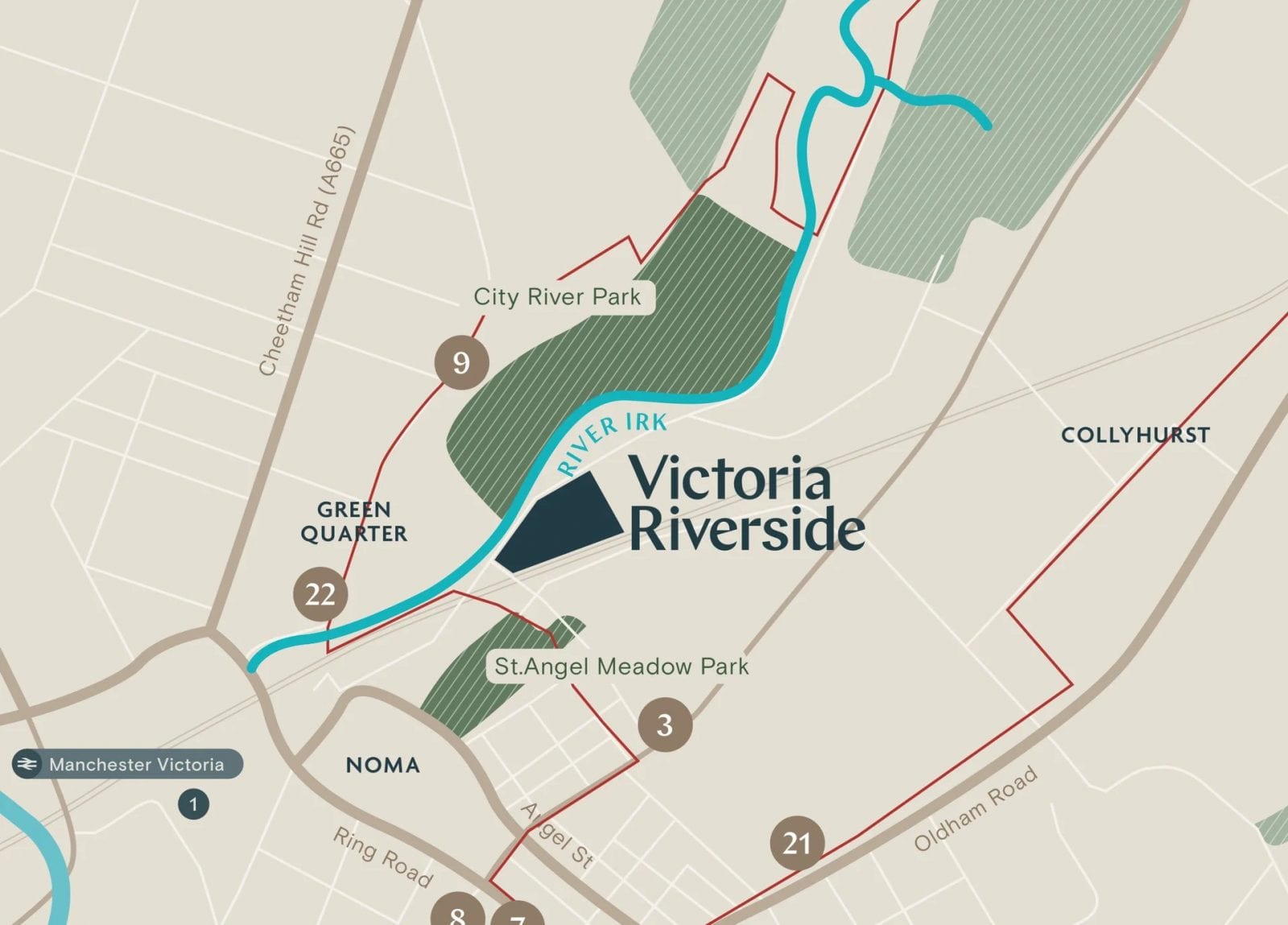
Forming part of Manchester City Council and Far East Consortium’s (FEC) ‘Northern Gateway’ masterplan – recently rebranded as ‘Victoria North’ – to regenerate and rejuvenate over 390-acres of land into new communities over the next two decades, the proposed City River Park will boast 113 acres of landscaped green space.
Set to be completed by 2024 in the north eastern area of the city, City River Park is expected to incorporate part of St Catherine’s Wood and the River Irk.
Much of this land is currently disused and has sadly become somewhat of a fly-tipping hotspot.
City River Park has been described as “a park for the people”.
ADVERTISEMENT
A description of the proposed plans for the park on the Victoria North website reads: “At the heart of the regeneration is the City River Park, which covers 113 acres of new and improved parkland and will become one of Manchester’s largest city centre green spaces.
“The park will vary in character providing a diverse and active new recreational corridor for the community including parks and smaller amenity spaces.
ADVERTISEMENT
“City River Park will enhance existing habitats and create new habitats for wildlife, and be guided by climate positive design to create results which as carbon neutral as possible. Connectivity and accessibility are also key ensuring high quality pedestrian and cycle movement within luscious green spaces for active lifestyles and wellbeing”.
The £4 billion ‘Victoria North’ project will aim to create around 15,000 homes north of Manchester Victoria train station over the next 20 years, and is made up of seven neighbourhoods.
These neighbourhoods are: Collyhurst Village – which Manchester City Council and FEC submitted first phase regeneration plans for last month – Collyhurst South, New Cross, New Town, Red Bank, Vauxhall Gardens, and Smedley Dip and Eggington Street.
ADVERTISEMENT
Speaking on the decision to rebrand as ‘Victoria North’, Gavin Taylor – Regional General Manager at FEC in Manchester – said: “The Northern Gateway has served us well as a name as we shaped plans for the area’s regeneration, but as we begin to bring forward development this year, it’s the right time to start creating a sense of place for what will be a significant new district in Manchester, as well as an identity that people can engage with”.
He continued: “When taken together, Victoria North’s seven neighbourhoods are greater than the sum of their parts and we want there to be a sense of cohesion between them.
“Each area will have its own unique characteristics, meaning we can celebrate the rich identities of existing communities that we’re passionate about preserving, alongside new ones that we’re excited to be creating.”
Sir Richard Leese – Leader of Manchester City Council – added: “We are at the beginning of an incredibly exciting phase of history for this part of Manchester and with some eagerness to see how this potential unfolds”.
You can find more information about the Victoria North project here.
News
Police appeal launched as woman dies after being hit by lorry in Bury
Daisy Jackson
A woman has tragically died after being hit by a lorry in Bury yesterday afternoon.
At around 3.45pm on Tuesday 6 October, emergency services were called to a road traffic collision in Radcliffe.
The collision was between a pedestrian and a lorry on Church Street West.
Tragically, the pedestrian – a woman in her 50s – passed away at the scene despite the efforts of emergency services.
A large cordon was in place yesterday and road has remained closed this morning.
Officers from GMP’s Serious Collision Investigation Unit are now appealing for information.
They said: “At around 3.45pm yesterday (Tuesday 6 October 2026) we were called to reports of a road traffic collision between a pedestrian and a lorry on Church Street West, Radcliffe.
“Emergency services attended but sadly the pedestrian, a woman in her 50s, passed away at the scene.
“No arrests have been made and enquiries are ongoing.
“Anyone with information including CCTV, Ring doorbell or dashcam footage is asked to contact police on 101 quoting log 2299 of 06.10.26. Reports can also be made via our website of the LiveChat function at www.gmp.police.uk.
“Alternatively you can contact Crimestoppers anonymously on 0800 555 111.”
New measures announced to tackle ‘rogue’ landlords across Greater Manchester
Emily Sergeant
A cohort of trained enforcement officers are set to hit the streets in all 10 boroughs to help improve the lives of the region’s renters.
Forming part of Greater Manchester‘s commitment to the highest-quality housing standards alongside the Good Landlord Charter, the newly trained enforcement officers will be tasked with protecting tenants, joining Council teams in checking rental properties, bringing enforcement action against bad landlords, and cracking down on illegal practices.
The introduction of the new enforcement officers comes after what has been ‘years of sustained pressure’ on local budgets.
Greater Manchester Combined Authority (GMCA) says it is working with the 10 councils across the region to strengthen local teams, rebuild in-house skills and expertise, and ensure that powers can be applied with consistency in all boroughs.
As mentioned, this all forms part of the Good Landlord Charter – which is GMCA’s ‘bold approach’ to drive up standards for renters across the region.
Landlords of more than half of rented properties in Greater Manchester have now signed up as supporters of the Charter, and as supporters, they have committed to going above and beyond legal minimums to improve the renting experience for hundreds of thousands of people.
“A safe place to call home is the cornerstone of a happy, healthy life,” explained Mayor Bev Craig. “But for years, people have felt trapped in poor-quality housing, and cash-strapped councils were unable to step in to help. I’m putting an end to that.
“We know there are plenty of good landlords in Greater Manchester, and many of them have already signed up to our Good Landlord Charter, but too many are just not good enough.
“That’s why we’re deploying a new generation of expert housing officers onto the streets of our towns and cities.”
Mayor Bev Craig declared that she ‘won’t stand by and let rogue landlords take advantage of people’.
She continued: “By empowering renters, working with responsible landlords, and using our powers to crack down on the bad ones, I will make sure everyone in Greater Manchester has the foundation for a good life.”

 The Manc -
18th March 2021
The Manc -
18th March 2021