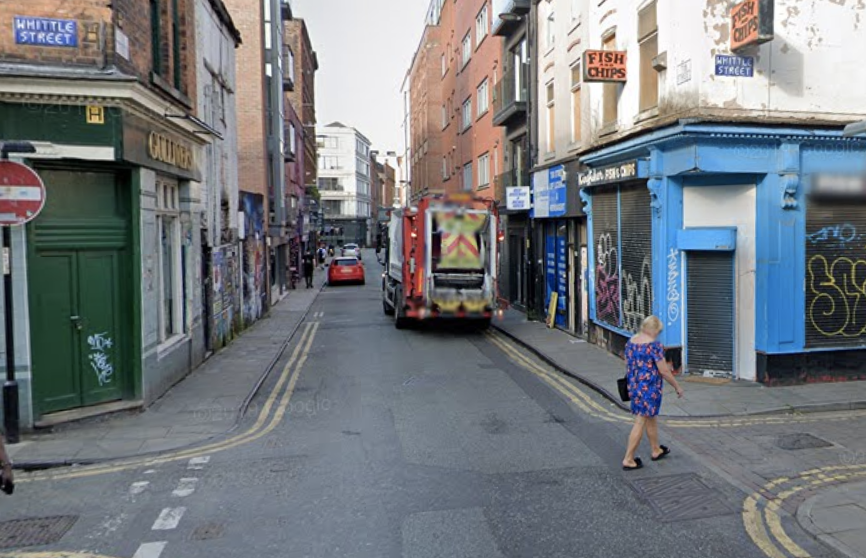
Tib Street is a built-up blend of bakeries, bars, florists, cafes, newsagents and sex shops nowadays. It’s an intriguing and peculiar old part of town that seems to have a bit of everything.
But it wasn’t always this way.
For many years, this slender stretch of Northern Quarter had a single definitive trade that used to attract Mancunians in their thousands: animals.
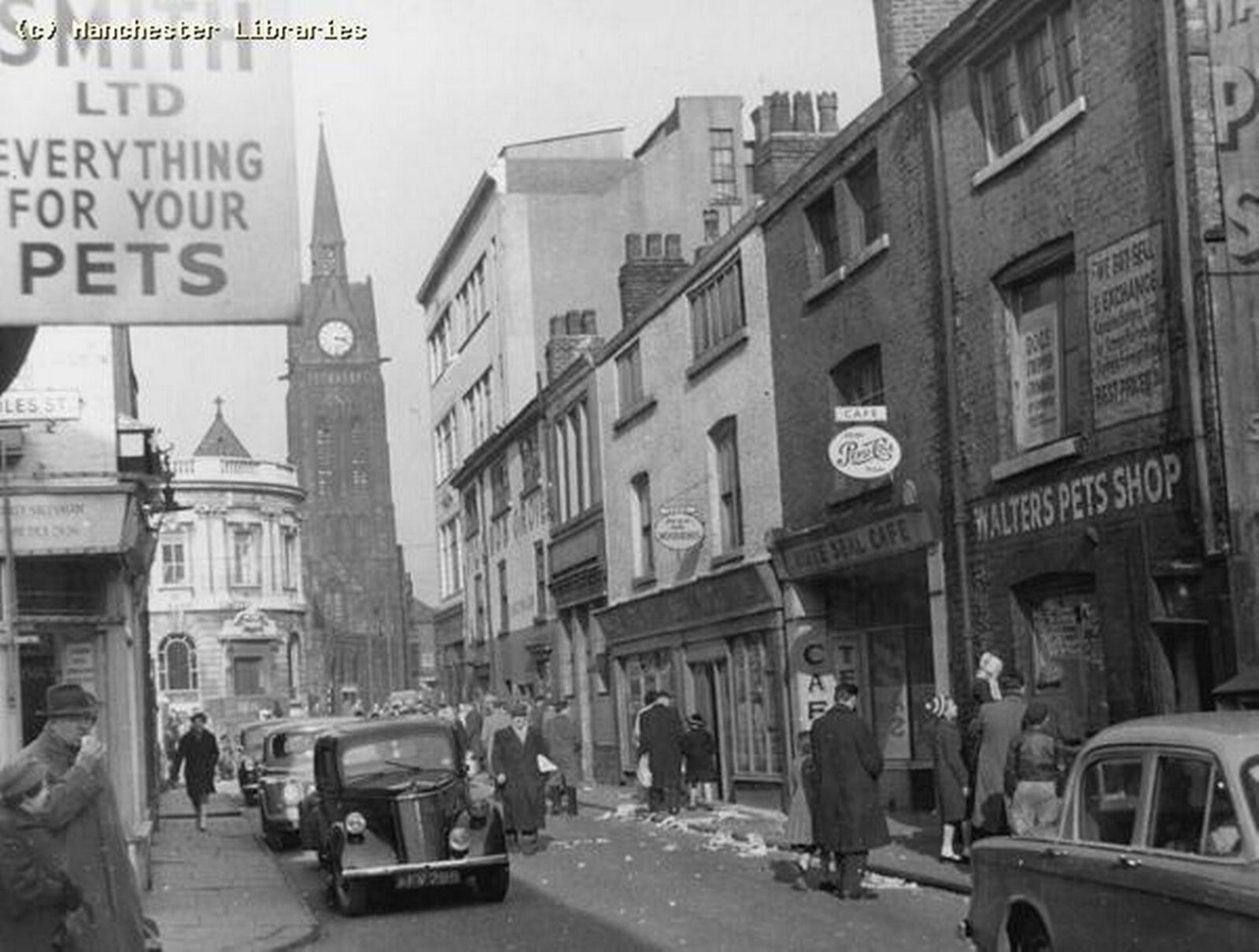
Established as an agricultural space in the 1800s, Tib Street gradually morphed into a pet shop paradise during the early 20th century; a cavalcade of creatures peeking out from behind the windows that lined the street.
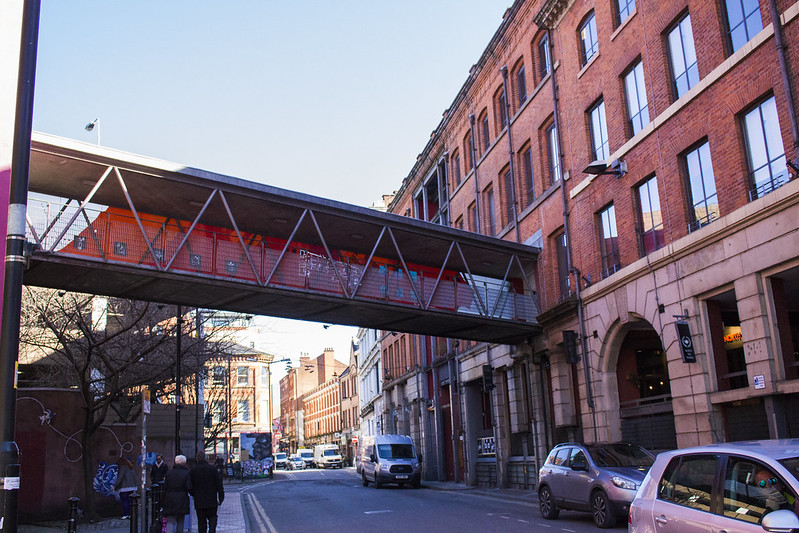
Hayley Flynn, the founder of Skyliner and a walking encyclopaedia of Manchester history, has previously dived into the history of the area on her walking tours, having discovered that Tib Street was a truly ‘wild’ part of the city.
ADVERTISEMENT
“There’s always been animals on Tib Street since it was established around the 1800s,” Hayley explains.
“But it became less about agriculture and pigs, and more about pets when the area became more developed in the early 1900s.
ADVERTISEMENT
“There’s still one pet shop there today but it was the arrival of the Arndale in the mid to late 1970s that saw most of the area close down and businesses move out.
“The area then became what we have today partly through the natural process of gentrification, partly down to arts-led regeneration.”
One of the most prominent traders in Tib Street’s heyday was a man name Walter Smith – who owned one of the longest-running pet shops in the area.
ADVERTISEMENT
He eventually sold it to another family, the Browns, but they kept the original name – and the original founder’s legacy survives in a painting titled “Mr Smith’s Dream” created by artist Liz Scrine.
“The Dream piece is based on Under Milk Wood by Dylan Thomas and the plan was the create the dreams of the animals in the pet shops in further lightboxes along the same wall, but the project was never completed,” Hayley informs us.
“So, we have this one piece that seems quite abstract as a standalone installation.”
Tib Street’s markets became bigger and more diverse throughout the 1900s.
As the areas began to attract five-figure attendances on Friday evenings, the pubs opened earlier to accommodate growing numbers of traders.
ADVERTISEMENT
“Around Tib Street could draw crowds of up to 10,000 on a Friday night, much of this was market footfall around Smithfield, especially the Shudehill side (the wholesale fish markets on High Street),” Hayley tells us.
“Then to serve the workers of the markets the pubs opened very early in the morning – so it was something of a 24 hour city in that respect.
“Teenagers relied on the markets for entertainment and a social space, and it was popular with sex workers too, so it was a bit of a wild place at times.”
Google
Much of the animal trade and pet shops shut down on Tib Street in the seventies, but the concealed structure of the street rendered it ideal for explicit stores to pitch up for patrons; away from city residents’ prying eyes.
“The pet shops and other independents along Tib Street were a very popular day out right up until the 70s,” says Hayley.
ADVERTISEMENT
“Even later on, strange independent traders who managed to survive in the area for a while longer drew in crowds, there was a latex mask shop that was popular with the younger crowd.”
Modern Tib Street is no longer a round-the-clock fiesta of beasts and booze, but if you crane your neck upwards, the relics of its past are in plain view.
Perched gently on the buildings, you’ll see a pandemonium of painted parrots.
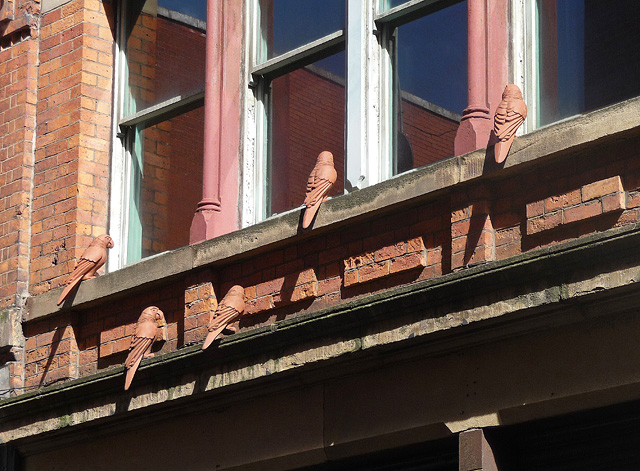
“The birds form part of the same art trail as Mr Smith’s dream, they’re looking back into the building wondering where to go now that the pet shops are closed,” Hayley explains.
“They’re the Sulking Parrots of Tib Street, and have found themselves homeless. There are other birds like this hidden around the Northern Quarter to look out for, from doves to toucans.
ADVERTISEMENT
“They’ve been handing around since the late 90s but have been surprisingly overlooked, suppose that’s just testament to the fact we should always look up.”
To discover more about the amazing history of Manchester, you can take a walking tour with Skyliner – led by Hayley herself.
Tours are resuming later this month following lockdown; currently limited to five people due to group restrictions.
Beat-Herder Festival 2026 – the wonderfully weird festival we can’t stop coming back to
Emily Johnson
Another weekend done in the magical, mystical world that is Beat-Herder.
For one weekend every year, a farm in Clitheroe transforms into what the organisers describe as “a place full of beats and barminess” – and honestly, they couldn’t have summed it up any better.
Big enough to keep you discovering something new all weekend, yet small enough that you’ll keep bumping into the same friendly faces, Beat-Herder strikes the balance perfectly.
Every corner has something different going on, every stage has its own personality, and every sound system is absolutely dialled in.
Where else can you go for a swim, get a tattoo, pop into church, visit Paris and dance until sunrise? No, we’re not describing a chaotic stag-do… we’re talking about Beat-Herder.
Every stage deserves a mention, but a few really stood out this year.
Julie’s Barn, a.k.a. ‘Gay Paris’, remains one of the festival’s best-kept secrets. Hidden away in the woods, it’s worth every wrong turn trying to find it.
A glowing dancefloor, disco balls hanging from the trees and a crowd that somehow never seems to leave. We even stumbled across a secret ‘Samurai Breaks SSBB’ set that had the place bouncing all the way through until sunrise.
Credit: The Manc Group
Over at Stumblefunk At The Factory, Breakage delivered one of the sets of the weekend. The bass rattled the roof, the crowd never stopped moving, and the whole place felt like it was about to lift off.
It’s also home to one of Beat-Herder’s many weird little surprises, with hidden missions and the chance to spy on other festival-goers. If you know, you know.
The Garage is another annual favourite. DJs squeezed into the front seat of a car while everyone else danced on the bonnet of old scrapped cars, bouncing to the bass that rattled from White Noise Audio’s soundsystem. It’s those ridiculous little details that make this festival unlike anywhere else.
Then there’s Beat-Herder’s Got Talent, which has become a non-negotiable part of our weekend. The winner earns a slot on the main stage, so every act gives it everything. This year’s line-up featured everything from incredible harmonica performances and live bands to rap duos.
But one contestant completely stole the show.
She walked on stage, admitted she wasn’t sure her talent was quite as impressive as everyone else’s, and the crowd fell silent. No instrument. No backing track. You could hear a pin drop. What on earth was this contestant about to do? And then she proceeded to fit her entire fist in her mouth.
If that doesn’t sum up Beat-Herder, we’re not sure what does. The wonderful woman didn’t win the contest unfortunately, but let’s hope she can get booked for next year, ey?
One of this year’s new additions was The Dub Tub, which quickly became one of our favourite discoveries. Artists like Woody Cook swapped high-energy sets for slower, dub-inspired sessions, creating the perfect place to reset before diving back into the madness.
Oh, and of course, in true Beat-Herder fashion, the DJs were performing in a bathtub, of course.
And speaking of madness… all the classics are still there. The famous tunnel leading to hidden stages, the weird and wonderful walkabout performers, the random discoveries you’ll never find on a map, the hidden swimming pool, fancy dress costumes, and the constant feeling that you’re about to stumble across something completely unexpected.
Massive credit has to go to everyone behind the scenes. From the organisers to the volunteers and crew, everything runs incredibly smoothly, despite how wonderfully chaotic it all feels. Beat-Herder, you’ve done it again; roll on 2027.
Meet the team that reimagined The Horse and Jockey into a gastropub masterpiece
Lydia Mastrolonardo
The Horse and Jockey is a historic neighbourhood pub that has forever been a cornerstone in the heart of Chorlton, with its iconic Tudor exterior and outdoor seating looking out onto The Green.
Since the team behind the well-known and loved The Black Friar and Leo + Roobs in Salford, headed by Managing Director Neil Burke and Executive Chef Ben Chaplin, reopened the pub in October 2025, we have since seen some significant changes.
Positioning themselves as Chorlton’s first-ever proper gastropub, they’ve expertly balanced maintaining the pub’s character and restoring the cosy indoors while catering for Manc foodies, with an ever-evolving menu consisting of fresh local produce as well as a wide selection of Joseph Holt award-winning beers.
Credit: Bigger Boat Hospitality
We’re not the only ones who have noticed the hard work these two have put in – the transformation has led to the Horse and Jockey being crowned as one of the best local boozers at the Pub and Bar Awards.
Today, we had a chance to talk with Ben, who is the mastermind behind their delicious dishes and makes it all possible…
For anyone who doesn’t know you, give us a little bit of background on your career as a chef thus far?
“I started in the kitchen when I was 15 and worked my way up through different kitchens. Ended up working for Aiden Byrne, who remains the youngest person ever to achieve a Michelin star at 22. I worked for him for about nine years, ran one of his pubs for him and helped develop Manchester House.”
“I then went off and worked as head chef at Australasia for two years and 20 Stories for another three years before meeting Neil. Together we opened The Black Friar in 2021, Leo + Roobs in 2024, now the Horse and Jockey and are 100% looking for more venues.”
How would you sum up the Manc food scene at the minute?
“Very diverse. Within the industry side of it, it’s difficult with a lot going on with VAT and wages, but there are some great venues doing some great food even just in Chorlton alone, and there is a lot of choice – I actually think it rivals London.”
This has become a staple of their annual calendar of events. See more from this year’s edition HERE.
We already know you’ve worked wonders bringing The Black Friar back to life and taking it beyond just a pub – what lessons have you taken from that experience to the Horse and Jockey?
“I think not just the Horse and Jockey but one of our values as a company for Bigger Boat is we are ‘yes people.’ So trying new things and not just saying no to something because we don’t want to do it, saying yes first and trying to find a way to achieve it.”
“It’s something that we don’t just do here, but we do it at the cafe, The Black Friar, and we’re going to do it going forward, opening more and more places.”
If you could describe how the approach is different between the two venues, what would you say?
“The spaces in The Black Friar allow us to do a lot more events; we obviously have a bigger outdoor area, so that leads to us being able to sell different areas for different events. We don’t have that as much here, and this is more of a neighbourhood, local pub, serving gastro-style food.
“The Black Friar we can go from events to weddings pretty seamlessly – we do a lot more there as there’s space for it and even more to come.”
They’ve even started doing a picnic basket offer. (Credit: The Manc Eats)
What is your favourite dish on the menu?
“We change the menu so often here (the Horse and Jockey) following the seasons, often changing a dish a week. However, right now my favourite is probably our lamb rump with a red pepper and harissa hummus with a hazelnut and sesame seed dhukka.”
And if you could sum up the food in three words, what would they be?
“Evolving, tasty and bold.”
These two truly know what they’re doing with these restorations, and we can’t wait to experience what else they take over in the future.
Don’t believe us? Go on down and try it for yourself.
You can read our full review of the food and drink from when they first reopened the gorgeous suburban, village-style spot down below.