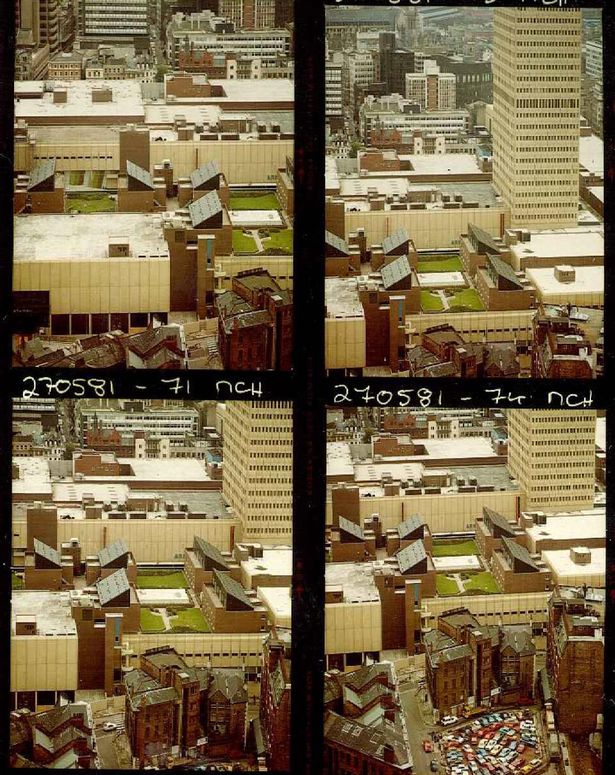
For some years, rows of tidy little maisonettes sat on top of the Manchester Arndale housing some of the first pioneers of inner-city living.
Built in 1981 and named after a Victorian backstreet that had been demolished to make way for the mammoth shopping centre, Cromford Court nodded to days past whilst also looking to the future.
At the time, only around 1,000 people actually lived in the heart of Manchester – mostly caretakers and other people who felt it practical to be close to the city for their jobs.
There was just a handful of communities dotted around the centre back then, despite Manchester City Council’s best efforts to try and persuade people to move into an area where they could live, shop and work all without having to commute.
In a way, the residents of Cromford Court were pioneers. Counted amongst their numbers was none other than Mike Pickering, one of the regular DJs at the Hacienda and the man responsible for signing the Happy Mondays to Factory records.
ADVERTISEMENT
Speaking to Manchester researcher and tour guide Hayley Flynn, better known as Skyliner, on her blog Pickering’s friend and fellow Hacienda DJ Graeme Park remembers:
“In 1988, I used to stay at Mike’s and I had my own room. I’d roll up to his every Friday and park my car in the Arndale’s multi-storey car park and get the lift from the street up to the roof.”
ADVERTISEMENT
“We had some great nights in there after finishing The Hacienda,” he added.
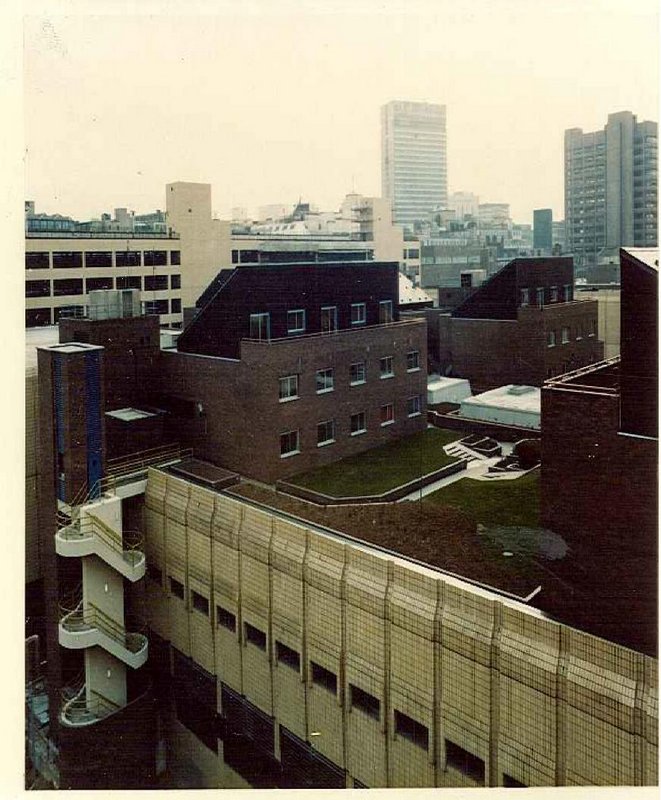
Apparently, the view wasn’t as great as you might expect because the flats weren’t actually that high up. However, according to Graeme, you could see some bits of the city and there was a decent view down into the street below whilst walking from the lift to the flats.
After getting stuck in the lift once, though, he reportedly always took the stairs for fear of a repeat.
ADVERTISEMENT
The flats did have their own direct access for residents, and according to Eric Larmett – a surveyor for Manchester City Council who visited the trio of six-storey blocks several times for his job – it was its own little oasis up there, away from the hustle and bustle of the city centre.
“They were private residences which only the tenants could reach,” he said, speaking to the BBC back in 2011.
“As a result, it was like having a gated community right in the middle of the city.”
Although the maisonettes were initially described as “expensive ‘penthouse’ units” in the 1986 Domesday Book, in reality, they were far from it – rented out to tenants of the North Country Housing Association.
Known as ‘the podium’ to its residents, neat little communal gardens added to the allure of the place – although apparently, these same gardens caused a few headaches for the shops below who were reportedly ‘plagued’ with ‘mysterious leaks’ as a result.
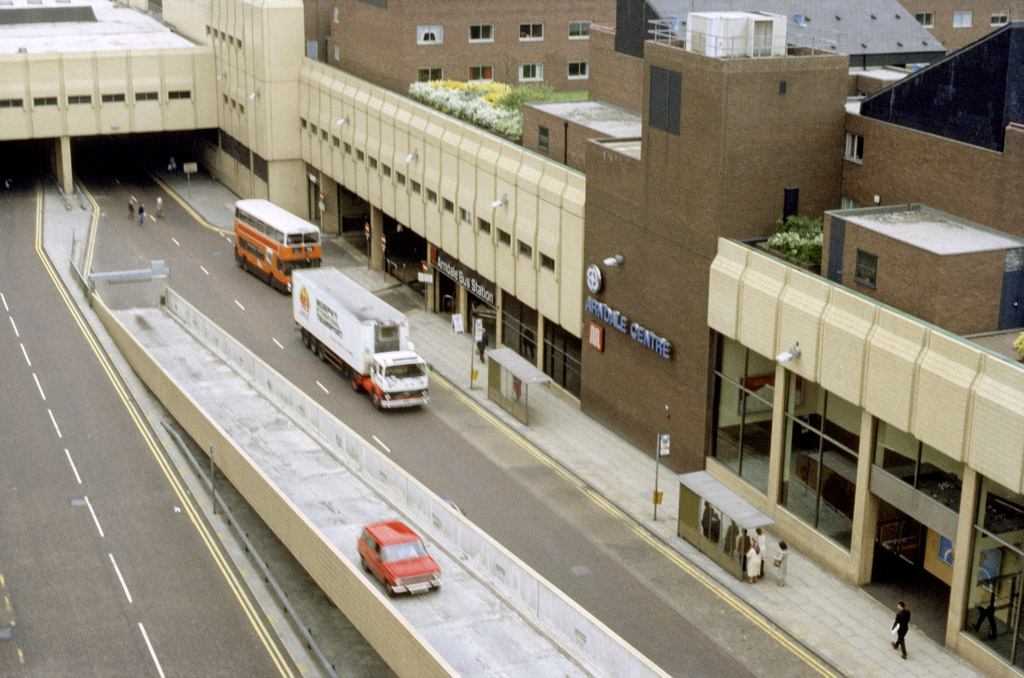
Inhabited on and off from 1981 until 2003, the little community on top of the Arndale finally came to an end in the early noughties – seven years after the IRA bomb that led to the shopping centre needing to be almost entirely rebuilt.
It’s often said that that bomb explosion was so powerful it only left a red postbox behind, but in fact, Cromford Court wasn’t too badly damaged.
Notably, one resident – a 77-year-old RAF veteran suffering from the flu at the time – didn’t even bother to get up when the telephone warning to evacuate hit, considering himself to have survived much worse feats during his time in service.
In subsequent years, Danny O’Neill has become a part of an urban legend as the story of the man who ignored the bomb because he didn’t want to get out of bed has been told time and time again.
Having been a rear gunner in a Lancaster in the war, he reportedly told police and authorities “he was buggered if he was going to let a small bomb affect him.” What a guy.
Feature image courtesy of the Manchester School of Art Slide Library at Manchester Metropolitan University Special Collections.
Feature
‘If only he was here’: Peter Hook reflects on Ian Curtis as Joy Division join Rock and Roll Hall of Fame
Danny Jones
We were lucky enough to play a part in a bit of music history (albeit only a small one) this week, as we had the privilege of chatting with the one and only Peter Hook of Joy Division and New Order, as the pair were finally admitted into the Rock and Roll Hall of Fame.
A long overdue bit of recognition, if you ask, but a momentous day nonetheless.
Chatting with Hooky and a long-time friend, collaborator, and beloved Manchester-based DJ, Graeme Park, in the aftermath of being named in the ‘Class of 2026’, he was visibly moved and honoured by the announcement. Here’s what he had to say…
Joking from the off by repeating Graeme’s initial question, “How does it feel?” (an absolute tap-in, that one), the 70-year-old bassist and co-founder of both iconic Greater Manchester groups admitted that they “had a couple of false starts”, to put it mildly, but went on to add: “we can only thank our fans.”
Confessing there has been somewhat of a mixed reaction about “what it means” to them and/or in the industry these days, he made it clear that on a personal level, it’s still a huge moment.
Put simply, he said: “Without the fans, we’d all be nothing.”
He also went on to praise the sort of no-nonsense, DIY and unapologetic approach of the Manc music scene, quipping: “You know, what would Simon Cowell have said about Ian Curtis, Bez, Shaun [Ryder] – Ian Brown, for god’s sake?!”
Acknowledging that while no one was necessarily an “accomplished singer” (often the case when you start early and just pursue a passion), his caveat was that “they had heart and soul” and “they embody something deep within us all that has lasted and will continue to last.”
Noting a de facto ‘Renaissance’ that a few names have enjoyed – especially following the passing of certain notable figures – he believes, rather, that they never went anywhere and that Northern crowds and beyond have helped those songs stretch to three, four, even five different generations.”
He’s not wrong: they’ve never stopped connecting with audiences, and they NEVER will.
Once more, it was an absolute joy (again, pardon the pun) to chat with Peter and Parky, who clearly haven’t lost their love for each other, nor this business – even after all these decades.
Congratulations to both bands, Hooky, Bernard Sumner, Stephen Morris, Gillian Gilbert, Tom Chapman, Phil Cunningham, as well as every session musician who’s ever played these tunes and kept them alive.
Last but not least: forever and always, rest in peace, Ian Curtis.
Inside Soho House Manchester as rooftop pool finally opens
Daisy Jackson
Soho House Manchester finally opened its doors to members late last year – but there’s still more to come.
The exclusive members’ club, which costs from £2,400 per year to access, faced several years’ worth of unavoidable delays as it transformed the old Granada Studios.
And even now that members can finally visit the space for networking, dinner and drinks, events, and working, Soho House isn’t actually finished.
Instead, the hotly-anticipated venue is opening in phases – the latest of which is that beautiful rooftop pool, with views overlooking the city from the top of the former television studio.
New images taken inside Soho House Manchester show several of the completed spaces, from lounges with beautiful natural light flooding through skylights, to stylish candlelit dining rooms, to gorgeous bedrooms.
In keeping with the building’s history, the Soho House design team have stuck with a premium mid-century interior, including terrazzo flooring and warm wood details, muted green and orange colour palettes, and chrome furniture.
Have a look inside Soho House Manchester:
Soho House Manchester is now open. Credit: SuppliedBeautiful interiors. Credit: SuppliedA bar space. Credit: Edvina BruzasRestaurant spaces. Credit: Edvina BruzasDetails of Soho House Manchester. Credit: Edvina BruzasMid-century details at Soho House Manchester. Credit: Edvina BruzasInside Soho House in Manchester. Credit: Edvinas BruzasNew spaces are still opening. Credit: Edvinas BruzasThere are 22 bedrooms inside. Credit: Harry Crowder
There are now 22 beautiful bedrooms up on the sixth floor, exclusively available to Soho House Members, which carry on the 1950s heritage design.
As the build continues, members will soon have access to a Soho Health Club with a gym, reformer Pilates studio, smoothie bar, and infrared sauna and steam room.
Every Soho House has a strict no-photos policy to protect to privacy of members – which means unless you fancy forking out £333.33 a month, you might never see inside it beyond the club’s official photography.