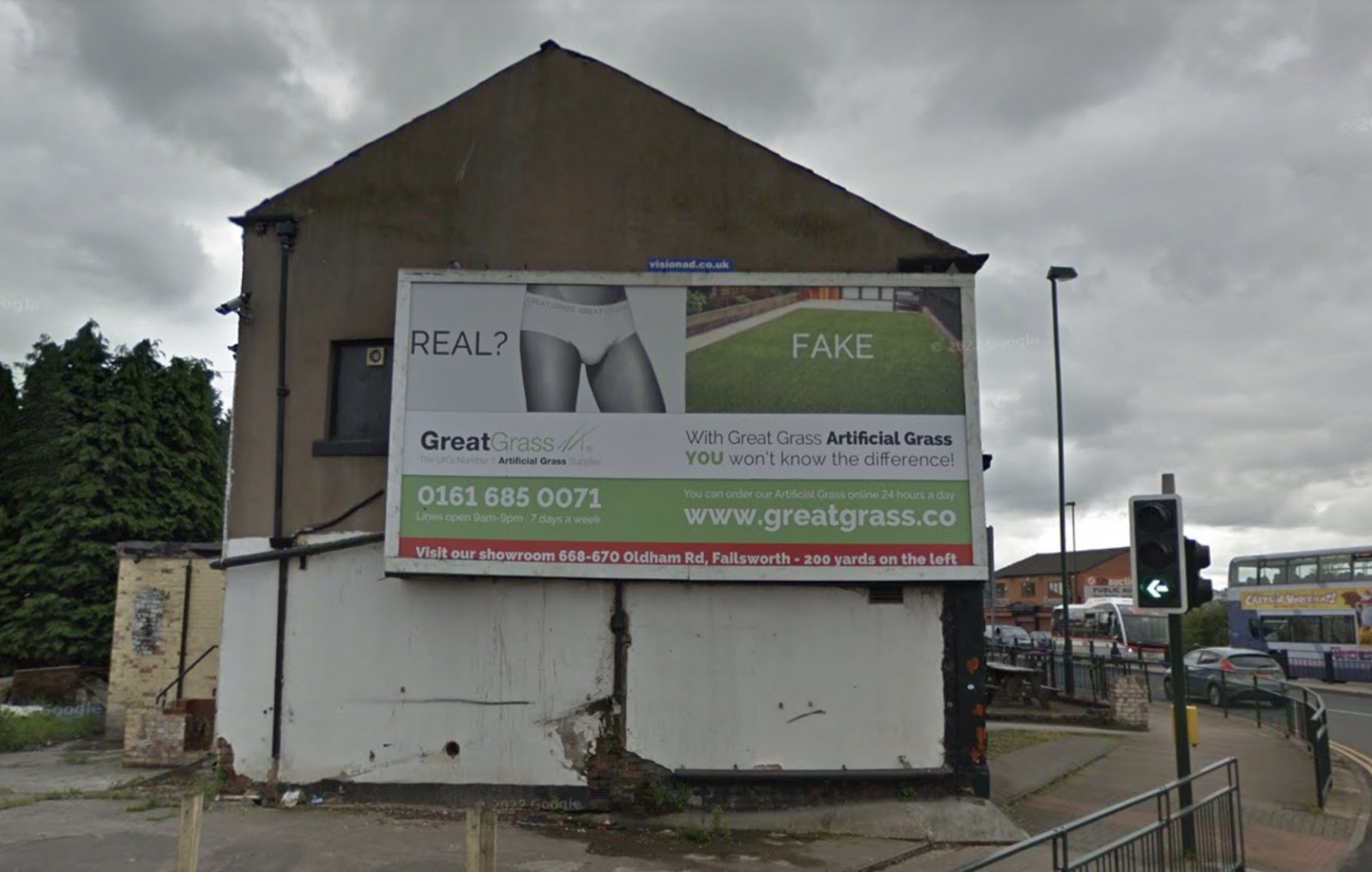
An artificial grass business in Oldham has been ordered to take down a huge advertising billboard after people complained it was ‘offensive, harmful and irresponsible’.
The advert for Great Grass MCR featured a woman wearing ‘only thong-style underwear’ laying on the lawn, alongside the strap line ‘Get laid by the best’.
The massive poster just off the M60 also featured the words ‘ARTIFICIAL GRARSE EXPERTS’.
Complaints made to the Advertising Standards Agency said that the ad ‘objectified and sexualised women’.
The ASA decided to uphold complaints made about the latest Great Grass MCR poster, saying that it ‘was sexually suggestive and would be seen as presenting the model as a sexual object’.
A previous Great Grass billboard. Credit: Google Maps
The ruling states: “The ASA considered that those who saw the ad would understand that it featured a woman. The model was dressed only in underpants and was lying on her front on the grass which exposed her buttocks.
ADVERTISEMENT
“Large text above the image stated, “ARTIFICIAL GRARSE EXPERTS”. We noted that the word ‘grass’ was spelt incorrectly to include the word “arse”. We considered that was likely to be understood by readers to be a reference to the model’s buttocks and had the effect of making that exposed part of her body the focus, thereby drawing attention to the ad.
“The ad also stated, “Get laid by the best”. We considered “get laid” would be understood by readers as a slang reference to sexual intercourse. We considered that text, together with the model’s pose and state of undress, was sexually suggestive and would be seen as presenting the model as a sexual object.
“We acknowledged that while sunbathing, people might recline on a lawn wearing revealing clothing. However, we considered that in the context of the ad, in particular the references to “arse” and “get laid”, the model was portrayed as a sexual object, rather than someone who was sunbathing.
“For those reasons, we concluded that the ad objectified and stereotyped women as sexual objects, was irresponsible and likely to cause serious offence.”
Great Grass said that ‘Get laid by the best’ is a slogan they’ve used for years, and added that only three complaints were made about an advert seen by thousands.
The ruling also added: “Great Grass also said that to assume that the person featured in the ad was a woman was wrong and offensive to the transgender community.”
The ASA continued: “Vision Advertising, the media owner, said that Great Grass had been using the slogan ‘Get laid by the best’ on their marketing material for many years, and it meant that they believed they were the best at laying artificial grass.
“They said the image of the person sunbathing on their new lawn was not offensive as that was something that most people would do.
ADVERTISEMENT
“They did not believe that the ad objectified and sexualised women and they also said that identifying the person in the ad as a woman was debatable and a matter of opinion.
“Vision Advertising confirmed they had received no complaints.”
Featured image: ASA
News
Altrincham named one of the UK’s best places to live in 2026 in The Sunday Times’ annual ranking
Emily Sergeant
A popular Greater Manchester town has been named among the UK’s best places to live by the Sunday Times in its annual ranking.
That’s right… it’s that time of year, once again.
The Sunday Times is known for pulling together a list of what it considers to be the most sought-after places to live in the UK every year, and 2026’s ranking has officially been published today – with dozens of locations across the country making up the comprehensive guide, and six of those coveted locations being right here in the North West.
The Sunday Times’s expert judges have visited all locations on the list, and assessed factors such as schools, transport, culture, broadband speeds, access to green spaces, the health of the high streets, and much more to devise the always-talked-about annual ranking.
Macclesfield in Cheshire, Eden Valley in Cumbria, Lancaster in Lancashire, and Aigburth in Liverpool are just some of the North West areas named by the publication in the 2026 list.
Altrincham has been named one of the best places to live in the UK / Credit: The Manc Group
A spotlight has also been shone on two Greater Manchester towns, and one of two has even been given the regional North West title… but which are they?
Where has taken the top spot as the best place to live in the North West for 2026, and is therefore one of the best places to live in the whole of the country? Well, that honour has been given to none other than Greater Manchester’s very-own Altrincham.
The publication described the Trafford town as ‘classy, cool and effortlessly comfortable’.
“Altrincham is a top-notch town brimming with independent businesses and big brands, and now it’s flying even higher,” The Sunday Times said.
The fact that co-working has now arrived on the high street thanks to the conversion of the old Rackhams department store, and that the town’s cultural and creative ‘cachet’ is also on the rise, have been highlighted as reasons as to why Altrincham has been chosen as the North West’s winner, as well its newly-flourishing fitness scene.
Of course, the town has also been praised for its transport links into Manchester city centre and across the region, as well as it being a great place for families thanks to the excellent local schools on offer.
Didsbury was the other Greater Manchester town chosen to represent the best of the North West – with the Manchester suburb described as being ‘stylish, solid, safe, and, yes, a little bit smug in parts… but that’s okay’.
You can read the full Altrincham feature here, and see where else The Sunday Times included in its list for 2026 here.
Featured Image – Geograph
News
11 arrested and £70k cash seized during early-morning police drug raids across Greater Manchester
Emily Sergeant
11 people have been arrested, as well as a large amount of cash and drugs seized, during early-morning raids across Greater Manchester.
The raids took place during the early hours of the morning yesterday (Thursday 19 March 2026), where Greater Manchester Police (GMP) successfully executed eight warrants simultaneously across Tameside, Oldham, and Rochdale to tackle a ‘suspected criminal network’ involved in the distribution of class A drugs and firearms.
Officers from Tameside Programme Challenger team, the District Intelligence Unit (DIU), and GMP’s Tactical Aid Unit (TAU) were deployed to each of the addresses.
Following weeks of intelligence gathering and preparation, a total of 11 people – each aged between 24 and 77 – were arrested on suspicion of drug-related offences during the raids.
Eight men and three women were arrested on suspicion of a range of offences, including conspiracy to supply class A and B drugs, being part of an organised crime group, possession with intent to supply, money laundering, and possession of an offensive weapon.
They all remain in police custody for questioning at this time, GMP confirmed.
During searches of the addresses, various class A, B and C drugs – including crack cocaine, heroin, cannabis, and nitrous oxide – were seized, while further recoveries of £70,000 in cash, a zombie knife, a BB gun, and four vehicles were also made at the same time.
Speaking following the success of the raids yesterday, Chief Superintendent Shan Nasim, District Commander for Tameside, said: “[This] operation has been a powerful example of our continued, determined effort to dismantle organised crime in our district and Greater Manchester.
“We have 11 people in custody being questioned by our investigation teams in relation to an organised crime group (OCG) that have been causing widespread harm across our communities.
“This action caused significant disruption of an organised crime group (OCG) and has prevented drugs and weapons from reaching the streets, as well as the associated harms that come hand in hand with organised crime.
“Organised criminals exploit vulnerable people and blight our communities; we will take robust action to catch offenders, keep our communities safe, and protect vulnerable people across Greater Manchester.”

 Daisy Jackson -
16th November 2022
Daisy Jackson -
16th November 2022