Manchester City Council have detailed a list of noteworthy points in relation to the prevention of a second outbreak of coronavirus (COVID-19) in Manchester.
Health officials from Greater Manchester Combined Authority (GMCA) have recently released a list of ‘seven things you need to know’ about Manchester’s COVID-19 outbreak prevention plans going forward.
In a question and answer-style statement via council website last week, David Regan – Manchester’s Director of Public Health – explains the role of COVID testing data and postcode analysis, early warning systems, and the approach to preventing any future outbreaks of the virus.
He addressed a number of frequently-raised questions/points by members of the public and offered some clarity for those who may be feeling somewhat in the dark.
ADVERTISEMENT
___
What is Manchester’s current position on COVID-19 cases and what if that number starts to rise?
ADVERTISEMENT
Mr Regan stated that in the Manchester city region, “we are still seeing a small number of positive cases” arising each day, but “the number remains relatively stable at the moment”.
He confirmed that Manchester is currently eighth lowest of the 10 Greater Manchester boroughs – based on the total number of positive cases for population size – but this does not however mean that “we can be complacent because we are still dealing with a pandemic where the situation can change quickly if people don’t follow advice”.
He also stated that the “tried and tested” method of weekly postcode data would be looked at “to assess where the numbers relate to and what it means” should the number of confirmed cases rise, which would allow health professionals the ability to see from that local detail if the numbers related to a business, school or care home – or if they are separate cases on a particular street.
ADVERTISEMENT
If transmissions rates change significantly in the future, Mr Regan confirmed that Manchester City Council “would work with the rest of Greater Manchester and central government before taking any major decisions”.
Is the NHS Test and Trace service helping in Manchester?
Mr Regan stated that NHS Test and Trace is “for the greater good to protect us all” and is “without a doubt how we will beat the disease and keep it under control”.
He also reiterated that the importance of getting tested if you display symptoms cannot be underestimated.
He clarified that NHS Test and Trace “will not pass individual personal details between contacts. It will operate on a trust basis and the Test and Trace team will help each individual to understand what it means to them and whether or not they need to self-isolate”.
ADVERTISEMENT
We spoke with Manchester's Director of Public Health, David Regan, to ask him some questions about coronavirus.
— Manchester City Council (@ManCityCouncil) July 10, 2020
He also addressed the measures currently being taken in public places.
“We are also asking places like libraries, pubs and restaurants to record people’s details – which would then be destroyed after 21 days – to help with this process” he said.
“So, if I was in a restaurant where it found that someone then tested positive, the restaurant would be able to help the tracing service by saying who could have been in close contact. That doesn’t mean that everyone who was there that night would have to self-isolate – but it does mean that there would be a proportionate, safety-first approach.”
How likely is a second wave and will flu season make dealing with the pandemic harder?
With regards to the likelihood of a second wave, Mr Regan indicated that authorities would need to look back at other pandemics with second waves, like the Spanish Influenza and Swine Flu, in order to answer that.
ADVERTISEMENT
He said: “it’s the size of the wave – or waves – that’s important” and that “we have to keep them as small as possible to protect lives and also to make sure our health and social care services don’t become overwhelmed.”
“If we all follow the rules, we can keep our economy and schools open while functioning effectively – and avoiding another 12-week lockdown situation.”
Addressing the concerns surrounding the management of the coronavirus (COVID-19) pandemic in relation to the pending flu season, Mr Regan added that “autumn and winter are when we always see a rise in illness like flu and norovirus and we have to be prepared for that too”
He continued: “COVID-19 is a new virus and it’s going to be difficult to predict, however we do absolutely know that testing and tracing works very effectively.”
“And that is how we will contain the disease.”
ADVERTISEMENT
___
Closing out his statement by issuing a message to the people of Manchetser, Mr Regan went on to thank “everyone who lives and works in our great city for all you have done to date to help during the pandemic”.
He also reiterated the need to “keep following the guidance” so that we can “all tackle this together.”
For more information, visit the Manchester City Council website here.
#StaySafeSaveLives
News
Manchester’s historic Portico Library secures £6.4m funding grant towards its transformation
Emily Sergeant
Manchester’s Portico Library has secured a whopping £6.4 million grant from The National Lottery Heritage Fund.
In case you missed it, ambitious plans to transform the historic Grade II-listed building on Mosely Street were already unveiled last October… but now, The National Lottery Heritage Fund has announced it is committing £6.4 million of funding towards the project, hoping that the building thrives as the UK’s most sustainable historic library for generations to come.
The grant is being described as a ‘major milestone’ in the approximately £12 million Portico Reunited project.
The Portico Reunited project will look to ‘reunite’ the historic building’s three floors for the first time in over a century, creating a fully-accessible and sustainable cultural library.
Founded all the way back in 1806, The Portico Library played a central role in Manchester’s rise as the world’s first modern city, and since then has been serving as a window into the past and a providing a place of inspiration for anyone who needs it.
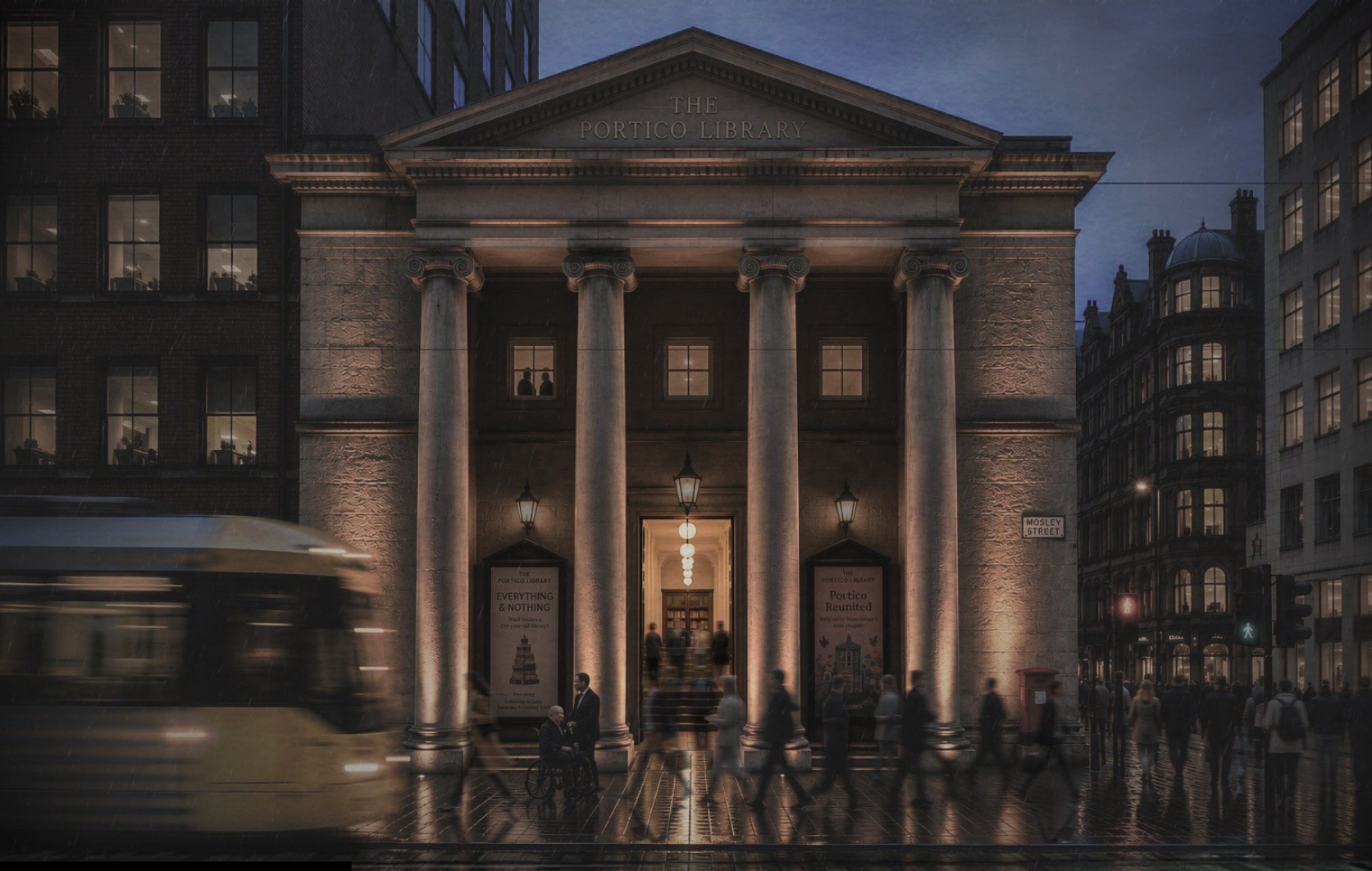
The Portico Library has secured a £6.4m funding grant towards its transformation / Credit: Purcell Architecture (Supplied)
Crucially, plans will see a step-free entrance and lift installed to make the library accessible to all.
There’ll also be new exhibition and event spaces introduced as part of the scheme to explore the stories of Manchester’s communities and the city’s heritage. There will a Northern Bookshop, showcasing regional and emerging writers, and independent publishers, as well as a creative Portico Kitchen, which will celebrate the city’s food culture, writing, and history.
A place for school groups, families, and all people to explore Portico’s collection and experiment creatively also forms part of the plans.
Dr Thom Keep, Librarian and CEO of The Portico Library, called the funding grant a ‘landmark moment’ in the Portico’s ‘rich and complex history’, and a ‘huge achievement’ for its staff, trustees, volunteers, and partners.
“Thanks to National Lottery players, we can reunite this extraordinary building and make room for people to discover, learn and create together,” he added.
“We have listened to thousands of people about what the Portico could become, and their ideas and experiences have helped shape these plans.
“Our ambition is a library that belongs to the whole city – a place to discover remarkable collections, question the stories we have inherited, and create new possibilities together.”
Manchester City Council has granted planning permission and listed building consent for the project, and the building is expected to close for construction in late spring 2028 and reopen once again in early March 2030.
Following reopening, the transformed library is expected to welcome around 95,000 visitors each year.
Featured Image – Purcell Architecture (Supplied)
News
New data estimates that 7.3m Oasis fans are set to miss out on 2027 tour tickets
Emily Sergeant
New data has revealed that as many as 7.3 million Oasis fans could be set to miss out on tickets to the band’s 2027 tour.
In case you need bringing up to speed a little, it was announced earlier this week that, following the unprecedented success of the reunion tour, Oasis Live ’25, last year, including five nostalgia-drenched gigs at Manchester’s Heaton Park, Oasis would be hitting the road once again in 2027, and this time around, they’re going BIG.
We’re talking 11 nights at the Etihad Stadium and a return to the iconic grounds of Knebworth for four special shows there too, kind of ‘big’.
The iconic Manchester band will also be taking to a range of other world-famous stages across the globe, including five nights at Glasgow’s Celtic Park, and major cities like Barcelona, Amsterdam, Paris, Rome, and Las Vegas.
But despite the elevated number of dates the Gallaghers and co will be performing, some new data has unfortunately revealed that millions of fans may still not be lucky enough to snag a ticket.
The ticketing system for Oasis Live ’27 is not what it was for the last tour, nor will it be similar to many other tours of a similar scale in the past either, as this time, the band and their promotors are taking necessary measures to ensure ‘genuine fans’ get their hands on the tickets and that dynamic pricing doesn’t creep in.
Instead of going into detail on that now though, you can read our full guide on how to get tickets for the Manchester and Knebworth shows here.
Experts at online ticketing platform TicketSource have analysed the scale of demand for Oasis tickets by comparing the 10 million fans worldwide who queued for the initial release of 1.4 million tickets for their 2025 tour, with the newly announced 2027 tour dates and stadium capacities.
With an estimated 2.67 million tickets available across 38 dates and 11 locations between 21 May and 19 September 2027, Oasis could still face huge demand from fans hoping to see them live.
But research reveals the band would need to play 112 Wembley-sized shows to accommodate everyone who tried to get a ticket in 2025.
The 2027 tour would accommodate just 26.7% of those who tried to get tickets last time, meaning almost three-quarters (73%) of them could miss out, leaving a shortfall of more than 7.3 million fans.
Fingers crossed you’re among the lucky lot that secure tickets, though.
Featured Image – Joshua Halling (Press Image – Supplied)

 The Manc -
20th July 2020
The Manc -
20th July 2020