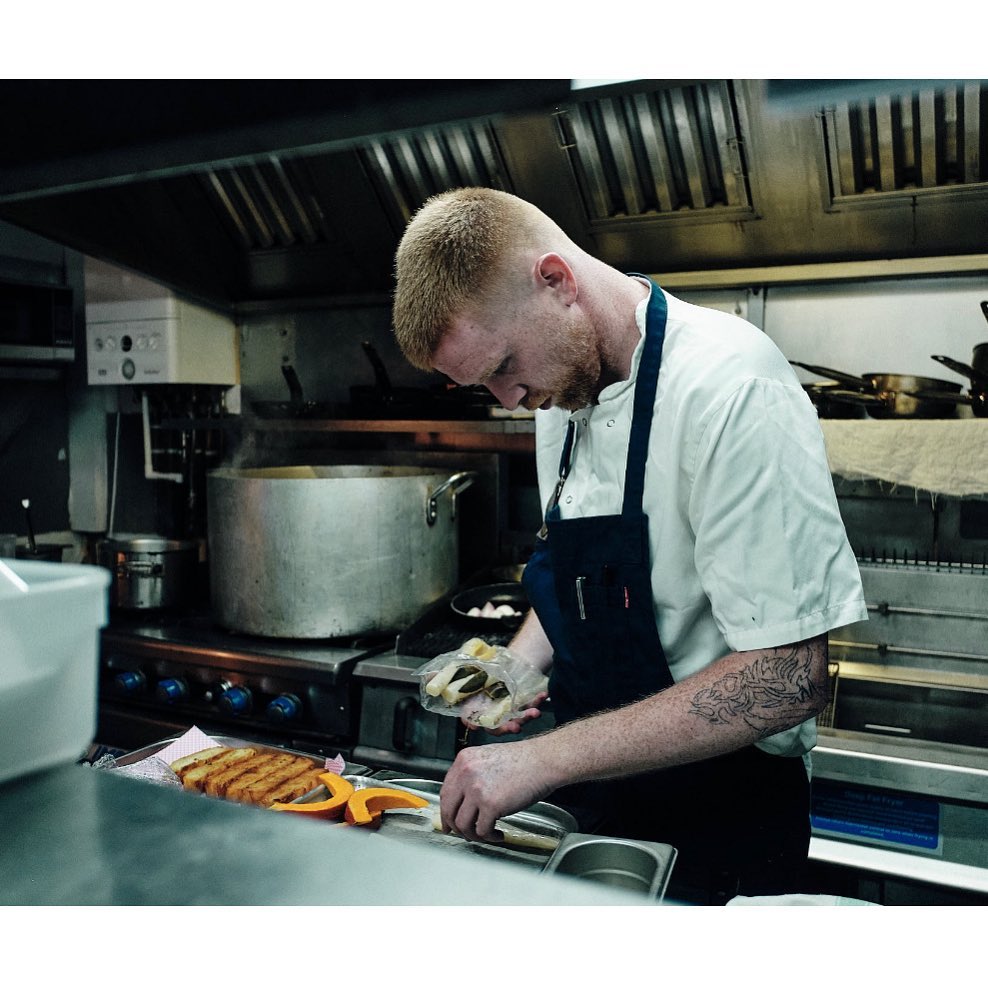
After just two years spent serving inventive British plates to the good people of Stockport, popular restaurant The Moor has announced it can no longer afford to continue to operate.
In a shock closure announcement posted to the restaurant’s website, owners said The Moor would not be reopening its doors again and reflected on the challenging events of the past two years, writing: ‘this is not the time to be running a small independent business.’
In the now-deleted statement, chef James Hulme wrote: “This is tough to write, we have taken the decision to close our doors. The last two years have been crazy, we set out with the intention to offer some of the North West’s best produce at a reasonable price.

Image: The Moor Image: The Moor
“We did everything to make this happen but ultimately, for a restaurant that wanted to be as sustainable as possible – from making charcoal, utilising every piece of the animal or fish, having close to zero waste and working with small independents – we believe that moving forward, as a business, this simply isn’t sustainable.”
The comments made by Hulme echo those recently made by the team at acclaimed West Yorkshire gastropub The Moorcock, which has a similar concept and has just announced it will be breakng its lease next year.
ADVERTISEMENT
He had previously worked as a chef at the famous D&D London restaurant Quaglino’s, as well as under Aiden Byrne when he opened the group’s first Manchester restaurant 20 Stories in 2018.
Citing rising food costs as a partial factor in the decision, he continued: “We do not want to compromise on what we serve by buying in cheaper mass produced food served with horrendous mark ups.
ADVERTISEMENT
“These aren’t the only reasons, there are some personal factors too that have led to this decision.
“We wish to thank every single customer (even the couple that left a bad review) for coming and supporting us through this journey. In February 2020 we thought Brexit was the biggest hurdle we would face, how wrong we were….but so many of you have helped either through your custom and support or even putting an apron on when we were short staffed!
ADVERTISEMENT
“Finally to the staff, thank you so much, I dreaded telling you all the news but you were awesome and very understanding. The Moor won’t be back but please, support local, support independent and most of all appreciate the value, quality and time that indies put into what they do.”
Whilst TripAdvisor reports are not always the most reliable, a quick glance at The Moor’s page shows the eatery did not receive one negative review during the past two years with most diners rating it excellent or very good (we confess that we couldn’t find the bad review Hulme alluded to in his farewell statement).
Critics that made it over in the midst of the past two years’ lockdowns were equally ebullient, praising the restaurants’ inventive, flavour-led menu and use of quality produce.
Government grants local councils power to make pavement parking illegal in their region
Emily Sergeant
New powers are being made available to local leaders across England to introduce pavement parking restrictions in their area.
Blocked pavements can create serious barriers for parents with pushchairs, wheelchair users, blind and partially sighted people, and older people, and campaigners say this limits individuals’ independence and makes everyday journeys harder and less safe for them.
So, in a bid to help keep pavements clear and accessible for everyone who uses them, the Government has introduced new local powers.
Following a public consultation – which first took place all the way back in 2020 – the Department for Transport (DfT) has confirmed that local leaders will be given ‘new and improved’ legal powers to make it easier to restrict pavement parking across wider areas, rather than relying on the previous approach where action was often limited to individual streets.
The Government has granted local councils the power to make pavement parking illegal in their region / Credit: Samuel Regan-Asante (via Unsplash)
The Government says local leaders ‘know their streets best’ and are therefore best placed to respond to local needs.
Under this new approach, local leaders will be able to decide to take action on pavement parking in their area, while still getting to retain flexibility where they deem pavement parking may still be acceptable.
“Clear pavements are essential for people to move around safely and independently, whether that’s a parent with a pushchair, someone using a wheelchair, or a blind or partially sighted person,” commented Local Transport Minister, Lilian Greenwood.
Blocked pavements can make it harder for parents with pushchairs, wheelchair users and blind or partially sighted people to get around.
That’s why we’re giving local authorities stronger powers to tackle pavement parking and keep pavements accessible. https://t.co/PIqkIw1LF2
“That’s why we’re giving local authorities the power to crack down on problem pavement parking, allowing more people to travel easily and safely and get to where they need to go.”
By putting decision-making closer to communities, the Government says this approach supports safer and more inclusive streets that ‘work better for everyone’.
The DfT will set out guidance to help local authorities use these powers in a ‘proportionate’ and ‘locally appropriate’ way later in 2026.
Featured Image – Sado Lavren (via Unsplash)
News
Ian McKellen to play legendary Salford artist L.S. Lowry in new BBC documentary
Emily Sergeant
Sir Ian McKellen has landed himself an exciting new role, and he’s set to play one of Greater Manchester’s most iconic sons.
One of the most celebrated British actors of all time playing one of the most celebrated British artists of all time? It was meant to be. That’s right, Ian McKellen is set to portray Salford’s very-own L.S. Lowry in the new BBC documentary, L.S. Lowry: The Unheard Tapes, produced by award-winning Wall to Wall Mediaand coming soon to BBC Two and iPlayer.
Marking 50 years since Lowry’s death, this immersive documentary film will focus on the touching and often surprising exchange between the enigmatic artist and Angela Barratt – a young fan whose interviews capture Lowry in his most intimate and reflective moments.
Recorded in the artist’s own living room, these tapes reveal Lowry’s authentic voice, which Burnley-born actor McKellen will lip-sync on screen.
Across these candid conversations, Lowry traces his journey from childhood right through to his final days, sharing the memories and experiences that shaped him both as an artist, and crucially, as a man.
Alongside this deeply personal account, the documentary is also set to explore the dramatic transformation of Salford and Greater Manchester, which Lowry, of course, depicted so prolifically in his work.
“To give play to Lowry through his own voice has been a unique privilege,” commented Ian McKellen as his casting was announced this week.
“These tapes reveal an intimate insight into the artist’s thoughts – his ambitions, regrets and his humour. Anyone like me, who admires his paintings and drawings, will be intrigued and delighted that the artist is brought back to life through his own words.”
Mark Bell, who is the Commissioning Editor at BBC Arts, added: “Marking 50 years since Lowry’s death, and celebrating Arena’s own 50-year tradition of ambitious, intelligent storytelling, this film comes at a very special moment.
“The inspired casting of Ian McKellen and Annabel Smith feels like life imitating art in the best possible way. But this film isn’t just about the life of the artist, it also provides an insight into the realities of urban life in Greater Manchester in the 20th century.”
L.S. Lowry: The Unheard Tapes is directed by James Kent, following his recent Emmy win for Lost Boys and Fairies, with executive producer Morgana Pugh, and producer Hannah Mirsky.
Further broadcast details will be announced in due course.
Featured Image – BBC / Wall to Wall Media Ltd / Connor Harris