Tens of thousands of nursing staff are set to walk out today in what is one of the largest strikes in the history of the NHS.
The Royal College of Nursing (RCN) – which is the nursing industry’s largest union, representing over 300,000 nurses across the UK – announced last month that thousands of its members had voted to take industrial action for the first time ever in its 106-year history.
The announcement that nurses are to walk out came after the union urged its members to vote in favour of striking when the ballot first opened at the start of October, with RCN’s general secretary calling it a “once-in-a-generation chance” to make real change.
Nurses are striking today in objection to “years of real-terms pay cuts” and “concerns over patient safety”, the RCN said.
Up to 100,000 nursing staff are taking part in the strikes in England, Northern Ireland, and Wales today, with a further day of strike action is planned for Tuesday 20 December.
ADVERTISEMENT
Strikes are taking place at the NHS trusts or health boards that have met the relevant legal requirements, with the union confirming that many of the biggest hospitals in England will see action taken by its members, but others “narrowly missed” the legal turnout thresholds to qualify for action.
The RCN has always maintained it will ensure strike action is carried out “legally and safely at all times”.
ADVERTISEMENT
The union said in a statement on its website nurses are “campaigning for a pay rise to overcome years of real-terms pay cuts and to protect patient safety by allowing the NHS to recruit and retain the nursing staff it desperately needs.”
“Since strike action was announced last month, we have repeatedly asked Health Secretary Steve Barclay to open formal pay negotiations,” the RCN revealed.
“However, ministers have declined every offer – and have instead chosen strike action.”
ADVERTISEMENT
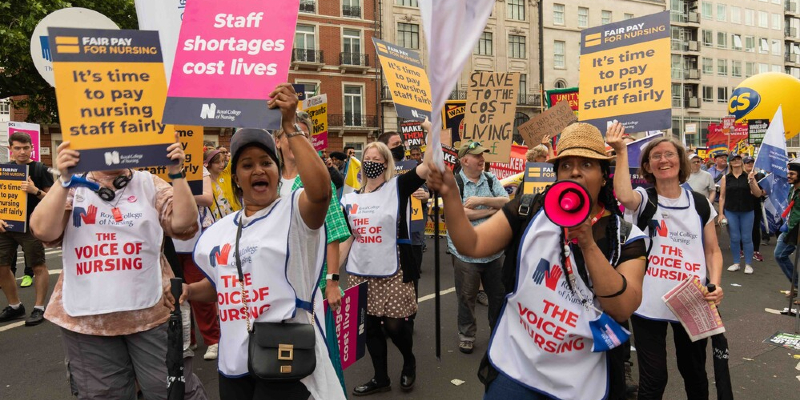
Tens of thousands of nurses walk out today in the largest strike in NHS history / Credit: Royal College of Nursing
Speaking ahead of strike action taking place today, Pat Cullen – General Secretary & Chief Executive at the RCN – said: “For many of us, this is our first time striking and our emotions are really mixed. The NHS is in crisis, the nursing profession can’t take any more, our loved ones are already suffering [but] it is not unreasonable to demand better.
“This is not something that can wait. We are committed to our patients and always will be.”
She continued: “I have tried to negotiate and get governments to act. They’ve had every chance but they chose to turn their back on us.
“As hard as this is, we won’t turn our backs on our patients.”
The RCN says today’s strike” could be the beginning of a longer period of action” if governments continue to refuse formal pay negotiations, or if pay talks don’t result in a “satisfactory outcome”.
ADVERTISEMENT
“The NHS is in a crisis, the nursing profession can’t take any more, our loved ones – your parents, children, friends and relatives – are the ones at stake here."
The mass walk out of nursing staff nationwide today comes amid warnings that nurses are leaving the profession in record numbers, and many are unhappy with working conditions, staff shortages, and ultimately, their pay.
A recent analysis by London Economics, as referenced by the RCN, found that pay for nurses in the NHS has declined at twice the rate of the private sector in the last decade, and that their real-terms earnings are said to have fallen by 6%.
The RCN wants nurses to be given a pay rise in line with the rate of inflation.
“Today, we strike for fairness,” Pat Cullen concluded.
“We strike for the future of our NHS. We strike because it’s our right – and our duty – to stand up for fair pay and for patient safety.”
Featured Image – Royal College of Nursing

News
New landmark chickenpox vaccine begins UK rollout to protect thousands of children
Emily Sergeant
A new landmark chickenpox vaccine is beginning its rollout across the UK in a bid to help protect hundreds of thousands of children.
Chickenpox is a common infection in children that spreads easily.
It is usually mild but it can lead to serious complications which need hospitalisation, including chest infections and fits. The latest Government data indicates that half of children will contract chickenpox by the age of four, and 90% by the age of 10.
Currently, children who catch chickenpox are typically advised to stay off school until all spots have formed a scab – which is usually five days after the spots appear.
But now, this new vaccine will mean children can miss fewer days in nursery or school, and reduce time parents need to take off work to care for them.
Hundreds of thousands of young children are now being offered the chickenpox protection as part of routine NHS childhood vaccinations.
The combined vaccine adds chickenpox protection to the existing measles, mumps and rubella schedule.
Surprisingly, it’s estimated that around £24 million is lost in income and productivity every year in the UK due to childhood chickenpox, so not only will the new vaccine rollout save money this way, but it is also expected to save the NHS a whopping £15 million a year in costs for treating the common condition.
The new vaccine comes following a recommendation from the Joint Committee on Vaccination and Immunisations – with a combined MMRV vaccine replacing the MMR vaccine to protect against measles, mumps, rubella, and chickenpox (varicella).
From now on, GP practices on the NHS will start to offer children the combined MMRV vaccine at 12 months and 18 months of age.
Dr Claire Fuller, who is the National Medical Director for NHS England, called the rollout a ‘hugely positive moment’ for children and their families.
“From now, the combined vaccine to protect against measles, mumps, rubella and chickenpox will be available at children’s routine vaccination appointments to keep children healthier and prevent sickness from these highly contagious viruses,” commented Dr Fuller.
“The new vaccine will also help the health service move its focus from sickness to prevention, and keep more children safe and in school.”
Featured Image – Jonny McCullagh (via Wikimedia Commons)
News
Greater Manchester hit with snow and ice weather warning to welcome in new year
Emily Sergeant
Weather warnings for snow and ice have been issued across much of the UK, including here in Greater Manchester.
As the country wakes up to the first working day of the new year, cold Arctic air now covers most of the UK, according to the Met Office – with temperatures being well below average, widespread frost and ice, and an increasing risk of snow showers.
Snow is expected to settle on the ground in some areas, particularly in northern and some central areas, while the risk of widespread ice could make travel ‘hazardous’.
While much of Greater Manchester falls under the yellow weather warning for snow and ice issued by the Met Office – which is now in force, and expected to end around midday today (2 January) – it will primarily be more southern and western parts of our region that are likely to see snowfall, if any.
Forecasters say an area of sleet and snow is expected to move southeastwards across parts of England and Wales, lasting approximately two or three hours in any one place, and where snow does fall, only one or two cm is likely for some and perhaps as much as five cm in a few spots, especially higher ground of north Wales, north west England, and perhaps the north west Midlands.
Some ice may form as a result of snow frozen surfaces, and icy patches will also develop quickly as sleet and snow clears.
Greater Manchester braces for snow as the Met Office issues a yellow weather warning / Credit: Geograph | Pexels
Under the yellow weather warning, you should expect some roads and railways to be affected with longer journey times, some injuries may occur from slips and falls on icy surfaces, and there are likely some icy patches on untreated roads, pavements, and cycle paths.
“With Arctic air now covering most of the UK, very cold weather will continue through the weekend, with minus double figures overnight in places and daytime temperatures struggling to rise above 0°C for some,” explained Chief Met Office Forecaster, Neil Armstrong.
“It looks like this cold spell could last well into next week and wintry hazards will continue with more weather warnings likely. It is therefore important people keep up to date with the latest forecast and warnings and plan ahead.”
You can keep up to date with weather warnings on the Met Office website here.